
 |
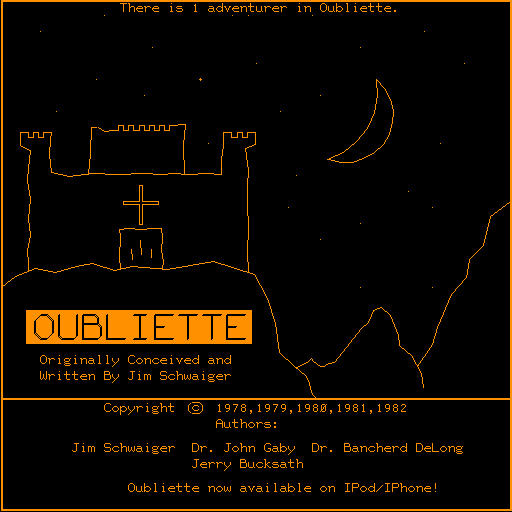
| Pronounced Oob-lee-et |
It was a predetermined outcome that I wouldn’t spend a huge amount of time on Oubliette. I am approaching it as a stepping stone from Moria to Wizardry, but I go into it understanding two things from prior reading; that, like Moria, it is designed for a multiplayer scene that just isn’t there any more, and that, like Wizardry, you would be nuts to play it solo.
The first thing I did, as I always do when loading a PLATO game, was to check out the helpfile, which is as extensive and complete as we’ve come to expect of these games.

The introduction is a completely bland and generic “welcome to Oubliette” message informing me that I will have adventure, glory, and fun. No backstory or flavor text or anything like that.
Characteristics match D&D characteristics, including charisma, and the page also mentions the classes which favor said characteristics.
- Strength – Favored by hirebrands, increases damage and ability to carry heavy items and incapacitated party members.
- Intelligence – Favored by mages, increases likelihood of learning spells
- Wisdom – Favored by clerics, increases success rate of casting cleric spells
- Charisma – Favored by courtesans and Valkyries, says to increase “leadership” and “sex appeal” without further explanation
- Constitution – Increases HP and success rate of resurrection
- Dexterity – Favored by hirebrands, increases number of “swings” per attack and increases success rate of thievery actions
Alignment, hits, and naming work mostly as you would expect. Alignments are limited to Lawful, Neutral, and Chaotic, but may as well be Good, Netural, and Evil.
The equipment section begins by telling us that new players begin with nothing, and must purchase gear right off the bat. Races without infravision will also need torches before entering the dungeon. Equipment may have class restrictions, and/or strength requirements.
 |
| Seems very Wiz-like. But why is the sample samurai unarmed? |
The Parties section straight up says that parties with fewer than four players will have a poor chance of survival. It recommends having fighters, clerics, and mages. It further recommends meeting party members in taverns, but that won’t help me much when I’m the only person even playing. Taverns can have up to 15 patrons, and there are multiple throughout the castle.
Types lists the races in Oubliette. There are 15, each gets a descriptive paragraph, and there’s a chart at the end with qualitative data.
 |
| I think that “base” concerns amount of XP needed to level up. |
I did a bit of analysis here, on a few assumptions – the biggest that “base” is a fudge factor meant to rebalance the races, and that for a solo game it wouldn’t make any difference since I couldn’t expect even the quickly-levelling kobolds to live long enough to reach level 2. Likewise, I assumed that age wouldn’t make a difference here either; I had no expectation of even reaching Orcish old age. And lastly, I dismissed Infravision as nothing more than a convenience that just saves you from needing to keep buying torches.
- Goblins are just bad, inferior in every statistical way to Elves, Uruk-hai, Ogres, and Orcs.
- Kobolds are even worse! They’re categorically inferior to every race except Dwarves and Ur-viles (who have mostly better stats but worse charisma).
- Dwarves are the only class with a dexterity penalty, which (along with base) is the only area that Kobolds, Goblins, Hobgoblins, and Halfdwarves beat them at.
- Elves are better than Halfelves, who are better than Humans, who are better than Goblins.
- Elves are also better than Pixies.
- Uruk-hai are better than Halfdwarves, who are better than Goblins.
- Ogres are charismatic. Huh?
- Ur-viles are strange, nearly identical to humans, except wiser and much uglier.
It seems likely to me that the list of races expanded over time throughout Oubliette’s development, given that Dwarves through Uruk-hai are in perfect alphabetical order, but the list then goes to Ogres and Pixies. My proposed first-batch of races somewhat corresponds to the races in AD&D 1st edition, but with the addition of half-dwarves and Uruk-hai. Other races are monsters, which weren’t playable in D&D until the later 2nd edition and the Complete Book of Humanoids, and the last two, Ur-viles and Eldar, are nods to Stephen R. Donaldson and Tolkien. Wizardry’s list of races doesn’t seem to be based on any of this; all of its races come directly from AD&D 1st edition, including the Gnome race which is absent in Oubliette.
The Classes section, unlike Types, doesn’t give much description, merely listing each one’s stat and alignment requirements, the level at which they start learning spells, and an unexplained stat called “Multiplier” which I am assuming concerns XP needed to level up.

Here, there’s meat to chew on regarding the Wizardry connection. This is, to my knowledge, the first time a CRPG had a real implementation of D&D’s class system, and it goes well beyond what D&D of the time offered. Most of these classes did not exist in D&D by 1982.
The four basic Wiz classes, Clerics, Fighters, Mages, and Thieves all correspond to the D&D basic set, but its elite classes must have been inspired by Oubliette. Bishops are Sages, Lords are Paladins, and Samurai and Ninja are Samurai and Ninja.
Some other observations:
- Demondim is another Stephen R. Donaldson nod, and probably wasn’t in Oubliette from the start. It’s a bit odd to see this as a class, as the Donaldson novels describe Demondim as a race. In any event, they're identical to Clerics except that they are always evil. Wizardry would simply allow Clerics to be good or evil.
- Courtesan and Valkyrie seem to be a unique female-specific classes to Oubliette. Valkyries would eventually be found in Wizardry 6.
- Hirebrands are just fighters.
- Ninja, Samurai, and Sages also seem to be Oubliette introductees, which found their way into later D&D editions.
- Minstrels are obviously bards, an AD&D1 class, making Oubliette the first CRPG to have them.
- Peasant might be a Moria leftover; the default class when you have yet to join a guild.
- Rangers are from AD&D v1.
- Ravers are just evil Paladins.
The Castles section is really about just one castle, LIGNE, where all new players start, and the subsequent sections about the amenities offered there. It lists controls available in the castle, which include first-person navigation controls identical to the ones in Moria, and some controls specific to multiplayer. Whereas Moria allowed players in a party to wander independently, just not too far from the group leader, Oubliette uses the now more familiar blobber scheme where only the leader may go exploring, and everyone else follows.
Some other things of note here:
- The helpfile recommends putting three fighters or clerics in the front and in the back, because monsters may attack from the rear.
- Non-lawful characters may steal from their own party members, but will be kicked out if caught. Lawful characters can steal from dead party members.
- The castle has a bulletin board where players may post or read notes.
- Known spells may only be checked while in the castle, for some reason.
Corwin’s and Merlin’s are the general store and magic shop, respectively. At Merlin’s, items are unidentified. You may inspect items to try to determine what they are, or pick them up for a better chance, but if you pick up a cursed item, you’re compelled to buy it.
The Leisure Spa costs $100k for a room, but the helpfile doesn’t really explain what it does.
Guilds are a feature that seems to be lifted from Moria (or perhaps backported into Moria), but without making it into Wizardry. One of the perks of joining a guild is that they will provide for you a companion at your request, but if you lose your companion, you lose a rank.
Charmee shops buy and sell charmed monsters. I don’t know of any other game that does this.
Hotels allow you to rest and heal at a better rate, for a price.
Non-combat options lists the controls in the dungeon when not in combat. There’s a lot of overlap with castle controls, but there are a few extra options, including:
- Paladin healing magic
- Paralysis-curing Elven magic
- Casting spells
- Using items
- Killing charmed or held monsters
- Lighting torches
- Picking up dead or stoned characters
During combat, these options are available:
- Fight
- Parry
- Spell
- Hide
- Run
- Seduce
- Bard charm
- Dispel
- Call for help
- Use item
Monster Types lists 16 categories of monsters and their properties. These correspond exactly to Wizardry’s monster classes, plus the categories of midgets, flyers, and aquatics. Afterward is a complete list of monsters and their vital stats.

The Treasures section looks very familiar to Wizardry players.

The trap types are wholesale borrowed by Wizardry too, plus a few unique to Oubliette.
- Darkness
- Polymorph
- Sex-Change
- Sprinkler - douses lit torches, no effect on magic light
The spell system is just like Wizardry, down to the majority of the spell functions. The names are all changed, except for dumapic, which in Oubliette is a light spell.
 |
| Katino, frankly, has a better ring to it |
The helpfile perused, I entered the Oubliette to roll my character.

Being an ogre seemed like a good idea for the maximum strength boost, and a good boost to constitution and hits. Infravision would save some money on torches, the intelligence & wisdom penalty would not be missed if I didn’t bother with spellcasting, and, for some reason, ogres get a charisma bonus.

No backsies if you re-roll, so I went with my third roll, which seemed to be better than the first two. These stats allowed me to be a hirebrand, peasant, or thief, so I went with hirebrand, and named my ogrish hirebrand “Ahub.”
You can start in the castle or the dungeon. I’m not sure why you would want to start in the dungeon, given that you’d be alone and unarmed, but the option is there.
There are maps of Oubliette available on the Internet, so I won’t be providing any here, but I decided to map out the castle blind, just so that I’d be encountering its features naturally.

There’s the familiar wireframe perspective! Note the complete absence of any UI. I began my mapping under the assumption that you start facing north.
The map is pretty big, not as big as Moria’s in terms of raw square count, but it isn’t subdivided into 6x6 blocks, making it a lot more complex and less repetitive, and at 841 blocks, it’s more than twice as large as Wizardry’s 20x20 maps. The castle map has a lot of long, winding corridors that go nowhere, and I completed more than half a circumference of the map before finding any points of interest other than the dungeon stairs.

Wizardry’s castle served the same gameplay function, but was reduced to a branching menu (at least until Wizardry IV, where the castle became an explorable, albeit hostile zone). I don’t know if this was due to space limitations, or a deliberate streamlining, or that the format wouldn’t make as much sense in a game where one player controls the entire party, but it does effectively streamline play. That said, I can also see the value of Oubliette’s explorable castle. It helps train the player in first person maze navigation, without the threats of monsters, traps, or darkness.
The first landmark I found was the Patriarch’s Temple.

This institution wasn’t mentioned in the helpfile – I thought at first that this might be the healing house, but it isn’t.
I found the jail in the same maze-like city quadrant as the temple.

Just outside of the maze, I found an array of rooms, most empty, but some containing guild halls, each corresponding to a player class. Curiously, any guild lets you join for free, doesn't care what your class is, and you can leave without repercussions.
 |
| Promises of loyalty are cheap in Oubliette. |
With more exploring, I found some inns, the most expensive of which was called “The Pauper’s Hostel.”

There was also a morgue in the area, which I guess is sort of like an inn.

In this same city block, I found Kesim’s Casino.

I played a round of each game. You can play Blackjack and Craps for free by betting nothing, which might not be a bad way to find the odds of winning.

 |
| I didn’t really understand the rules of craps here. |

The Taverns were all empty.

The House of Healing offered services that I normally would expect of the temple.

There was a place that seemed like it might have once sold mercenaries, but was inoperative.

A potion shop sold some prohibitively expensive potions and scrolls.

Corwin’s General Store sold torches in regular and economy grades, and a sundry of armor, weapons, and other equipment.
 |
| I have got to know what the Golden Diapers do! |
A charmed monster shop rented men and beasts at prices that I could never hope to afford.

Another one in the same block stated “You get what you pay for!” and suspiciously offered the same list, but for free, so I got an Orcus. What could possibly go wrong?
The magic shop stocked items grouped by category.

Within each category were items listed by price, and nothing else.

Nothing was even close to being within my means, so I wasn’t allowed to even inspect the items, let alone buy them.
There was a bank, but I can’t really see what its purpose would have been.

Plenty of rooms, though, were just empty. It’s as if they were planning to fill the city with more things, but ran out of ideas.
After I finished mapping the city, I went to Corwin’s, the only shop where I could afford anything, bought a dagger, and went into the dungeon.
 |
| A familiar scene |
Exploring a bit, I found my first encounter.

What happened next was a bit hard to follow – combat is realtime, and messages go by pretty fast, but I survived, and I think that Orcus killed both burglars.
 |
| Also a familiar scene |
I inspected the chest they left behind, and it told me the chest contained a poison-needle trap. I tried to disarm, and had to type in the name of the trap, but when I did, it said the chest wasn’t trapped after all.
My second encounter was just as easy, and produced a handsome reward.

With over 1,000 gold in tow, I went back to Corwin’s general store and bought a helmet, short sword, and plate mail. Then I went back into the maze and explored a bit, and stumbled into a teleporter which led to 12 skeletons.

Again, I wasn’t quite sure what happened, but I survived again. It didn’t seem like combat lasted close to 12 rounds, but maybe the skeletons ran away. I got their loot, once again untrapped.
I wandered around a bit, unsure of my bearings, and fell into a pit.

In the room to my left, a few hobbits finished me off.

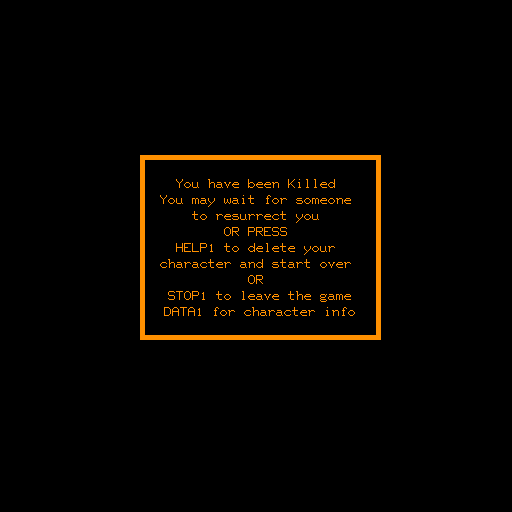
At this point, I decided I wasn’t interested in trying again. This game just isn’t meant for solo runs. I’m not sure why I got a free Orcus, but I certainly couldn’t have survived as long as I had without him, and it wasn’t enough to survive for very long.
The direct influence on Wizardry and the blobber CRPGs beyond is pretty clear, even from what I’ve seen of it, and maps at Zimlab’s Oubliette fan page reveal some elements beyond what I could reasonably experience on my own. Moria before it set some groundwork, but has so little in it to make the dungeon crawling worthwhile, and the combat system is rather simplistic. Oubliette introduces far more elaborate dungeon maps with tricks and traps, and the helpfile and solo experience tantalizingly hint at a deep, tactical combat experience that the subgenre is known for. And Oubliette has several surface elements suggesting more breadth, if not depth, than the genre would know for years to come; its lists of races, classes, equipment, and monsters are just that extensive.
But Wizardry has significant advancements over Oubliette that proved integral to the subgenre. Most notably, it’s the first time we see the party under a single player’s control, and every aspect of the game except exploration is retooled to make this work. Furthermore, it features an end goal, a plot, and it put unique encounters and events in the dungeon, making it actually worth exploring.
I mentioned in July, at the start of this train ride of PLATO games leading to Wizardry, that dnd co-creator Dirk Pellett condemns it as a plagiarism. Although there is plenty of Oubliette that I can’t really evaluate – I’ll never truly appreciate how deep its combat is (or isn’t), I’ve seen enough that I can emphatically disagree. Specific ideas and even techniques are lifted wholesale, certainly, and follow Oubliette’s presentation so closely that we can’t reasonably grant the possibility of two independent interpretations of D&D ideas. I can understand his resentment at seeing PLATO-originated ideas having gone commercial without giving any credit where it was due. But Pellett gives the impression that Wizardry was nothing more than a copy+paste job, and that, simply, isn’t correct.
That’s it for the wave of PLATO games. I don’t know if I’ll be going back. PLATO’s most popular game, Avatar, amalgamates features from most of the games before it, and it anticipates features of games to come, but it isn’t clear to me that it directly and significantly influenced anything of note. Another notable PLATO game, Spasim, is often credited as an early space simulator, and sometimes even as a first-person shooter, but again, I don’t know of any sources claiming it as an influencer. For now, I’m finally moving on to Wizardry.


