Showing posts with label LucasArts. Show all posts

Tuesday, October 21, 2025

Koronis Rift: Won!

The all-important repo-tech bot freezes up on the final rift
 

One gets the impression that Koronis Rift was rushed to meet a deadline (I empathize!). The engine itself is cool stuff, featuring rolling terrain with multiple levels of elevation, multiple levels of parallax depth with dynamic shading to indicate distance, and a 3D perspective that convincingly bumps up and down as you drive through the rifts' endless peaks and valleys, but everything after that is a technical mess.

The most obvious clue are the bugs. Dear lord, the bugs. I've seen:

  • Modules disappear from my inventory
  • The rover unable to move from its landing zone
  • Shields not recharging, despite having ample energy
  • The RT Robot get stuck on terrain
  • Modules that don't do anything
  • The screen become half-filled with corrupt graphic data
 

Most of these bugs can put the game in an unwinnable state, but they can be prevented with a bit of care to avoid their trigger conditions, or if worse comes to worse, using the ingame save/load system.

What can't be avoided is the askew difficulty curve which is completely at odds with the game's premise. 

The apparent intended gameplay loop of Koronis Rift seems to be one where you explore the rifts, fight drones, and collect upgrades for your craft so that you can move on to harder rifts and get even greater rewards, but this just doesn't work out. Drones become deadly within a few minutes of playtime, and get deadlier the longer you play. You do not even have time to clear out the first and easiest rift; the upgrade modules you find there are pretty weak, and the drones will overwhelm you before you have time to find them all.

To get anywhere, you've got to figure out which modules are worth having, you've got to know where to find them, and you've got to have a plan to extract them efficiently, because this is a perpetual arms race between you and Koronis' planetary defense system.

To that end, there are four module upgrades which you absolutely must have. In order of priority:

  • A shield module, so that you don't immediately die when shot at. You start with an utterly worthless one.
  • A generator, to recharge your shields and weapon energy. Once you have a decent shield and generator, your life expectancy improves dramatically.
  • A battery, for more weapon energy.
  • A better laser gun. The one you start with is crap but it's better than nothing. But you'll need more firepower to do any real damage against the drones once they start showing up with shields of their own. Any upgrade requires a battery, and the bigger the gun, the bigger the necessary battery.
 
You do okay with the basics.

That's four modules, and there's only six slots for modules, so you've only got two more to play with. The modules also come in a variety of colors which enhance or reduce effectiveness against drones of matching/opposing colors, and the manual recommends keeping a variety of colors, but I can't see how that is feasible when you're already using four out of six available modules just for the essentials!

Some other modules you might find:

  • Radar - Waste of a slot. Your normal radar always points toward the closest hulk, but radar modules override this by pointing toward the closest hulk containing a module with the same alien insignia as the radar. Pointless unless you already know exactly what you're looking for.
  • ECM - The manual claims that it makes you harder to detect, but I don't think it actually does anything.
  • Drive - Improves propulsion speed. I never bothered using it.
  • Crosshairs - Locks onto drones of certain colors. Has some usefulness but not all that great; it doesn't lock onto everything, it won't "lead" (and therefore won't let you hit) fast-moving drones, and it has a tendency to hijack your rover controls making you drive or turn when you didn't intend to.
  • Inertial dampener - This one's a game changer, but you definitely don't want it activated all the time. Turn it on, and enemy drones slow down, making them sitting ducks as long as they're close enough to shoot. But it's an energy hog, and using it slows down your shield and laser recharge rates. It also doesn't stop the drones from shooting back; in fact, they'll be able to concentrate fire on you until you destroy them (or they move out of range). A powerful weapon, but it can get you killed if you're not careful.
  • Detonator - You need to find one to win the game. You can just keep it on the scoutship until you reach the final rift, because it has no other purpose.
  • Map module - Displays a minimap. Very rare, very useful, because some of the later maps are quite maze-like and the Fractalus engine isn't terrific for first-person navigation.
 

As a side note, when you are using all six module slots, it's possible to collect and carry a seventh one back to the ship for analysis/equipping, but this is a pretty tedious process that requires multiple trips back and forth to shuffle your inventory around between your rover, scoutship, and RT bot. It's worth it, but it's annoying and could have been avoided with better UI design.


Through days of failed attempts and note taking on what can be found where, I eventually discovered a solution. You can't afford to waste a lot of time exploring the early rifts, but you can't just jump to the end and survive on your basic starting kit either. But you can skip a lot more of Koronis than you probably think. 


Rift 1 


Even in this early rift, there's not enough time to fully explore and loot its meager powerups, but the things you actually want are fairly close by.

Loot the hulk immediately in front of you for a 15% power shield (better than nothing) and keep going for a 12% power generator. Ahead of you is a radar - do not collect it yet! Keep moving, going around the crest, and you'll discover a battery.

Turn back, grab and ignore the radar, and your compass will now point to the last thing on the rift worth taking - a 6% power laser.

Lift off and fly to Rift 16. Yes, that's right, rift 16.


Rift 16

Shields are indicated in the upper-right; each bar absorbs the corresponding laser color

I said it before - your upgrade priorities are shields, generators, batteries, and lasers, in that order, and you find all of them on Rift 1, they're just weak.

You'll find all of these on Rift 16 too, only here, they're far more powerful. And you'll find them in almost the same order. The tricky part is surviving long enough.

The shield, rated at 62% power, is right behind you, and if you're fast you can grab and equip it before Koronis scrambles its first drone.

The generator, at 81% power, is the next closest, but you'll need to go around a ridge to get it. Try not to get distracted by the other hulks who may take priority on your radar - you really need this generator to survive long here, but with a bit of luck you can locate it and fight off the drones before your shields run out of juice.

Once you get it, you're safe for awhile, even with an underpowered gun. Fights will take longer, but it will be some time before the drones can penetrate your shields. Still, you don't want to dawdle. There's a crosshair module by the inner ridge too, which I don't bother with, but the rift also has a 70% power battery, and 79% power laser, both of which which you absolutely want, and an inertial dampener which I find more useful than the crosshairs.

The inertial dampener should always be turned off when you are not engaging drones. Turn it off whenever you make planetfall, prepare to turn it on when you need to fight, and turn it on when one flies onscreen. Don't be afraid to turn if off in the middle of a fight, especially if your shields start to run low.

Leave once you have it all. The only other things found here are two out-of-the-way radars which are incapable of finding anything in subsequent rifts.


Rift 17 

Turn right here, not left.
 

You start tucked in a crevasse, but if you can find your way out of it, you'll soon locate the critical detonator module. Stash this on the ship for sure.

Other good things here include a 70% power shield, 91% power generator, 85% power battery, and mapper. It's a pretty open map, so it's not that hard to find them.


Rift 18 


The mapper comes in real handy here, thanks to the maze-like ridges. But there are only a few things worth keeping; a 95% power generator, 77% power laser (the efficiency is much higher than the 79% power laser found earlier), and 95% power battery. Everything else can be dismantled.


Rift 19 

The most maze-like rift, but it's not worth exploring.
 

This one's a quick snatch-and-grab. The only worthwhile thing here is a 67% power shield (also rated much more efficient than then 70% power shield found earlier; I'm guessing that means faster recharge). And it's directly ahead of where you start.


Rift 20


Sell the inertial dampener - by now it's a liability. Equip the detonator. In retrospect, you don't really need the mapper here; the rift layout is pretty open, but I brought it anyway. A drive module might have been better here, but oh well.

There are no upgrade modules to be found here, only drones and bases that shoot back, but if you got here quickly enough and equipped properly, your shields should protect you. Bases can be destroyed with your own laser, or by the RT bot, but it has a tendency to get stuck after destroying them - you can fix this by blowing away your own bot and returning to the scoutship for a replacement.

Eventually your radar will lead you to the main defense base. Once the skies are clear, send the RT bot in with the detonator, and Koronis is yours.


GAB rating: Bad

Funnily enough, Koronis Rift's biggest issue is poor difficulty balance, just like in Sinistar, only this time it's seemingly thanks to being rushed rather than executive-level demands for greater coin returns. More time spent playtesting would have improved this game immensely.

The technology here is impressive, the concept is novel, there are some interesting ideas on display, and I had a modicum of fun once I figured out an optimal path to Koronis Rift's conclusion, but the vast majority of my playtime was tedious trial and error, frustrated further by bugs and UI hiccups, and that part of it wasn't fun at all.

Thursday, October 16, 2025

Game 458: Koronis Rift


I'll give LucasFilm credit for one thing - their original wave of Atari games might not have all been fantastic, but they've all been original. Even as the third and final game to use the Fractalus engine, Koronis Rift is wildly different from either of the games that came before it; a flight sim, a dungeon crawler, and finally, well, this one's a little hard to pin down.


The manual, once again placing more emphasis on backstory than gameplay instructions, explains a familiar scenario. You are a space scavenger, you've been searching the galaxy for scraps of valuable precursor technology, and you've hit the motherlode - the legendary Koronis planetoid, the dumping grounds of the Ancients, whose garbage makes your state-of-the-art science computer look like a ZX80. 

With 20 rifts to explore and loot, you land your surface rover into the nearest one and start searching for caches of their strange technology, all of which is compatible with your rover, and some of which enhances it.


And in about five minutes, the planet's drone defense system blows you and your underpowered rover into space dust.


What the manual doesn't tell you is that you're on a time limit. The game starts seeming like a tank sim, with some pretty convincing movement and acceptable visuals, with a looter shooter element as you need to explore the rift for upgrade modules like better shields and better lasers, but you absolutely do not have time to wander. The drones get powerful fast, and you need to keep up.

The modules and their locations are not randomized, but their purposes are obscure. Each module comes with two symbols and colors with some cryptic meaning to puzzle out - the manual gives some explanation, but it's badly explained, and deliberately incomplete. For instance, it will tell you that the eye icon represents shields, and that power and efficiency are both important stats, but do you want the pink Terran shield with 12% power and 12% efficiency, or the green growthform shield with 11% power and 15% efficiency?

Then, to actually analyze and equip these modules, you've got to wrestle with a horrendously over-engineered interface.


PSYTEK, your onboard science droid officer, is cute, but makes the simple act of comparing two modules a laggy, frustrating experience. You've got to move stuff from the rover to the conveyor belt. You've got to activate the belt to bring the thing in front of him. Selecting "Analysis" begins an overlong animation of PSYTEK punching numbers into the computer before he eventually comes up with the power:efficiency ratio of the selected module, but it also might do nothing, because this screen tends to drop inputs and lags when it doesn't, giving you no immediate feedback to indicate your command was accepted.

Worst of all, when you move a module back into the rover, it's incredibly easy to move it onto an occupied slot by accident, which deletes the module already in it. Forever. This will almost certainly happen if you touch the joystick during the conveying animation before it finishes. If that happens to a module you wanted to keep, then you might as well restart the game, and this has happened to me a lot.

One thing is clear by now - this isn't merely a tank sim looter shooter, but a metapuzzle to be solved through trial and error. You've got to learn where the good stuff is stashed, you've got to learn what it does, and you've got to be efficient about it, and you've got to accept that you're going to die a lot in the process.

Saturday, September 20, 2025

Game 456: The Eidolon

Read the manual here:


LucasArts might be best known for their classic adventure games, or perhaps for their numerous Star Wars games, but the first wave of releases under the LucasFilm Games label was a series of four pseudo-3D action games for the Atari and other computers. I already played two of them, as they had been created in 1984, though they went unreleased for over a year until LucasFilm secured a publishing deal with Epyx.

The Eidolon, one of the two developed for Epyx in 1985, reuses the Fractalus engine for a very strange first person dungeon crawl. The manual takes the form of a Vernean inventor's journal, chronicling his subterranean travels under the surface of the earth's crust in the titular Eidolon, a powered tunneling vehicle armed with a fireball cannon.

Exploring a strange world, to seek out new life forms, and destroy them!
 

The journal explains some of the game concepts in-universe, but purposefully leaves a lot of key details out. For instance, there are monsters lurking about these caves which can be destroyed with your cannon, but what the manual doesn't tell you is that the monsters are invulnerable until you get quite close, and you can waste a lot of energy and time shooting at them from outside the kill range before you realize this. And it explains that there are four types of colored fireballs you can fire (destructive red, energizing yellow, freezing blue, and transmogrifying green), but gives me no reason why I'd ever want to bother using anything but red. And indeed, I never discovered any reason to, except for at the end of levels, where you are forced to. More on that later.

Despite using a more advanced iteration of the Fractalus engine, I found Eidolon to be ugly and unpleasant to look at. There's no equivalent of the former game's show-stopping re-entry sequence, and there's not much to look at except monochromatic walls - essentially an inversion of Fractalus' craggy landscape. Fractalus can get away with a bit of abstractness, given you're flying over the landscape and rarely need to be all that spatially aware, but in Eidolon you're navigating a maze, and the spatial demands are much higher than what can be visually communicated.

It took some tries before I quite figured out what The Eidolon is all about, but eventually I got good enough to consistently reach the eighth and final level, but I can't beat it.

Some basics about how the game works - very little of this is explained in the manual:

  • Each level is a maze, with three regular monsters hiding somewhere in it, plus a dragon.
  • Find and destroy the dragon to win the level. The C-H gauge helps you find it.
  • Each regular monster has a colored key card that you can collect after destroying it. A barrage of red fireballs is all you need (once you move in close enough) but easy does it - fireballs drain your batteries quickly and you have little power to spare for overkill.
  • There are also a number of fireballs just bouncing around the corridors.
    • Yellow and green fireballs can be scooped up with the space bar for more energy.
    • Blue fireballs can be collected to freeze time for a few seconds, but you can't hurt enemies during this time.
    • Red fireballs hurt you, but can be neutralized by shooting them with your own reds. Easier said than done - imprecise graphics and abysmal framerate make it hard to tell if you were successful, and if you fire a second red by accident, well, now you just have a new red fireball to deal with.
  • The dragon is shielded by an invisible force-field which will be opened by a specifically-colored key card. Later levels require two or three of them.


The dragon fights are chaotic and visually incoherent, but there's a logic to them. Each level's dragon is vulnerable to a specifically colored fireball, and only trial and error can help you find it. The trick is that when you inflict damage, you see sparks fly, but when you don't, it's damn near impossible to tell if it's because you flung the wrong color, or you missed, or it was neutralized by the dragon's own ordinance. But it's not randomized, so you're good once you learn. And if you get low on energy, you can recharge by hanging back and mashing the space bar to absorb the dragon's attacks - only red ones can't be absorbed, and most of the time you'll heal faster than you get hurt.


Here's a video of my best attempt:


There's another aspect to The Eidolon which isn't obvious, and isn't necessary to begin playing, but absolutely crucial to understand if you want any chance of finishing the game. You don't need every key-card to beat most levels. However, unused key-cards carry over level to level, and if you kill every monster on the first four levels, you will have exactly enough key-cards to finish the rest of the game. So do it! Then you may ignore the rest of the non-dragon monsters completely. You're on a tough time limit, and the deeper you delve, the more complicated the mazes, and the nastier the monsters. The less time spent fighting them later on, the better.


The eighth level is dark and confusing to navigate. Floating fireballs do help get your bearing.


And then there's a seven headed dragon at the end. I have no idea how you're supposed to deal with this. I can't manage to destroy a single one of the heads, not even with save states.

What's even going on?
 

There is footage on Youtube of someone beating the game, and the last fight is roughly three minutes of visual chaos, concluding with a sprite of Nicola Tesla holding a dragon egg.


GAB rating: Bad 

Rescue on Fractalus was visually striking but a bit too simplistic. Low difficulty helped make its slow performance bearable, and the look and feel made the experience enjoyable. But The Eidolon is ugly, punishingly sluggish, awkward to control, and needlessly obtuse. Or as "D" put it, "this is lame."


Updates could continue to be slow between now and November, unfortunately. My place of employment tends to go through cycles of idleness, buildup, and crunch, and we're hitting crunch hard thanks to upper management making some wildly optimistic assumptions about the efficiency of vibe coding. You can churn out 75,000 lines of code in a few months without any SME's this way, but the product will be a buggy piece of crap that does maybe 10% of what it's supposed to do, and it turns out the client doesn't want that.

Sunday, December 4, 2022

Ports of Entry: LucasArts

This list excludes the majority of games that LucasArts outsourced to third party studios (e.g. Star Wars: Battlefront, LEGO Star Wars, etc.). Other Ports of Entry posts will cover them later.
 

Unknown lead platform:


Star Wars: Rebel Assault

First released for PC & Macintosh in 1993

Released for 3DO and Sega CD in 1994


Star Wars: Rebel Assault II - The Hidden Empire

First released for DOS/Windows and Macintosh in 1995

Ported to PlayStation in 1996


Afterlife

Released for DOS/Windows and Macintosh in 1996


Gladius

Released for Gamecube, PS2, & Xbox on October 2003


Star Wars: Republic Commando

Released for PC & Xbox on March 2005


The Secret of Monkey Island: Special Edition

Released for PC, Xbox 360, & iPhone on July 2009


Monkey Island 2: Special Edition

Released for PC, PS3, Xbox 360, iPad, & iPhone on July 2010

Select chronology:  


Atari 8-bit era


Title Date Contemporary ports
Ballblazer 1985-4 Same-year ports to Apple II & C64
1986 ports to Amstrad CPC, Atari 5200, & ZX Spectrum
Rescue on Fractalus! 1985-4 Same-year ports to Apple II & C64
1986 ports to Amstrad CPC, Atari 5200, & ZX Spectrum
Koronis Rift 1985-10 Same-year ports to Apple II & C64
The Eidolon 1985-10 Same-quarter ports to Apple II & C64
1986 ports to Amstrad CPC, MSX, & ZX Spectrum


Commodore 64 era


Title Date Contemporary ports
Labyrinth 1986-11 Simultaneous port to Apple II
1987 ports to MSX & PC-88
Habitat 1987-1
PHM Pegasus 1987-2 Simultaneous port to Apple II
1988 ports to Amstrad CPC, PC, & ZX Spectrum
Maniac Mansion 1987-9 Simultaneous port to Apple II
1988 ports to Famicom & PC
Zak McKracken and the Alien Mindbenders 1988-8 Same-year ports to Amiga & PC
1989 port to Atari ST


Early DOS era


Title Date Contemporary ports
Battlehawks 1942 1988-10 1989 ports to Amiga & Atari ST
Their Finest Hour: The Battle of Britain 1989-10 1990 ports to Amiga & Atari ST
Indiana Jones and the Last Crusade: The Graphic Adventure 1989-12 Simultaneous ports to Amiga & Atari ST
1990 ports to FM Towns & Macintosh
The Secret of Monkey Island 1990-9 Same-year port to Amiga
1991 port to Atari ST
Loom 1990 Same-year ports to Amiga, Atari ST, & Macintosh
1991 port to FM Towns
Secret Weapons of the Luftwaffe 1991-8
Monkey Island 2: LeChuck's Revenge 1991-12 1992 ports to Amiga & Macintosh
Indiana Jones and the Fate of Atlantis 1992 Same-year ports to Amiga & Macintosh
1993 port to FM Towns
Star Wars: X-Wing 2/15/1993
Maniac Mansion: Day of the Tentacle 1993
Sam & Max: Hit the Road 1993


Multimedia era


Title Lead platform Date Contemporary ports
Zombies Ate My Neighbors SNES 1993 Same-year port to Genesis
Star Wars: Rebel Assault ??? 1993 Same-year releases on PC & Macintosh
1994 releases on 3DO & Sega CD
Star Wars: TIE Fighter DOS 1994-7
Star Wars: X-Wing - Collector's CD-ROM DOS 1994
Full Throttle DOS 5/2/1995 1996 port to Macintosh
Star Wars: Dark Forces DOS 1995-3 Same-year port to Macintosh
1996 port to PlayStation
The Dig DOS 1995-12 1996 port to Macintosh
Star Wars: TIE Fighter - Collector's CD-ROM DOS 1995
Star Wars: Rebel Assault II - The Hidden Empire ??? 1995 Same-year releases on DOS, Windows, & Macintosh
1996 port to PlayStation
Star Wars: Shadows of the Empire Nintendo 64 1996-12 1997 port to PC
Afterlife ??? 1996 Same-year releases on DOS, Windows, & Macintosh
Indiana Jones and his Desktop Adventures Windows 3.x 1996 Same-year port to Macintosh


Windows era


Title Date Contemporary ports
Outlaws 3/31/1997
Star Wars: Jedi Knight - Dark Forces II 10/9/1997
The Curse of Monkey Island 11/1/1997
Star Wars: Yoda Stories 1997
Star Wars: Jedi Knight - Mysteries of the Sith 2/17/1998
Grim Fandango 1998-10
Star Wars: Rebellion 1998
Star Wars: Episode I - Racer 1999-5 Simultaneous port to N64
2000 ports to Dreamcast & Macintosh
Indiana Jones and the Infernal Machine 10/1/1999 2000 port to N64
The Curse of Monkey Island: LucasArts Archive Series 1999


Late era


Title Lead platform Date Contemporary ports
Star Wars: Episode I - Jedi Power Battles PlayStation 4/4/2000 Same-year port to Dreamcast
Escape from Monkey Island Windows 11/7/2000 2001 ports to PS2 & Macintosh
Star Wars: Starfighter PlayStation 2 2/21/2001 Same-year port to Xbox
2002 port to PC
Star Wars: Galactic Battlegrounds Windows 11/9/2001 2002 port to Macintosh
Gladius ??? 10/29/2003 Simultaneous releases on Gamecube, PS2, & Xbox
Star Wars: Republic Commando ??? 3/1/2005 Simultaneous releases on PC & Xbox
Star Wars: The Force Unleashed Xbox 360 9/16/2008 Simultaneous port to PS3
The Secret of Monkey Island: Special
Edition
??? 7/15/2009 Same-month releases on PC, Xbox 360, & iPhone
Monkey Island 2: LeChuck's Revenge -
Special Edition
??? 7/6/2010 Simultanous releases on PC, PS3, Xbox 360, iPad, & iPhone

Thursday, November 11, 2021

Games 296-297: Ballblazer & Rescue on Fractalus!

These games were released in April 1985, but according to LucasArts they had been completed by March 1984, shelved when an Atari publishing deal fell through, and picked up over a year later by Epyx. As the date of completion interests me more than the date of official release, I'm playing them now instead of later.


If I had to name a single apex game developer, it would be LucasArts. Famed for their adventure library, all-time classics after all-time classics in the adventure genre like Loom, Monkey Island, and Day of the Tentacle left their mills throughout much of the 90's with impossible-seeming consistency, thanks to some of the top talent in the industry. And yet, these famous genre masterpieces can overshadow the company's other accomplishments, which, including three of the best first person shooters of their era, several good SNES action games, and of course the legendary TIE Fighter, would make them an A-list studio even without the adventures.

For a while, I assumed that Maniac Mansion, the first adventure to use LucasArt's famous SCUMM engine (and, at the time, the earliest game supported by ScummVM), was also their first game. In my mind it was the beginning of their legacy, a game that introduced point & click mechanics to the graphic adventure genre in a manner recognizable to the modern gamer, and that hadn't quite solidified their winning formula and conventions yet. The slightly prototypical nature of the game, in which characters can die and have other bad things happen to them, puzzles have multiple solutions, and there are several possible endings depending on how you reached the game's conclusion worked to both its benefit and detriment. We'd see refinement and eventual perfection over the next few years.

Thanks to Mobygames, I learned that this assumption was not the case - Maniac Mansion is predated by a non-SCUMM adventure Labyrinth. Even before that, though, there were four pseudo-3D action games. Until now, I hadn't played any of these games, having subconsciously written them off as irrelevant to the LucasArts narrative, though in truth this was very likely because ScummVM and DOSBox could not support them.


Game 296: Ballblazer


Is that... Bobbin Threadbare?

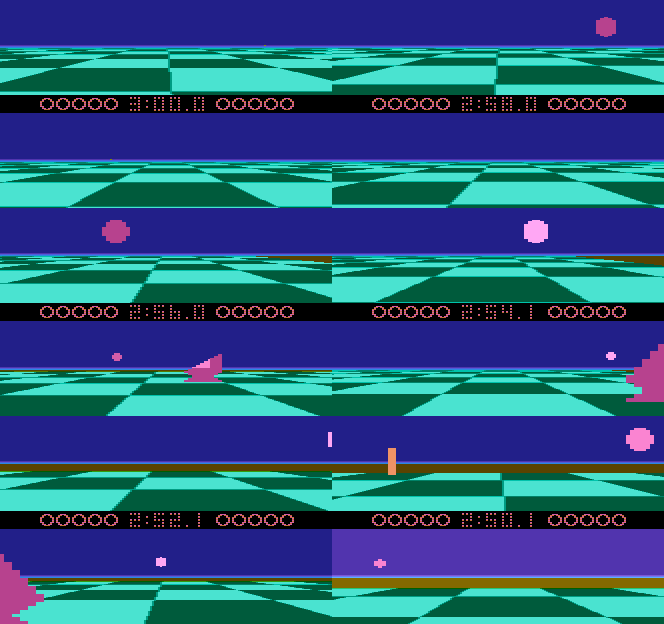
Ballblazer: The simplest, fastest, and most competitive sport in the known universe. It's basically one-on-one soccer, but made interesting, and perhaps confusing, by its sense of speed in a first person perspective.

The tiles' edges are even anti-aliased.
 

I expect that the pseudo-3D effect is pure trickery, using pre-rendered frame loops to convey lateral movement, and palette-swapping shenanigans for the back-and forth effect. Rotation is only done in 90 degree snap increments, so everything will be perfectly perpendicular to the horizon. Kid stuff on, say, the Sega Genesis, but on an 8-bit computer with only the most basic support for scrolling tile layers, and coming from the basic looking Boulder Dash, this is impressive.

Ballblazer's manual is long on flavor text but short on gameplay instruction. About half of it takes the form of a transcript of an intergalactic radio interview with former Ballblazer champion Arboster Kipling, who recounts the centuries-old history of the sport, explaining how its high speed, high g-force maneuvers were born in the wake of stellar warfare, and how earthlings are underdog newcomers to the competition. Typical gameplay and strategy is then described in the format of sports commentary of an ongoing match.

Game rules are quite simple.

  • At the start of each point, the ball is launched into the middle of the playfield. You and your opponent start at positions midway between the ball and the opposite goal, and the first player to touch the ball controls it.
  • Your vehicle automatically orients itself. When you do not control the ball, you face it. When you do control the ball, you face your goal.
  • Pressing the button emits a high-energy force blast. When you control the ball, this launches it toward the goal at an angle dependent on timing. When your opponent controls the ball, the force blast can knock it out of their control. Either of these actions also knocks you backward with significant force, but a push that does not come in contact with the ball does nothing.
  • Goals move left and right. Each point scored reduces some of the width between the posts.
  • A standard goal scores 2 points. Shooting the ball into the goal from outside your line of sight scores 3. Carrying it into the goal only scores 1.
  • Scoring uses a push-pull system, where once the combined score of both players equals ten, each point scored by one player also reduces the score of their opponent.
  • Victory goes to the player with the higher score after three minutes elapse, or in the event of a tie, to whoever scores a single point in overtime. Scoring ten points also awards victory, but this is unlikely to happen unless the players are mismatched in skill.


I played some rounds with "B" and recorded two of them, in which the first of them I cream him, and the second it looks like another easy victory until he turns around and pulls ahead at the last minute.

GAB rating: Above average. Ballblazer is confusing and disorienting for a little while, until you get used to its speed, its knockbacks, and automatically rotating weirdness. Then it becomes fun for a little while, but the game's just too simple to have a lot of strategy and lasting value. But you can't beat its presentation. Or can you?


Game 297: Rescue on Fractalus!

If Atari's Star Raiders was the system's original killer app, taking what we could charitably call inspiration from Star Wars (among other sci-fi properties) to make the most cinematic home video game experience possible in 1979, LucasFilm's Rescue on Fractalus comes full circle, pushing the system hard and employing its wide color palette and lots of clever trickery to make a demoscene-worthy flight sim, if not necessarily a very engaging one. The re-entry sequence alone must have been jaw-dropping at the time, first diegetically transitioning from its level select screen by way of an animation that suggests an airlock door opening, the stars fading into view as your ship comes out of hyperspace, the descent into Fractalus as its oppressively golden-yellow exosphere rises from the bottom of your viewscreen until fills your field of vision, and finally, the endless crags of Fractalus fade into view through its thick, Venusian atmosphere.

The soundscape, too, is a work of art. Fractalus is a desolate and hostile place, and though the title and high score screens trumpet a Williamsesque fanfare (one that strongly reminded me of Star Wars: Rogue Squadron), music is wisely omitted from the gameplay scenes as you glide through its harsh winds and arid crags, leaving your ears free to listen to the whines of your engine and the blasts of anti-air gunfire. As you locate pilots, the objective of your mission, the dull thuds of their footsteps against the rocky surface as they sprint toward your ship cannot be mistaken for the hollow clangs of their fists desperately banging on your metal hatch, which grow weaker and longer apart in intervals as they succumb to the planet's toxic atmosphere.

Your radar proves the most useful tool for locating pilots, as the fractal-inspired terrain lines are difficult to make coherent sense of, and most of the time will obstruct your view of the surface where the pilots wait. It's not difficult at all, thankfully, to avoid crashing into the crags. You'd almost have to try to do it on purpose, and the damage to your ship isn't severe if you do. Anti-aircraft guns mounted on these crags will shoot at you, and though they don't do much damage individually, you'll need to destroy any within visual range of a landing site before attempting a rescue, or you'll be shot at like a fish in a barrel. You don't have to be exact with your guns, which is a good thing indeed given the game's low framerate, which only seems to tumble further while you're being shot at.

When you do land within range of a pilot - he needn't be in your sight as long as the blip on the radar is close enough - you have to shut off your engines to coax him out of his downed ship, and open your airlock to let him inside. Switching the engines on too early will kill him. Once you rescue your quota, you can continue flying over Fractalus to search for more or to destroy more targets of opportunity, but you may return to the mothership to increment the stage and along with it the difficulty.

The difficulty is very forgiving until the rather late stages - I started at level 4, and made it to level 22 on my first try, having played for a good two hours, and not had any close calls. A few new challenges get added gradually - flying UFOs are added into the mix, which kamikaze your ship for much more damage than the stationary guns do, the guns become more densely concentrated, fire more frequently and accurately, sometimes landing damaging critical hits, and your rescue quotas increase. By level 16, Fractalus starts undergoing day-night cycles in which night completely blacks out your visual conditions, save for occasional flashes of illumination from enemy gunfire, and you are forced to rely exclusively on your instruments. This isn't as punishing as it probably sounds.

Most famously, the pilots you rescue sometimes turn out to be Jaggis in disguise, and attempt to smash through your canopy once they get in range, and will if you don't kill them with your engine backwash quickly enough. Or, if you were foolish enough to open your airlock prematurely, they'll enter your ship and tear it apart from the inside. The former event was what caused my first death, as I, not realizing how little time you have to switch on your engines before they instantly incapacitate you, had been too lax about it, and erred on the side of not accidentally wasting a pilot.

By level 25, things get much more challenging - in fact, I couldn't beat level 25 in several tries, even as level 22 gave me no trouble at all once I knew better than to dawdle. Anti-air guns batter you from everywhere, constantly, draining your energy reserves quickly. You can't pick them off from a distance, and as you close in for a kill, you invariably fly into range of multiple other guns. Only after clearing a a fairly large radius, which can feel more dependent on luck than skill or strategy, can you start rescuing pilots, who partially refill your energy reserves on collection. Once you can start doing that, it gets a lot easier, except for one thing - the Jaggis can punch through your canopy in less than half a second now.

Below is a video of me failing level 25. I got pretty close, but fell to a disguised Jaggi in the end.

A side-note, you can improve the game's framerate by playing the XEGS cartridge version and emulating an accelerated CPU, which is configurable in Altirra. The 65C816 at 7.14Mhz resulted in a few glitches, but the game seemed to sustain its maximum framerate (which admittedly isn't that great) no matter how intense the action got. This is not reflected in the above video.

GAB rating: Above average. If I could recommend a game on look and feel alone, Rescue on Fractalus would be that game. I almost can, but Rescue on Fractalus just isn't all that engaging. Once the novelty of its technology wears off, you're left with a repetitive and simplistic shooter that takes entirely too long to offer a challenge, and isn't satisfying even when it does. Still, it's very much worth a play, just be sure to play the original Atari version, as the cinematic immersion is badly compromised on machines that don't enjoy its wider palette (like the Commodore 64).

Most popular posts