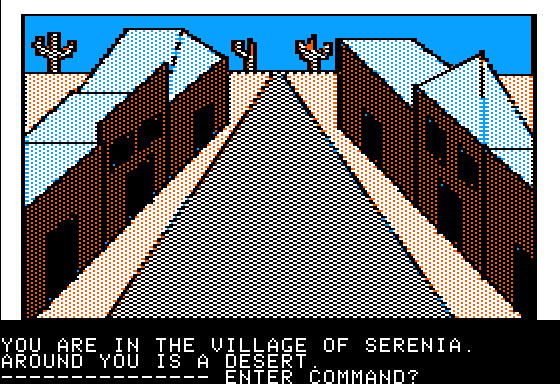
Mystery House is public domain, and can be downloaded in DSK format for use in an Apple II emulator or in ScummVM.
https://www.scummvm.org/games/#mysthous
Sierra games were my introduction to adventures. I had played Zork once before, but King’s Quest for DOS was the first adventure game I ever owned, and the first I had beaten. I re-bought the series on CD-ROM when King’s Quest Collection came out, replayed everything and some games I missed (such as the 1990 KQ1 remake), enjoyed the additions like the making-of videos and the King’s Questions trivia game, and read every design document, history, and article on the disc again and again. It’s there where I first heard of Colossal Cave Adventure, which was mentioned frequently as the game that inspired Ken and Roberta Williams to make their first game, Mystery House, which, according to Sierra, was the first graphical adventure game ever made.
At some point during the Windows XP era, when I was comfortable with computer emulators, I decided to go on a Sierra retrospective, starting with the Apple II High-Res Adventures. I played all of them, though not very much about them sticks in my memory. For Data Driven Gamer, I intend to replay the whales, but not necessarily go beyond that.
And so, I’m a little bit surprised that Wizard and the Princess, a game mainly known for being Sierra’s second graphic adventure ever (and often incorrectly cited as the computer game seen in
Big), meets whale requirements with 36 votes, while Mystery House falls short at only 23. Even Mission Asteroid, a kid-oriented adventure with barely ten minutes’ worth of content, has whale status at 27 votes. This kind of situation is exactly why I have my method of identifying and playing notable ancestors, of which Mystery House certainly qualifies.
In replaying Mystery House, I opted to use AppleWin rather than ScummVM, due to the way colors are handled. ScummVM renders a sharper display in color mode, but aside from the title screen, Mystery House is a black and white game, and the Apple II video chip handles color strangely.
 |
| ScummVM, color mode |
This should be white-on-black, but the vertical lines are green and purple! This is due to the Apple II’s unusual method of drawing colored pixels, where pairs of horizontally adjacent pixels generate artifact colors, only appearing as white when both pixels in the pair are "on."
ScummVM has a monochrome mode, but it renders everything in an unattractive green.
 |
| ScummVM, B&W mode |
AppleWin has an actual black-and-white mode free of any color artifacts, and it’s also possible to switch to it and back without quitting the game, unlike ScummVM.
 |
| AppleWin, monochrome mode |
There’s also a curiosity in the title screen. Even there, the title is “High-Res Adventure #1.” Did the Williams' already know there would be more? Or is this a re-release, and might there be a lost, older version where the ingame title is simply “Mystery House?” The fact that color is not used anywhere in the game except the title screen makes me consider this as a possibility.
Mystery House had no instruction manual other than the blue reference card, but there are ingame instructions, which seems to be a common thing in early Apple II games.
Ok, what is it with early home computer adventure games calling the game “Adventure” in the ingame instructions? Also, talk about spoiling the plot.
Most of the instructions just concern how to use the parser, with commands like “N” to go north and “LOOK [OBJECT] to examine something more closely.” Notably, one page informs us that "north" corresponds to the top of the screen, "east" corresponds to the right, which would be very useful information if it weren't a complete sham.
The last page is a Clue-like suspect list that doesn’t give a damn about gendered adjectives:
Starting off in front of the house, I was almost immediately baffled by the parser. “OPEN DOOR” produced the message “I DONT UNDERSTAND WHAT YOU MEAN.” Every cardinal direction just produced “I CANT GO IN THAT DIRECTION.” I also tried “GO HOUSE,” “GO YARD,” “GO DOOR,” until finally “GO STEPS” took me to the steps. I tried checking under the conspicuous welcome mat, but the parser wasn’t having it. The door was unlocked, anyway.
As promised, seven people are here, even though this isn’t the living room. I don’t know why I’m here. I don’t know why they’re here. I just know that some of them are going to die. And isn’t the south doorway labeled “DOORWAY” just precious?
Kudos, Roberta, for going the full nine yards with this whole ‘graphics’ concept. They aren’t good graphics, but she tried. Other developers might have been content just to type out the contents of this note in standard text, but here we get a graphic showing what this handwritten note actually looks like.
Another note sounded ominous:
 |
| Rejected Collins Crime Club manuscript: The 123 Murders |
Soon after, I found the first body:
Inspection revealed it to be Sam the mechanic, killed with a blunt instrument.
Before long it got dark, and then I couldn’t see. There weren’t any grues, but the screen graphics area would just be black, so I restarted, knowing I’d have to find a light source before too long. I found a candle in the dining room, some matches in the kitchen, and went exploring the house.
Adjacent to the kitchen was a “forest” area that I couldn’t find any way to leave. Every direction just took me to more identical forest.
The second floor had a lot of “doorway” rooms that looked like they should go somewhere, but none of the movement commands seemed to work except to return me to the previous junction.
The third floor was an attic with an immovable ladder and a hammer. Sam’s murder weapon, perhaps?
Back on the first floor, I tripped on a rug and my candle set fire to the house. Roberta’s love for killing the player started off young.
Restarting again, I went to the kitchen, figuring it to be a good place to get water. The room description only tells you that the kitchen has a stove, a refrigerator, and a cabinet, but there is a sink in the picture, and “LOOK SINK” gives you a closeup.
 |
| It's right there! |
More parser troubles plague the sink. “TURN FAUCET” and “TURN ON WATER” do nothing. The correct command is “WATER ON,” one of the few things I remembered from reading a walkthrough many years ago. To fill a water pitcher, “FILL PITCHER” doesn’t work, but “GET WATER” will.
The extinguished fire burned a hole in the floor, revealing a key!
But when I typed “UNLOCK DOOR” in the entry hall, it just said “YOU HAVE NOTHING TO UNLOCK IT WITH.” Not the right key, I guess.
Then I realized the doorway rooms responded to “GO DOORWAY,” giving me access to more mansion rooms. In a bedroom, I found the body of Sally.
A blond hair on her dress means it was either Tom the plumber, Bill the butcher, or Daisy the cook.
Entering another room, an unknown assailant with a lousy aim threw a dagger in my general direction!
Exploring more rooms, I also found the body of Dr. Green, who was stabbed to death, and Bill the butcher, strangled.
Four down. Tom the plumber, Joe the gravedigger, and Daisy the cook are left. I’ve so far refrained from mentioning that I already know Daisy did it. That much I can remember from my previous playthrough. I think at this point we’re supposed to conclude this and not think too hard about it, or consider possibilities such as that maybe Joe strangled Bill with some nylons that he found in a bedroom drawer, and then killed Sally and left one of Bill’s blond hairs on her body to throw the detectives on the wrong trail.
I explored as much of the house as I could, but still couldn’t find a use for the key. So I went to the forest in case I could find anything of value there, using my collection of items as breadcrumbs. I found nothing useful there; it’s the game’s own Maze of Twisty Little Passages, but I did find that you can return to the kitchen by moving “up” from the forest’s starting screen, if you can even find your way back there.
Exploring the house again and keeping my eye out for anything looking like doors, I found that the attic had a door leading to a storage room with a locked chest that my key could open.
 |
| Oh, my! |
I got stuck here and had to resort to a walkthrough. The next thing I needed to do was in the study.
I had tried taking the painting before, but because of the game’s response, I assumed it wasn’t an interactive object, or perhaps that this was a window and not a painting.
Turns out it is interactive, but you have to call it a “picture.” Behind it is a button which opens a secret passageway.
The passageway led to the fifth victim.
Tom the plumber, stabbed to death, with a daisy in his hand. Come on, Roberta, your clues are getting sillier each time. What are we going to find next, Joe dead from eating a plate of poisoned spaghetti?
The hole in the west wall led to a passageway to a lone pine tree in the forest. I climbed it, and up there was a telescope pointed at the attic.
Heading down the tree into the forest, I would have been lost there, except I knew from exploring earlier that you can return to the kitchen by heading “UP” from one of the rooms, so I just wandered and eventually found my way back to the kitchen.
The big key opened the front door, but this didn’t really help me, so I went up to the attic, which suddenly had a trapdoor in the ceiling that wasn’t there before.
 |
| Masterful storytelling by a master storyteller. |
I shot Daisy.
 |
| Wait, is she still standing up, or was she lying down before? |
Daisy’s note:
God knows why she would write that down.
Returning to the basement, I could not figure out what to do next, so I looked at a walkthrough again. You’re supposed to type “REMOVE ALGAE.” Right.
This exposed a loose brick, concealing the jewels. Then I left the house.
I never found Joe the gravedigger’s body. Maybe he got away. If so, business is going to be great for him when he comes back.
Honestly, this is one of those games more interesting for the fact that it exists than anything else. I do appreciate the commitment to using graphics, making it more than just a text adventure that happened to have graphics in it, and I also appreciate that while the Williams’ chief inspiration was Adventure, they decided to make a murder mystery rather than just make another cave exploration and treasure hunt game, even though they didn’t completely avoid the treasure hunt aspect. In contrast, Scott Adams’ Adventureland, an Adventure-inspired game, plays much like an ultra-compact version of it, though with completely different puzzles and treasures. Later versions supplied graphics which did absolutely nothing to inform you of things other than what the stark prose already told you, and in some cases told you less.
But neither innovation is done well here. The graphics are even more amateurish than the intro screens of Akalabeth, and a murder mystery calls for a more well thought out plot and setting than a cavernous treasure hunt does. Mystery House hasn’t got it – the very concept demands an emphasis on plot and characters, but five of the characters have no purpose except to pop up dead, one doesn’t even do that, and none but Daisy (assuming she’s the one who wrote the notes) have any kind of personality. Nor is the plot any more coherent than Adventure and Adventureland, and in a murder mystery it ought to be. If the instruction card had just said something like “it is rumored that there are old jewels hidden in this abandoned house, and you and seven strangers are here tonight to loot it,” that would have been good enough.
It fares badly compared to Adventureland in other ways too; the puzzles are poorer, the austere room descriptions haven’t even got a minimalist charm, and the parser, though claiming to recognize over 300 words, still feels worse, with most of my difficulties in the game stemming from not knowing which set of words the game expected me to use to do a certain thing. Even exploration is worse than in Adventureland. The ingame instructions tell you that cardinal directions correspond to different sides of the screen, north on the top, south on the bottom, but this principal is violated almost constantly. In the dining room, for instance, north is left and south is right, which can't be determined in any way except by trying to move in each direction. Consequently, I'm never quite sure what direction I'm supposed to be facing upon entering a new room and have to use trial and error to establish this, whereas Adventureland prevented this by always telling you, in the status bar, which direction the room exits were.
One interesting note is that Mystery House got a release in Japan featuring entirely new graphics, still drawn in the same vector style, but drawn far more competently, with an almost cinematic flair.
Any enterprising coders want to try making a fan translation?
My Trizbort map (forest region is simplified):