Our
next whale of 1984 is Bruce Lee, by Datasoft, but as this is the first
(and only) of the company, I have selected a few ancestors to play as a
short retrospective. I am largely unfamiliar with Datasoft, having only
heard the name a few times mostly in connection to Atari computer games,
such as the Alternate Reality series and of course Bruce Lee, and as a
publisher/localizer of Japanese arcade games and European computer
games.
The
earliest games of Datasoft are TRS-80 programs listed in a full-page ad
in the March 1981 issue of 80 Microcomputer magazine:
Although Arcade 80 and Football Classics appear to be lost, The Resurrection of Iago has been dumped.
It's
just Othello. Nothing unique about it. Iago plays a pretty strong game,
which isn't an especially hard to program a computer to do. There are
six selectable levels of difficulty, but on levels 5 and 6, the game
either freezes a few moves in, or takes so long to calculate its move
that I can't tell it hasn't frozen. Even on level 4, the AI can take
between two and five minutes per turn except for the very first and very
last ones.
I lost on level 4, but it wasn't a total curb stomp. I even managed to capture two of the corner pieces.
Later
in the year, Datasoft partnered with Tandy and became one of the first
third-party developers to support the new TRS-80 Color Computer,
affectionately known as the CoCo. Despite the name, these computers are
not color-capable versions of the TRS-80, and have virtually no hardware
similarities, lacking even the Zilog Z80 CPU from which it got its
namesake. Retailing for $400 in 1980, the machine cost only a bit less
than the much more capable Atari 400, while also costing more than the
VIC-20 machines it was intended to compete with. These machines failed
to gain the sort of traction that the black & white TRS-80's had,
and did not produce a single game that interests me in particular.
Nevertheless,
the CoCo is an important part of Datasoft's early history, if just a
stepping on the way to becoming an Atari shop. From 1981 to 1984,
Datasoft released six original games on the platform (the originality of
all but two is debatable) and three licensed arcade ports, most of them
published by Tandy. The first of them is called Popcorn.
It's
a technically fine conversion of Atari's Avalanche and controls as well
as any paddle-based game I've seen yet. Avalanche is still a mediocre
game, and Popcorn is more mediocre still.
For one, popcorn lacks
any kind of difficulty progression; the speed you set at the start is
the speed you get until you run out of lives, not even incrementing if
you clear a screen. Missing a rock means the loss of a paddle, just like
in Kaboom!, but in Kaboom! this handicap was offset by a decrease in
difficulty, and you could earn paddles back. Neither happens here, and
missing even means the stage resets to its initial state, so you're just
trapped in a feedback loop where if you can't beat a stage in one try,
it only gets harder for your next one. And if you can beat a stage in one try, then it doesn't get any harder the next loop and you can probably do it again, indefinitely.
Neither Iago nor Popcorn is interesting enough for me to rate or number.
In 1982, Datasoft released four games for the TRS-80 Coco; Card Games,
a collection of, well, card games, Clowns & Balloons, a copy of
Exidy's Circus, The Sands of Egypt, an adventure game, and Shooting
Arcade, a clone of Sega's Carnival. One of these interests me more than
the rest, and no points for guessing which one.
Game 301: The Sands of Egypt
Read the manual here:
My first thought while reading the manual was that Michael Berlyn must
have played this. Not only is the premise nearly identical to Infidel -
you play a Sir Percy, searching for a lost pyramid in the Egyptian
desert after being ransacked, abandoned, and stranded in the desert by
your own disgruntled archaeological team - but the backstory is even
written as a letter from Sir Percy on a sheet with a hotel letterhead
(nonsensically called "Hotel de Mecca"), just as we'd see in Infidel's
folio packaging. It's played for laughs here, with Percy's excessive
English poshness and not-so-secret judgmental attitude irritating the
crap out of his colleagues.
Ok,
so the writing isn't exactly on Infidel's level, but if I'm not
mistaken, this is the earliest adventure game I've played with animated
graphics. There's even some parallax scrolling when you move.
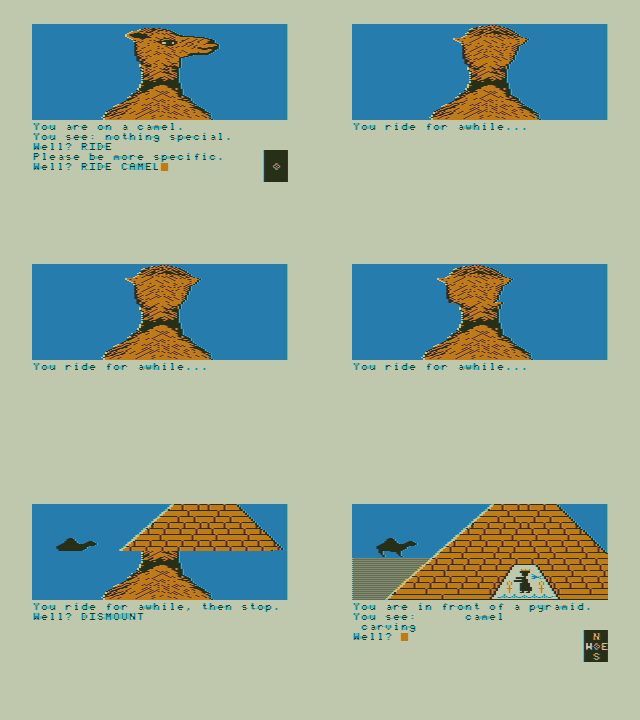
 |
Huh, Moon Patrol wasn't the first!
|
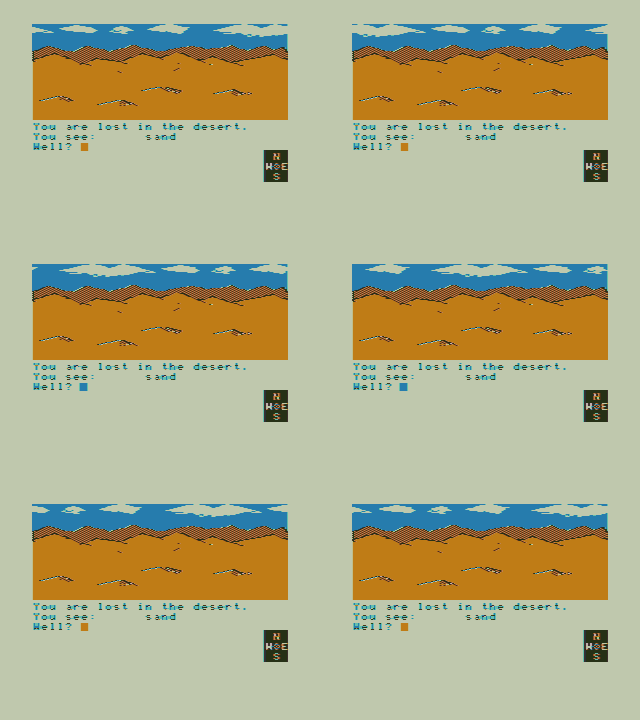
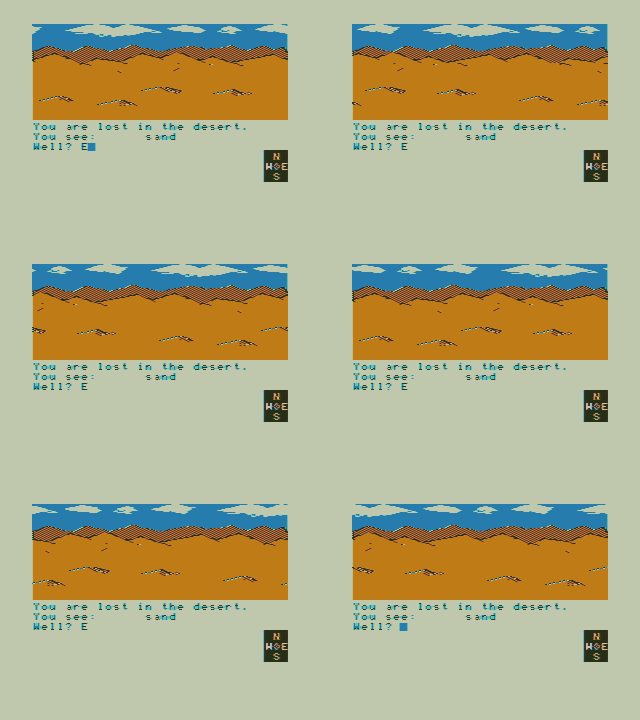
If
it isn't clear yet, this is a MOTLP, without much in the way of
landmarks or changing scenery to help make a map, and you have no
inventory items to breadcrumb with. It's potentially hell, but
thankfully I found a shovel after a little bit of wandering. A snake was
very nearby and I figured I could probably kill it with the shovel, but
decided to map out the initial area first. A fairly low branch
complexity factor makes mapping it more doable than most. Even though
almost every screen has four exits, most just loop back on themselves,
which you'll recognize if you dropped the shovel, and only one takes you
"back" more than a room or two.
In the middle of the maze,
there's a small cliffside area where I found a rope that disintegrates
when touched but tells you it's made from palm fronds, which I'm sure is
a clue. More desert is on the other side, and at the end of it, a pool
area, which wouldn't even let me drink from it.
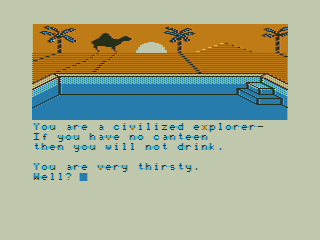 |
It's a joke and it works better if you've read the manual
|
"GO
CAMEL" advised me to try "MOUNT," but that didn't work. "GO POOL"
worked, and showed a cover in the water, but I couldn't figure out what
to do with it.
Not
only could I not figure out any way to lift the pool's drain or do
anything that resulted in useful feedback, I couldn't figure out how to
leave this screen either! And I died of thirst, waist-deep in a pool of
water.
Restarting,
I got the idea to try digging in every screen, which located a torch
and magnifier scattered around. The shovel did kill the snake, leaving
behind a puddle of snake oil, and opening the way to more desert, where I
found a canteen. The procedure to drink was a bit confusing - I had to
bring it to the pool, fill it, and then after DRINK didn't work, I
eventually realized that filling it caused me to drop it without any
indication that I had done so. Picking it up again, I could drink the
water for a respite from my thirst. I brought it back to the snake oil,
where I took one more drink, emptied the canteen, and got the oil.
Stuck,
I turned to a walkthrough. What you have to do next is type "GO TREE"
from the pool area. This is a situation where the interface is lying to
you, as it lists "pool" as a goable location, but "pyramid" is also
listed but unresponsive to commands, and "tree" isn't listed at all. You
have to rely on the graphics to divine that possibility, and I didn't.
Dropping
everything allowed me to climb, where I saw fronds that I couldn't
figure out how to interact with, and dates that I could take. Feeding
them to the camel let me mount it, and ride to the pyramid.
Examining
the carving here showed the pharaoh engraving to be holding an actual
scepter, which I could grease with the snake oil and pull out! The
pyramid could be climbed too, and an axe was sitting at the top. At this
point, I was hitting the inventory limit, and I'd have to start leaving
excess items at a centralized location. I picked the pool for this,
where I swapped the snake oil for more water. The axe cut the palm
fronds, which I could braid into a rope.
I thought I could
lift the pool cover with my hooked scepter, but once again, none of the
commands I could think of trying worked. Nor could I
find a way to convey my wish to lift the pool cover with my rope
instead. "TIE ROPE"
was accepted but demanded a followup, and "TO HANDLE" didn't work, nor
"SCEPTER" or "COVER" or "HOOK" or any permutation I could guess.
The
answer, shown in walkthrough is to type "HOOK SCEPTER," followed by "TO
HANDLE." Right then. Pulling the scepter then opened the cover and
drained the pool.
Leaving behind the shovel and dates, and taking
with me the axe, magnifier, rope, torch, and canteen, I figured it would
be dark beneath the pool drain, and that I'd need to light the torch by
using the magnifying glass in the sun. But my attempts to communicate
this to the parser were in vain; "LIGHT TORCH" was recognized, but
demanded to know how, and I couldn't figure out the expected verbiage.
"WITH MAGNIFIER" did not work. Sure enough, going into the drain got me
killed in the dark. I consulted the walkthrough again.
My verbiage was
right. But it only works while inside the pool, and not on the screen
outside of the pool where the sun is clearly visible. Arghh!
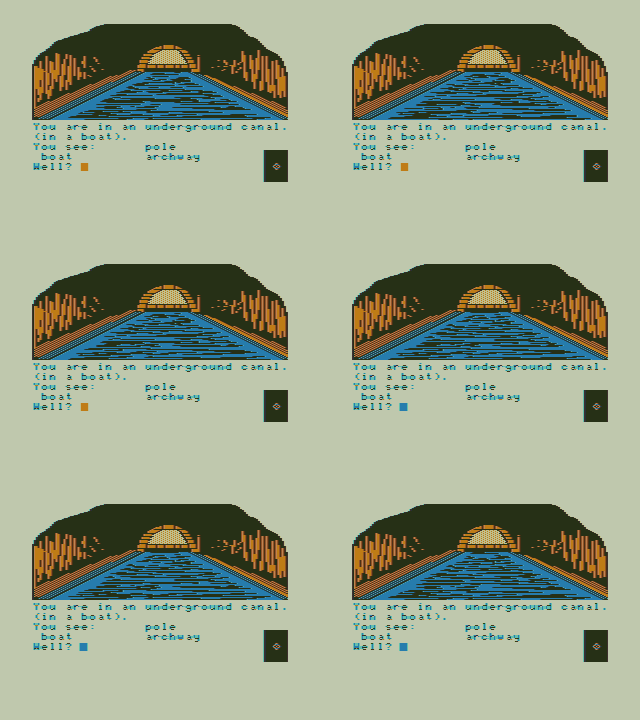
With light I could explore this falaj, and discovered a boat.
I could float it, but without any way to control it, the boat drifted east and over a waterfall.
Reloading, this time I took the shovel instead of the axe, and could paddle the boat.
Securing the boat to the pole, I got out and went through the archway.
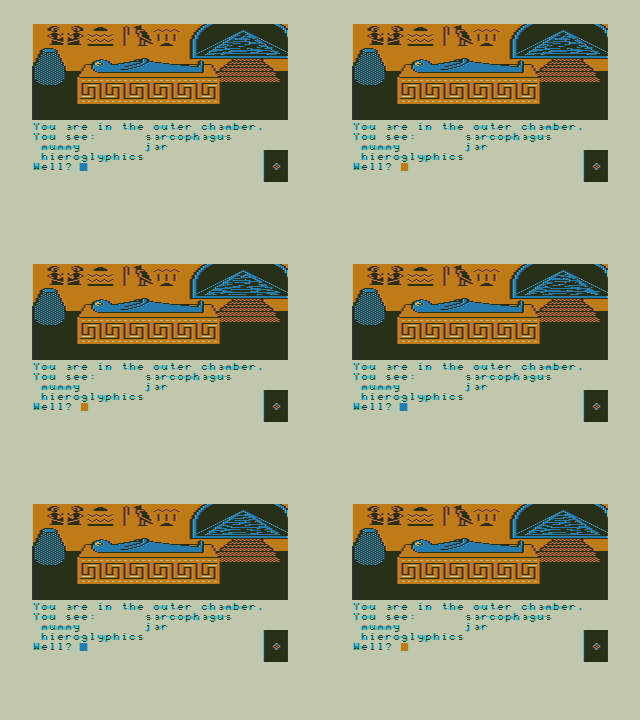
TRANSLATE HIEROGLYPHS showed this meaning.
So
I put the scepter back in the pharaoh's hands, and then a thin crack,
just wide enough for me to carry my torch through, opened in the wall,
leading to the inner chamber.
The
treasures, we're told, are far too heavy to be carried by one man, but
the ladder can be taken back to the entrance and climbed up and out
through the drain, back into the pool. CLIMB STEPS got me out, I
discovered after fumbling a bit more with the parser, and finally I rode
the camel back to Cairo, victorious.
 |
You have mastered The Sands of Egypt in 126 turns. This Adventure is over.
|
GAB rating: Below average.
The animated graphics are what make The Sands of Egypt stand out from
its contemporaries, and they are honestly not bad at all for the era.
The warm-hued palette is more pleasing than the harsh six-tone graphics
available to Apple's hi-res mode, and more appropriate for this kind of
game than the cool colors typical of Atari games. It makes me think that
the CoCo might have had untapped potential as a games machine, perhaps
marketed as a cheap alternative to the very expensive Apple ][+ rather
than trying to compete with the cheaper VIC 20.
But this isn't a
particularly inspired or well designed adventure. Even padded with a
MOTLP, which makes up the majority of the game's rooms, this is a tiny,
inconsequential game, without a single clever puzzle, and the only
difficulties I had were the difficulties with its parser. This is still
preferable to the downright player-hostile design in Sierra's late-era
Apple adventures, but it's overall not much of an experience.
Datasoft's
last TRS-80 CoCo game would be 1984's The Dallas Quest, and would reuse
the engine of The Sands of Egypt, but I'm not particularly interested
in playing it. The next ancestor I play will be one originally written
for Atari computers, bringing us into that era and setting the stage for
Bruce Lee next.