This equation, buried right in the middle of Balance of Power: The Book, is the most important thing there is. You can't do very much if you don't know what's possible to do without getting immediately nuked! However, I find it can be simplified further.
For every action you perform in a turn, the computer makes a decision on whether to challenge it or not, and this is based on two numbers, representing how much the Soviets resent your action, and how much they respect your right to do it.
Crawford doesn't fully explain all of the variables in the equation, but they are not equally important. My own version is as follows:

- Mod is equal to -1 when your action benefits a Soviet ally; it cancels out the negativity of the Hurt variable and causes them to dislike your action. In all other circumstances it is equal to 1 and can be ignored.
- Hurt is equal to 1 when your action harms the target nation, and -1 when it helps them.
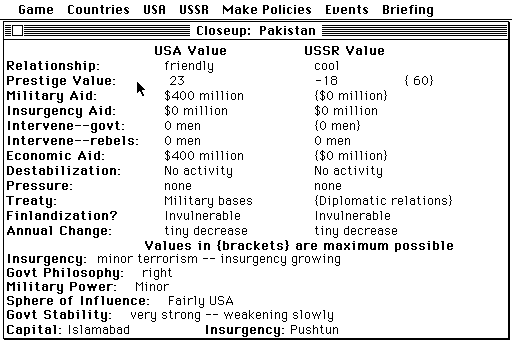
- DipAff is the Soviet prestige value for the nation, which is an exact number displayed on the closeup display. Positive for their allies, negative for their enemies. This means four possible scenarios leading to either net outrage or pleasure (aka negative outrage):
- Helping a Soviet ally: Outrage (double negative; Mod*Hurt)
- Hurting a Soviet ally: Outrage (no negatives)
- Helping a Soviet enemy: Outrage (double negative; Hurt*DipAff)
- Hurting a Soviet enemy: Pleasure (single negative; DipAff)
- Obligation is a positive number representing the Soviet treaty with the nation. Exact numbers are not given for all treaties, but a nuclear treaty means +127, and no relations means +0.
- DontMess represents the Soviet sphere of influence over the country and can be anywhere from 1 to 15.
- c is a positive coefficient representing a number of factors; the impact of your action, your reputation, the size of the country, etc. It's much more complicated than just multiplying numbers, but we can abstract it away for reasons I'll explain in a moment.
My Respect is a very similar equation:

DipAff, Obligation, and DontMess now refer to your purview of the nation, and Help is the negation of Hurt. As before, four scenarios are possible.
- Helping a US ally: Respect (no negatives)
- Hurting a US ally: Disrespect (negative Help)
- Helping a US enemy: Disrespect (negative DipAff)
- Hurting a US enemy: Respect (double negative; Help*DipAff)
Any "disrespect" action is unlikely to be tolerated.
Crucially, the c coefficient is exactly the same in both equations. It's challenging to estimate, but it does not determine whether Outrage or Respect is higher. It can only amplify the difference between the two.
Note that there is one possible action which both pleases the Soviets and earns their respect; hurting a mutual enemy. If a country dislikes both the US and USSR, you may harm them with total impunity.
After calculating Outrage and Respect, there's a third variable which we will call Bluff. This is randomized, but also affected by how much the Soviets fear you. Crawford discusses variables Adventurousness, Nastiness, and Pugnacity, but doesn't adequately explain what they do or what causes them, so let's just suffice to say that the more the Soviets back down from your threats, the smaller the Bluff rolls will be in the future.
Bluff is added to Outrage, and if it exceeds Respect, the Soviets will object and a crisis begins. The amount it exceeds by determines how much prestige is at stake.


During a crisis, Bluff will be re-rolled each time you escalate things, and will usually decrease. Should Outrage+Bluff ever drop below Respect, the Soviets back down, the crisis ends, and you win whatever amount of prestige was at stake. Bluff can actually drop into the negative if the crisis escalates enough, making it possible to win disputes where you were in the wrong, but the Outrage-Respect difference has to be small for there to be any chance of it.
What about when you object to a Soviet action? The calculations are essentially reversed. The computer calculates Outrage for the US; representing how much anger over the action you are entitled to. It calculates Respect for the Soviets, representing how much you ought to respect their policy. Bluff is added to Respect, and if Outrage exceeds Respect+Bluff, then the Soviets immediately back down. If not, a crisis occurs and the Soviets back down when/if Bluff diminishes enough to drop below Outrage.
There is a fourth factor I need to bring up too - Soviet patience is a finite resource, and infuriatingly, it is also hidden. When it runs out, an "accidental" war where the Soviets randomly nuke you before you even reach the double-dog-dare phase becomes inevitable thanks to the way RNG works.
To end this post, I thought I'd share my own data tables, grouping the countries based on their role.
First, US allies, presented in descending order of estimated loyalty:
| Region | USA prestige | USSR prestige | Total prestige | Sphere | Defense treaty | |
| West Germany | West Europe | 503 | -365 | 585 | Very strong USA | Nuclear |
| Britain | West Europe | 325 | -189 | 347 | Absolute USA | Nuclear |
| Japan | Pacific | 189 | -86 | 220 | Very strong USA | Conventional |
| Italy | West Europe | 168 | -84 | 216 | Very strong USA | Nuclear |
| France | West Europe | 267 | -200 | 428 | Fair USA | Nuclear |
| Canada | North America | 92 | -44 | 95 | Very strong USA | Nuclear |
| South Korea | Far East | 158 | -111 | 203 | Very strong USA | Conventional |
| Saudi Arabia | Middle East | 71 | -40 | 130 | Absolute USA | Bases |
| Spain | West Europe | 87 | -61 | 112 | Strong USA | Nuclear |
| Greece | East Europe | 33 | -8 | 53 | Very strong USA | Nuclear |
| Brazil | South America | 23 | 0 | 75 | Fair USA |
|
| Egypt | North Africa | 47 | -28 | 122 | Fair USA | Bases |
| Morocco | North Africa | 29 | -11 | 74 | Slight USA | Bases |
| Australia | Pacific | 49 | -32 | 70 | Very strong USA | Conventional |
| Sweden | West Europe | 31 | 15 | 100 | Strong USA |
|
| Thailand | Far East | 31 | -17 | 57 | Slight USA | Bases |
| Philippines | Pacific | 27 | -13 | 44 | Fair USA | Conventional |
| Israel | Middle East | 99 | -87 | 159 | Absolute USA | Conventional |
| Turkey | Middle East | 57 | -47 | 122 | Strong USA | Conventional |
Don't let the Soviets mess with these countries, and help them when they are in trouble. The farther down the list, the more likely you are to lose them if you renege on your duties!
Next, Soviet allies, in ascending order of estimated loyalty:
| Region | USA prestige | USSR prestige | Total prestige | Sphere | Defense treaty | |
| Iraq | Middle East | 0 | 0 | 95 | Strong USSR | Bases |
| Angola | Southern Africa | -4 | 4 | 17 | Very strong USSR | Bases |
| Yugoslavia | East Europe | 6 | 12 | 81 | Strong USSR | Conventional |
| Ethiopia | North Africa | -6 | 12 | 40 | Very strong USSR | Bases |
| Cuba | North America | -48 | 60 | 78 | Strong USSR | Nuclear |
| Syria | Middle East | -14 | 35 | 90 | Strong USSR | Conventional |
| North Korea | Far East | -119 | 163 | 190 | Absolute USSR | Nuclear |
| Czechoslovakia | East Europe | -56 | 140 | 180 | Absolute USSR | Nuclear |
| Romania | East Europe | 9 | 89 | 127 | Very strong USSR | Nuclear |
| East Germany | East Europe | -77 | 194 | 249 | Absolute USSR | Nuclear |
| Poland | East Europe | -57 | 191 | 245 | Very strong USSR | Nuclear |
| Vietnam | Far East | -140 | 280 | 358 | Absolute USSR | Nuclear |
You are likely to be nuked if you mess with them directly, at least early on in the game. Countries near the top may waver in their loyalty if things are going badly for them, but the initial instigator can't be you.
The third group are the battleground states, where anything can happen. These are in roughly descending order of touchability.
| Region | USA prestige | USSR prestige | Total prestige | Sphere | Defense treaty | |
| Colombia | South America | 12 | -2 | 31 | Fair USA |
|
| Mexico | North America | 11 | 2 | 37 | Very strong USA |
|
| Pakistan | Middle East | 23 | -18 | 60 | Fair USA | Bases |
| Venezuela | South America | 3 | 0 | 22 | Fair USA |
|
| Chile | South America | 10 | 7 | 14 | Fair USA |
|
| Honduras | North America | 5 | -3 | 13 | Fair USA | Bases |
| Peru | South America | 3 | 1 | 24 | Fair USA |
|
| Tunisia | North Africa | 1 | 0 | 5 | Strong USSR |
|
| Burma | Far East | Varies | Varies | 5 | Varies |
|
| Panama | North America | 0 | 0 | 1 | Fair USA | Bases |
| Taiwan | Pacific | 9 | -9 | 58 | Fair USA | Bases |
| Argentina | South America | -6 | 6 | 88 | Fair USA |
|
| Nicaragua | North America | -3 | 3 | 5 | Slight USA |
|
| Kenya | Southern Africa | 0 | 0 | 4 | Slight USSR |
|
| India | Far East | -3 | 3 | 49 | Fair USSR |
|
| Algeria | North Africa | 0 | 0 | 19 | Fair USSR |
|
| Tanzania | Southern Africa | 0 | 0 | 6 | Strong USSR |
|
| Zimbabwe | Southern Africa | 0 | 0 | 11 | Strong USSR |
|
| Sudan | North Africa | 0 | -1 | 10 | Slight USSR |
|
| Mali | North Africa | Varies | Varies | 6 | Varies |
|
| Mozambique | Southern Africa | Varies | Varies | 3 | Varies |
|
| Zaire | Southern Africa | Varies | Varies | 9 | Varies |
|
| South Africa | Southern Africa | 6 | -12 | 41 | Slight USA |
|
| Nigeria | North Africa | 8 | -17 | 109 | Strong USSR |
|
Lastly, we have some special cases that either defy simple categorization or otherwise have unique propeties.
| Region | USA prestige | USSR prestige | Total prestige | Sphere | Defense treaty | |
| Afghanistan | Middle East | -73 | 41 | 133 | Very strong USSR | Nuclear |
| China | Far East | 227 | -568 | 1455 | Slight USSR |
|
| Indonesia | Pacific | 16 | -22 | 72 | Slight USSR |
|
| Iran | Middle East | -112 | -48 | 205 | Slight USSR |
|
| Libya | North Africa | -18 | 12 | 38 | Absolute USSR | Conventional |
Afghanistan's communist government is militarily backed by the USSR and a nuclear treaty ensures that US support of the Mujahedin rebels won't fly. This was unprophetic on Crawford's part, as by the time Balance of Power shipped, the Soviets were already preparing to withdraw, leaving the homeland government to be overthrown by a coalition of Islamist militants. In the 1986 Windows version, Afghanistan loses the treaty and becomes a highly prestigious but unstable batttleground, and is likely to flip multiple times throughout the game even if you don't do anything. But in the original Mac version, it's a stronghold.
China almost constitutes a third superpower unto itself. Once a firm Soviet ally, relations with their neighbors have strained over the years, and relations with the US have stabilized. For all intents and purposes, though, China is untouchable. The Soviets won't tolerate you doing anything nice for them. The Soviets will tolerate you doing bad things, but China won't, and besides that they are much too powerful for you to even think about ending communism there.
Indonesia's far-right militaristic "New Order" government rose to power in 1965 and carried out a massive purge of communist sympathizers and other undesirable elements, enacted by the army, paramilitary death squads, secret police, and even street gangsters, who murdered hundreds of thousands of civilians with the CIA's encouragement and support. In 1983, the army enacted another series of extrajudicial killings in an effort to crack down on criminal activity and suppress communist leanings. In real life, Suharto's regime lasted until 1998, but in Balance of Power, Indonesia is in the throes of civil war, and Russia is backing the communist party. The numbers suggest that you should be able to risk an intervention, but the reality is that the communists are going to win, and there's nothing you can do about it.
Iran's 1979 revolution overthrew the west-instated shah and quickly transformed a prospering secular monarchy into the world's second-nicest theocratic state. They hate the Soviet Union, who have taken Iraq's side in a territorial war, but they hate the US even more. Consequently, you can do anything you like to Iran, but it won't accomplish much except make them hate you even more.
Libya's political coup of 1969 abolished the western-friendly monarchy and instated an Arab nationalist military dictatorship with a nominally pro-Soviet alignment. By the numbers, you might expect to have a chance of an intervention; they hate the US more than they like the USSR. And it is indeed both possible and historically accurate; de facto dictator Muammar Gaddafi's ambitions in North Africa were alarming to the US, who carried out multiple airstrikes and an assassination attempt in 1986. However, the absolute USSR sphere of influence and defense treaty makes replicating this a scary proposition. Weaken the Soviets' resolve a bit before attempting!