Showing posts with label Konami. Show all posts

Friday, July 17, 2026

The 10 most influential video games as of 1985

I've been reworking my DDG grapher program - the one responsible for that chart in the Data Driven Gamer banner and others which I used to use more frequently in retrospectives. On the surface, it doesn't appear any different, but the data sources are normalized. On the downside, this means I had to discard about a hundred corrections that don't fit the format, but on the upside, I can run queries on it now! And I thought it might be interesting to query this - what games, measured by both breadth and depth of influence, have been the most influential?

I won't go into the exact formula, but it is points-based, and the main factors considered are - what games did it influence, how strong or direct are the lines of influence, and how important are they? Magnavox's Table Tennis, though it directly influenced Pong, didn't really impact anything else of importance, and it itself is therefore not ranked as highly as Pong. Pong, conversely, directly spawned hundreds of clones, but the vast majority are irrelevant today and do nothing for Pong's score.

You'll need to click on the charts in order to read them legibly, and then probably only if you have a pretty big monitor! You might even want to open them in a new tab.


10: Asteroids


Atari's most successful video game of all time plays like an update of their own Computer Space, which in turn drew heavily from SpaceWar, which I consider the first important video game, and in turn is the MRCA of that genre, and nearly anything that features 2D space physics.

Apart from the success of Asteroids steering Atari's own direction, and very likely giving vector games a lease on life, there have been dozens of Asteroids clones, and some of them by pretty notable developers. The Stamper Brothers debuted with Vortex in 1980 and led to Ultimate Play the Game, and Rare. Jordan Mechner's first game Deathbounce copied Asteroids, and if nothing else, Broderbund's rejection encouraged him to be more original. Sega's early output included an Asteroidslike Space Fury. And Defender, one of the best and most original arcade games of its era, undoubtedly carries Asteroids in its DNA with its controls, its focus on inertia and wrap-around geometry.


9: Pong


By some criteria, Pong is arguably the most influential video game of all time. It's not the first by any reasonable definition, but it proved the industry was commercially viable, and in the earliest years of it, one could say the industry was Pong.

Other games had longer-lasting influence in terms of gameplay mechanics; we don't see all that many Ponglikes past 1980, but before that, Pong launched Atari, where its rebound mechanics would be seen again in games like Breakout and Combat, and hundreds of adaptations and clones, including Sega's Pongtron and Nintendo's Color TV-Game series.


8: Space Panic


Described by Chris Crawford as the first ever platform game, Space Panic isn't anywhere near as famous as Asteroids or Pong, and in my estimation, it isn't very good, but pioneering gameplay elements still in use today makes it more influential than either by my metrics.

The ladder-based platform traversal and trap'em up mechanics launched Broderbund into the Apple II era with its weirdly successful Apple Panic and came full circle with the smash hit Lode Runner. Universal themselves would also come full circle, releasing the far superior Mr. Do's Castle in Space Panic's image after years of uninspired shooters. Other notable games made in its image include BurgerTime, Floppy Frenzy, and very possibly another.


7. Scramble


Here, we're starting to enter the realm of concrete genre forerunners. Space Panic is a bit, well, alien to the modern concept of a 2D platformer, lacking even a jump mechanic. Konami's Scramble has some quirks that are foreign to the scrolling shmup formula, an arcade mainstay, but it is unmistakably part of that clade. It's these quirks, like bombs, emphasis on terrain, and fuel pickups which help us identify its direct descendants, and few are more direct than Konami's own Gradius, which had to be removed from the graph to keep it readable. Universal's Cosmic Avenger, SNK's Vanguard, and Anco's Cavern Fighter & Skramble copy it unapologetically.

Others take it in some interesting directions; Irem's Moon Patrol is, in my mind, very clearly a Scramble inversion that places the ship on the ground and swaps your bombs for SAM rockets. Alpha Denshi's surreal Jump Bug, also removed from the graph, is said to be the first sidescrolling platformer, but being a multistage autoscroller that runs on Galaxian hardware, I'm pretty sure it owes something to Scramble. Namco's Xevious undoubtedly took direction from it, featuring the same forward-firing guns and surface-targeting bombs but translated to a now-ubiquitous vertically scrolling format. Sega's Zaxxon goes in an even more daring direction, albeit a dead-end one, with a 3D axonometric perspective, which funnily enough winds up feeling more Scramble-like than some of its 2D descendants.


6. Donkey Kong


A game both massively successful and massively influential, Donkey Kong established Nintendo's dominance and defined platforming for years to come, especially on personal computers where smooth sidescrolling capabilities just weren't ready yet. Atari games Miner 2049er, Jumpman, and Bruce Lee are obvious descendants, as is Electronic Arts' Hard Hat Mack, and a whole bunch of ZX Spectrum platformers, starting with Chuckie Egg.


5. Colossal Cave Adventure


Not many games have an entire genre named after them, let alone a mainstream one, but this is the game that adventures get their namesake from. No text adventure but the earliest and/or most obscure have not been influenced by Don Woods' Adventure. Adventureland, a 16KB BASIC reduction was the first, we see multiple points of entry into the catalogs of Infocom and especially Sierra On-Line, and we're by no means done seeing its influence in this blog, even as graphic adventures start becoming viable enough to make text adventures commercially obsolete. Rogue, another, nicher game lending its namesake to a genre is known to have been influenced too, as is Atari's Adventure.


4. Breakout


We're reaching the point where I need to really start pruning back items from the graph to keep it from being unreadably cluttered. Several branches are omitted entirely.

Breakout was the first DDG whale, and even more so than Pong, it seems like every Japanese developer of the era, big or small, got their start with a Breakout clone. Sunsoft, Namco, Konami, SNK, Sega, Nintendo, Universal, Irem, you name it. Atari themselves would expand on the formula with Avalanche and Super Breakout, which influenced other games in turn, notably Activision's Kaboom, and we're not done with Breakout clones yet.

Breakout also steered the direction of the Apple ]['s hardware and firmware capabilities to some extent, as designer Steve Wozniak wished to recreate it. It also is known to have been a direct influence on one of the most significant video games of all time.


3. Pac-Man


Everyone knows Pac-Man, right? It's only the most profitable arcade game franchise of all time. Like Breakout, Pac-Man has an obscene number of imitators, but if Breakout clones were almost universally unimaginatively derivative, Pac-Man had a refreshingly diverse spawn of games that were clearly following in its footsteps, but also distinguished themselves in a variety of interesting ways. Oil's Well had its break-neck pace and pipeline-laying gimmick. Lock 'n Chase had its maze-reconfiguring barriers and a layer of strategy that came with them. Lady Bug had revolving doors and a pinball-inspired scoring element. Blueprint (again with the Stampers!) had its machine assembling and that bizarre, googly-eye-filled aesthetic that Rare would be known for. Bomb Jack took Pac-Man's scoring system and developed it into an intricate and complex system that challenged you to navigate its bomb-filled stages with precision and grace. And, of course, Midway's Ms. Pac-Man and Pac-Man Junior took the formula in their own distinct directions without overcomplicating its purity.

Namco's own Tower of Druaga would also springboard off Pac-Man's mazes and powerups to inspire a whole new aspect of gaming, but we won't be seeing that come into its own for quite some time.


2. Galaxian


With its colorful graphics and its comparatively elaborate attack formations, Galaxian might be an iterative improvement on Space Invaders, but enough of one that it quickly became the new go-to title to clone, both for the arcade industry and for bedroom micro programmers. Which leads right into our #1,


1. Space Invaders


Come on, you had to know this would be #1. Even in the brief few years it took for Galaxian to replace Space Invaders as the new standard, Space Invaders had spread its influence far and wide and at a pace faster than Breakout before it could dream of. Companies that copied Breakout now copied Space Invaders. Companies that didn't exist before copied Space Invaders. And in the years following Galaxian, the industry had gotten mature and diverse enough that blatant copying was beginning to get slightly blasé.

Space Invaders permanently affected the direction of video gaming, perfected the mechanic of "shoot things with your laser," introduced round-based difficulty curves, and to this day there is virtually no action game which can't be traced back to Space Invaders in some manner.

I expect that as my master graph continues to grow into 1986 and beyond, many of the games on this top ten will lose rank, especially Galaxian. But not Space Invaders. I've argued that Space Invaders' importance is often exaggerated, but never that it isn't the most influential game of all time.

Sunday, March 8, 2026

Superauthenticity: Arcade game aspect ratios

Photo by redditor AKJVermont

Early-to-golden-age arcade games, with bespoke video hardware and no real standards, pose some unique properties concerning aspect ratio and resolution. Among them are:

  • Vertically-oriented monitors
  • Vector monitors with point-plot resolution
  • Non-standard monitor configurations
  • Variable resolutions

Most of these games, even back then, were designed for a 15Khz 4:3 monitor. Even vertically-oriented arcade games would simply output a 90-degree rotated display and expect the monitor to be rotated likewise; MAME thankfully automates this for you by default. For the most part, you can achieve a reasonably authentic aspect ratio in MAME by simply letting it do its thing.

However, my superauthenticity theory speculates that some games simply didn't account for the distorting effect that non-square pixels would have on the final display, and if these games could be identified, then authentic aspect ratio is a flaw, and by using square pixels, instead of a corrected 4:3 aspect ratio, their presentation could be enhanced in a non-destructive manner.

I'm not even going to examine pixel aspect ratio here; it's too complicated to delve into that for such a wide variety of video display types, and arcade games generally had more precise video signals than console games of the day did, with much less overscan. I've already explained why it's bad to assume 4:3 DAR is authentic, but if I'm going to analyze arcade games, it's too much trouble not to.


Atari 

Breakout

Data Driven Gamer's first ever whale defies resolution analysis. MAME considers the resolution to be 896x252, but a raw screenshot captures at 228x1440. In reality, the video hardware was analog and any resolution capture is just an approximation.

Just let MAME deal with it. It's fine.


Centipede

Scaling:
DAR:

At 240x256 resolution, raw pixels give Centipede a nearly square screen layout. A vertical layout with authentically thin pixels just looks better. Right down to the font.

Verdict: 3:4


Star Wars

DAR:

Internally, Star Wars has a 'tall' resolution of 502x562, but this is a horizontal game. But since it plays on a vector monitor, resolution doesn't work in a typical way; 502x562 is effectively a grid of positions from which lines segments may begin or end. The line segments themselves are not bound to this grid (no staircases! no aliasing!), and because of that, the game's effective resolution is limitless.

Incidentally, vector games are a situation where I feel pixel shaders are appropriate for screenshot documentation purposes. I never use them for screenshotting raster games, as they are destructive to the raw image data, but vector games don't have raw image data, at least not in any sense that would produce a pleasing visual.

As for the best aspect ratio, MAME does provide an option to play at a tall aspect ratio, and in some ways, this actually looks better than 4:3. Fonts and 2D screen elements seem more natural, and the iconic Star Wars text crawl looks better this way. 

DAR:

But the Death Star is round in 4:3, and narrow in tallscreen, so it's clear that the artists gave some thought to the 4:3 aspect ratio. They just weren't consistent about it.

Verdict: 4:3


Marble Madness

Marble Madness runs slightly pillarboxed but has an output resolution of 336x240, which is extremely close to 4:3. I expect this was deliberate.


Paperboy

Running on a high-for-its-time-resolution 25Khz monitor at 512x384, Paperboy was designed for square pixels, and there's no other option.
 

Gauntlet

Another 336x240 resolution Atari game.


I think we can conclude from this that arcade game manufacturers like Atari considered display aspect ratio pretty much from the beginning. Star Wars was the only time that there was any inconsistency - I guess vector math is hard enough without also having to worry about aspect ratio. But let's look at some more, by other companies.


Namco 

Galaxian

DAR:

Galaxian is an odd case. The playfield, which is rendered by tile-mapping hardware, is 224x256, a 7:8 ratio. But the starfield behind it is generated independently of Galaxian's tile mapper.

Stars are not exactly pixels, but analog pulses of color on each scanline (which run vertically, not horizontally). Since each star is generated on a single scanline, a star's width is the same as a playfield pixel, but its height is smaller than one, and its vertical position can be anywhere.

MAME has to work with pixels, though, and simulates this by rendering 224 scanlines, but treats each one as being 768 pixels tall, and renders the 224x256 playfield with triple-tall pixels to fit. The simulated starfield is then 224x768, which provides a reasonable approximation of Galaxian's sub-pixel stars.

So in this case, the "raw" 224x768 resolution is definitely wrong and isn't intended to be right. Bringing the display in alignment with the playfield's 7:8 aspect ratio simply requires tripling the pixels horizontally. But an authentic 3:4 aspect ratio just looks more correct, I think.

Verdict: 3:4


Pac-Man

Scaling:
DAR:

At 224x288 resolution, Pac-Man is pretty close to a natural 3:4 aspect ratio, but different enough that some stretching occurs. But not so different, it seems, that Iwatani felt it necessary to account for this. Square pixels make Pac-Man perfectly round, the dots perfectly square, and the maze perfectly geometric.

Verdict: Square pixels


Dig Dug

Scaling:
DAR:

Another 224x288 game. Similarly, I think this looks just a bit more correct without the aspect ratio correction.

Verdict: Square pixels


Xevious

Scaling:
DAR:

Same resolution. Same thoughts.

Verdict: Square pixels


Pole Position

Scaling:
DAR:

Pole Position runs at 256x224 with fat pixels... but it just looks unnaturally stretched out that way.

Verdict: Square pixels


Overall, Namco seems less concerned with precise display aspect ratio than Atari did, but again, it's not consistent. Galaxian, one of their earliest games, looks better at an authentic 3:4 aspect ratio, and Pole Position, one of their most advanced of the era, looks better with square pixels, but the majority of their games ran at 288x224 where it doesn't make that much of a difference. I suspect that was a deliberate choice.


Midway 

Wizard of Wor

Scaling:
DAR:

Wizard of Wor runs at 352x240 and does a similar thing as Galaxian where the starfield signal is independent of the playfield pixels, but MAME doesn't use any resolution tricks to simulate this.

An authentic 4:3 requires thin pixels, and I think this looks better. 

Verdict: 4:3


Tapper

DAR:

Let's look the logo that Budweiser used in the early 80's:

With fat pixels, the bartender is a bit pudgy, but that banner is a pretty close match!

Verdict: 4:3


Spy Hunter

DAR:

Spy Hunter's got an interesting resolution of 480x480, though this is one of those situations where the sprites are drawn at a higher resolution than the background layer and MAME just uses that as the overall canvas. Long story short, Spy Hunter only looks right with thin pixels.

Verdict: 3:4


Midway, it seems, was not afraid of experimenting with strange (and often high) resolutions, and understood how to use non-square pixels.


Konami

Super Cobra

DAR:

Super Cobra and Scramble run on the Galaxian board and have the same resolution oddities due to the starfield generator.

As with Galaxian, 3:4 looks better than triple-wide pixels. 

Verdict: 3:4


Frogger

DAR:

We're still on Galaxian hardware, but this time the starfield generator doesn't do anything, and we're just looking at a 224x256 playfield where every pixel is tripled in height for no reason.

An authentic 3:4 once again looks the most natural.

Verdict: 3:4


Gyruss

Scaling:
DAR:

We're off Galaxian hardware, finally, and running at 224x256. This title screen, with the round earth, is the strongest evidence that Konami was taking non-square pixels into account.

Verdict: 3:4


Rush'n Attack

Scaling:
DAR:

So much for consistency! Rush'n Attack looks terrible at 4:3.

Verdict: Square pixels


Gradius

Scaling:
DAR:

Gradius has a bit more horizontal resolution than Rush'n Attack, and because of it, the 4:3 stretch isn't as pronounced, but I think this still looks better without it.

Verdict: Square pixels 


Nintendo

Donkey Kong

Scaling:
DAR:

We've looked at this one before when analyzing NES games' aspect ratios, and concluded that more often than not, Nintendo didn't really account for pixel aspect ratio, but sometimes they did. Donkey Kong on NES was an example where they did not; the arcade game has thin pixels and a vertical orientation, the NES has fat pixels and a horizontal orientation, and while the NES version's layout was reworked to account for this, the sprites and tiles were not.

But with the arcade original, I think they did account for the thin pixels. The rolling barrel looks rounder that way, and DK himself looks more proportionate, as do Mario and Pauline.

Verdict: 3:4


Donkey Kong Junior

Scaling:
DAR:

DKJr likewise looks better with thin pixels.

Verdict: 3:4


Popeye

DAR:

Popeye is another one of those weird cases where the sprites are drawn with much smaller pixels than the playfield pixels are. MAME gives it a canvas of 512x448.

Honestly, I think this looks better without aspect ratio correction. 

Verdict: Square pixels


Mario Bros.

Scaling:
DAR:

I noted before that both the arcade and NES versions of Mario Bros. seem better to me with square pixels. I still feel that way.

Verdict: Square pixels


Williams

Defender

Scaling:
DAR:

Defender runs at 292x240 resolution, which is pretty close to 4:3 but does stretch a bit to fit. The graphics are a bit abstract, but I don't really feel that the stretch is an improvement.

Verdict: Square pixels


Robotron: 2084

Scaling:
DAR:

Robotron has the same resolution as Defender, and this time I feel pretty certain the graphics are better left unstretched.

Verdict: Square pixels


Joust

Scaling:
DAR:

Joust also runs at 292x240, and looks a bit better without aspect correction.

Verdict: Square pixels


Sega

Zaxxon

Scaling:
DAR:

Sega's Zaxxon is, unambiguously, intended for thin pixels. It features a true isometric projection, but this needs the 3:4 aspect to be seen correctly.

Verdict: 3:4


Buck Rogers: Planet of Zoom

DAR:

Buck Rogers involves some analog video processing and MAME simulates this by setting the canvas at 224 scanlines of 512 pixels each. A double scan results in a resolution of 512x448. To me, this looks better than an authentic 4:3, which looks a bit too stretched horizontally. Either is better than raw output, obviously.

Verdict: Double scan


Space Harrier

Scaling:
DAR:

Space Harrier runs at 320x224, which is the same resolution that a lot of Genesis games would eventually run at, and has thin pixels on a 4:3 monitor. It's slight, but it's better this way.

Verdict: 4:3


Capcom

1942

Scaling:
DAR:

This looks a touch better at the thinner 3:4, I think.

Verdict: 3:4 


Commando

Scaling:
DAR:

Commando likewise looks better at 3:4.

Verdict: 3:4


Ghosts 'n Goblins

Scaling:
DAR:

But this one, which I did not and will not cover, looks better raw! 4:3 Arthur just seems a bit out of shape for this adventure. 

Verdict: Square pixels


Before this dive, I had a theory that western developers were more inclined to take pixel aspect ratio into account. Based on this sample, I can't say my theory is substantiated. While there does seem to be some correlation between region and aspect ratio awareness, it's not a strong one. Every Japanese developer here had at least some games that looked better with an authentic aspect ratio, and all of Williams' games look better with square pixels.

But there is another divide which seems much stronger - vertical vs. horizontal.

Almost every vertically-oriented game I compared looked better with a correct 3:4 aspect ratio. The sole exceptions were three by Namco, which ran very close to 3:4 anyway.

The horizontal games, on the other hand, for the most part looked better with square pixels. All of the exceptions had some unusual pixel properties; Midway's games run at strange resolutions with pixels that are either thin or very fat. Space Harrier uses thin pixels. Star Wars doesn't use pixels at all. The rest of the horizontal games here all have pixels with a PAR between 1.09 and 1.25, and I find they all look nicer with a PAR of 1.

Maybe I just have a bias towards thin pixels? I think it will be interesting to revisit this topic in the future, as vertically-oriented arcade games start to become less common, outside of niche genres.

Thursday, September 19, 2024

Game 437: Rush'n Attack


A green beret's got to have a plan to kill everyone he meets. My Ka-Bar is enough to cut through nearly everything the Red Army can throw at me - huskies, grenadiers, snipers, RPG troops, and even artillery. But the one thing you're never prepared for? Those karate-kicking commies who learned how to jump over my knife arm and kick me in the face.

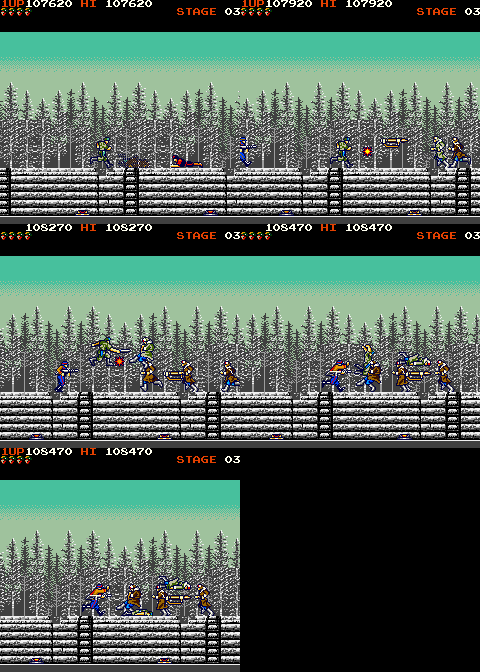
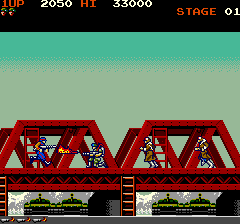
Rush'n Attack, known outside the U.S. as Green Beret, is often seen as a predecessor to Konami's Contra, and there are some strong similarities - you're a one-man army advancing through four side-scrolling stages of increasing difficulty, taking on countless enemies who can kill you in one hit but behave deterministically, emphasizing pattern memorization in order to make progress. Unlike Contra, though, weapons are scarce and temporary, forcing you to fight mainly with a knife, the enemies respawn aggressively and from all directions, and the act of jumping is an inertial commitment - you can forget about somersaulting through a hail of bullets while raining some death of your own from above. It actually plays much more like an earlier whale - Kung-Fu Master - which an anonymous commenter mentioned at the time I had played it.


Thankfully, Rush'n Attack is a lot more forgiving than its apparent inspiration despite the one-hit kills. Your knife is a good weapon - it's fast and has terrific range, and when you're surrounded you can often survive by wiggling the joystick and mashing the stab button a lot. Strict timing is not necessary. Enemies with ranged attacks have long delays between shots, ensuring you have a fair chance to rush'n attack them. Black enemies yield powerful, screen-clearing weapons, and the tricky parts where you'll want to use them are consistent. The game isn't by any means easy - I died multiple times on every stage until I learned enough to survive, but the difficulty feels reasonable and fair. Up until the fourth and final stage. Checkpoints are ample in every stage, but spare lives and opportunities to earn more of them aren't, and there are no continues.

In the below video, I use a single save state just before reaching stage four on a single life, so that I wouldn't have to keep replaying the first three. Even with this save state, completing level four took me just as many attempts as reaching it did.


Stage 1 is pretty easy once you've grasped the controls. Brown soldiers happily run headlong into your knife one-by-one. Machine-gunners spawn from the left but aren't too trigger-happy yet; best when you see one to turn around and stab before he gets a chance to shoot you in the back. Caution is better than reckless aggression, now and always. Black powerup-bearing enemies are ample but largely unnecessary.


A mortar-launching soldier guards the stage midpoint, and acts as an areal-denial weapon; the mortar has a fixed range, but launches in a parabolic arc that will hit you if you try to just walk over him. Luckily it takes him several seconds to reload - better learn how to dodge the shot and stab his face, because this is the easiest mortar guy you'll ever face.


Soon after, there's missile trucks, which you'll need to climb up on in order to avoid the land mines below. Rush'n Attack often gives you two or more paths separated by ladders, and more often than not, the upper path is safer.

At the end, a truckful of soldiers mobs you, including a jump-kicker or two, who will certainly end your life if you aren't ready.

But I was ready.

Next there's the harbor.


For the most part this is more of the same. Machine-gunners are quicker to shoot at you now, and you'll face rocket launchers too, but you can duck under them no problem - the only maybe tricky part is stabbing runners from both directions while prone. Jump-kickers show up every now and then, and some even parachute in from above, but they're not common yet. Land mines will force you to take higher levels, but this is generally safer anyway.

Advance carefully, being sure to push forward only when you know you can deal with whatever might be ahead, and you'll be fine. There is an invisible time limit, revealed only by an alert when you're cutting it close, but I only saw this alert once.

At the end, you face packs of dogs, who will probably kill you the first time or two, but once you know their pattern, you can't lose.


Stage 3 - the bridge - is much harder.


Right from the start you have to deal with a battery of zone-denying mortars while being rushed from all directions, including the dreaded karate commies. Black enemies drop grenade pickups, which are powerful but trickier to use than flamethrowers or bazookas.

Now, you really do need to save your weapons for the tricky parts. The jump-kicking are good targets - they were responsible for the majority of my deaths, as it's easy to forget to jump-stab them when there's so much chaos, and even when you do, jumping here is a momentum commitment that can get you killed on the descent.


You can also bait them into jumping early, but this is risky if anyone's pursuing you.


The boss here is a squad of autogyros. If you brought a spare bazooka, this is a piece of cake. If not, good luck.


Finally, Rush'n Attack pulls out the stops with its last stage - the army base. Nearly twice as long as any stage before it and stuffed with every variety of soldier and every possible combination, you'd better have a full complement of spare lives and a bit of luck.

You're safer on the mid-level, usually.

Two mortars - a good place for a grenade.

Did I mention grenades are powerful?

Sometimes the higher level isn't safer.
 
Oh, that's not fair!

Stand and I eat a bullet. Stay prone and I eat a boot.

Landmines and mortars guard the prison wall. You don't have many opportunities to advance.

Bazooka beats mortar. Easily.


The final boss here is a flamethrower unit, and compared to the grueling stage that they terminate, they are not too bad.

The first time I even reached them, I had one spare life left, and died almost immediately.


But on my second try, when I knew what was coming, I beat them easily.


Then it loops back to the first stage with a harder difficulty setting, where I didn't last long. But I'm satisfied.


GAB rating: Good. I was a little surprised, but I liked this one! It's not Konami's most ambitious game to date - that would be Gradius - but Rush'n Attack balances the challenging-but-fair design ethos and feels good to play, and manages to not feel overly monotonous either thanks to varied stage design and enemy attack patterns. I've heard it described as a proto-Contra, which isn't totally wrong, but sells the game short - the experience was enjoyable in its own right and didn't just make me wish I was playing Contra instead.

Most popular posts