The spies are at it again! Mutually shot down over a volcanic island, only one of them can complete the mission - to recover a lost missile - and escape by submarine, leaving the other marooned.
As the missile comes in three parts and they are scattered around the island, there's a good chance the other guy will locate one or two of them, and you'll need to find a way to relieve him of it. Booby traps are the way to go, but this time, they must be crafted from materials recovered on site - vines, sharp sticks, coconuts, and jet fuel.
As with the first game, I played a few rounds of the original Commodore 64 version (via VICE) with "R," and found The Island Caper a general improvement from the first game, though not without some issues. It's certainly a less confusing game - this time there's no question about whether you possess the missile parts or not, though you still need the manual to clarify some of the finer control points - the one-button, context-sensitive interface has different actions for "bury," "drop," and "put away," and some of the traps can be complicated to set up, especially snares and punji pits.
There are seven islands to play on, in ascending order of size and complexity, but the largest still felt a bit too small, so all of the recorded matches were on it. I play white, "R" plays black. I won most of the matches, but the last one ends in a dramatic volcanic eruption stalemate.
The spies are tougher than before, with long health bars and health regeneration, but this time, dead means dead. The island's natural hazards, quicksand and sharks, are more damaging than almost anything your foe can do to you.
Combat is crap, and that's actually a good thing, because it encourages using traps! It takes forever to kill your opponent with a cane, and it's not too hard for a losing opponent to evade and regenerate. Even if you find a gun, you'll probably run out of bullets before your foe dies, unless he was low on health to begin with. Booby traps, on the other hand, don't always kill, but they do always cause your opponent to drop what they were carrying. And if you can grab it and flee, you're well on your way to victory. If you can correctly guess which side of the island the submarine is moored at.
It's a better designed game than the first one, but it's still a bit limiting. In most games, both spies are going to locate at least one missile part - then what? You could track him down and kill him in combat, but the game really doesn't want you to do that except as a last resort. You could bury your missile pieces and place a bunch of traps and wait, but if both spies do that, then you're deadlocked until one of you breaks, and whoever does that will have to contend with their own traps. Finding a gun can turn the tide in favor of aggression, but it's not a foolproof strategy - the gun is rarely enough to kill, it tends to jam, being full of sand and all, there's no way to draw it when the enemy is already in sight, and searching for it gives your opponent plenty of opportunity to trap your critical path. Or swipe your missile parts.
Incidentally, the AI is horrid and not worth playing against. At level 5, it is essentially impossible to beat in direct combat, but too stupid to maneuver around your corpse after it kills you. I won by letting it collect and assemble the missile and waiting by the beach with a napalm trap, which it triggered, letting me grab the missile and flee to the submarine, and freedom.
GAB rating: Above average. Better than the first, no question, but it needed to be a little bit deeper in order to really accomplish what it was going for.
I remember way back in 1990 renting a manualless copy of Spy vs. Spy for the NES and wondering just how you were supposed to play this weird split-screen game. I'd make my spy walk around a bunch of rooms, pushing stuff like paintings and bookcases. Sometimes he'd find a briefcase, sometimes his face would turn blue and then he'd explode, and sometimes the black spy would enter and we'd beat each other with canes. But I had no idea how to win.
Nearly a decade later, I played an expanded port on Gameboy Color, and thanks to the ingame tutorials, everything made perfect sense in retrospect - the titular spies are searching a maze-like embassy for a bunch of hidden items - the secret plans, a passport, a wad of cash, a key, and most importantly of all, a briefcase to hold them in. Since you need all of the items to win, and your rival is likely to acquire at least one thing before you do, you'll need to kill him to get it back, and this may be accomplished by strategically placing booby traps, or by simply bashing his head in. Your rival, meanwhile, will try to do the same to you.
Now, in 2022, I'm trying the original Commodore 64 version of the game, armed with knowledge of how things work. And I'm wondering just how you're supposed to play this weird split-screen game.
Typical gameplay. Icons to the right represent items located, but not necessarily items possessed, as I'm about to unpleasantly discover.
A lot of the confusion comes down to some interface quirks, most irritating of all that doing just about anything - placing traps, checking the map, searching an empty container, just pressing a button when you aren't standing on the exact pixel necessary to interact with a thing, fighting, etc. - causes whatever object(s) you are holding to be dropped and become hidden somewhere in the room. If you aren't yet used to this, you might not even realize that you dropped your briefcase some rooms back. I played a few rounds with "R," and while we eventually came to grips with the interface, we never really got a sense of how to play with strategy.
What becomes clear very quickly is that goals revolve around who has the briefcase, as this is the only player who can hold more than one item. Have the briefcase? Then your goal is to find everything else, likely having to kill the other player for the last item. Don't have the briefcase? Then your goal is to kill the other player for it, perhaps by booby trapping an item they need.
Your arsenal of traps include bombs and springs, which are hidden inside furniture and sprung on the victim searching them, buckets of water placed on doors which fall on and electrocute (?) the spy who opens them, gun traps which are placed in furniture before being wired to a door but for all intents and purposes function as a door trap, and time bombs, which just explode and kill anyone in the room after a brief interval. Tools to bypass all of these traps except the time bomb can be found throughout the embassy, but taking one causes you to discard your inventory. Watching your opponent's screen is necessary in order to strategize, and the manual encourages this, rather than denounce it as cheating.
Black spy wiring up a gun trap
In practice, these traps didn't get used very much. The "trapulator" interface is slow and cumbersome, costing you time instead of buying it for you, and it's not made completely clear when a booby trap is set correctly, which would lead to to backfiring traps when we assumed it failed and set it again, only to discover it was set right the first time as it blew up in our faces. And if you plant a trap to create a problem for your opponent, and he doesn't spring or disarm it, then it becomes a problem for you later on, since both of you have the same goals. Victory generally came down to button mashy stick fights, initiated whenever both spies enter the same room, and I usually won, transferring ownership of the items to me.
The black spy futilely blocks my escape with a stick.
If the better stick fighter isn't you, then I'm not really sure how big brain play will help you either. Even if you manage to trick your rival into springing a trap, and manage to snatch up the items dropped during the few seconds he's out cold (itself no sure thing as dead spies respawn quickly and he might still spawn closer than you to the bounty), you're bound to cross paths again and just lose them back to him.
But let's say you are the better stick fighter, your rival knows it, and has ran away like the coward he is, turning the rooms in his wake into a funhouse of traps. You could force a win by simply waiting out the timer with the briefcase (or any other item) in hand, engaging in fights when possible to make his tick down that much faster.
I didn't get a chance to play enough two-player mode to really test this theory, but it held up in singleplayer. The AI at IQ level 4/5 is easily beaten by brute force on the most difficult maze. At IQ 5/5, it is an invincible fight master who magically knows the location of the briefcase and every item and the final exit and will take the most efficient path to hit them all without fault. He might run into your traps, or even his own, but it doesn't matter because he'll just get up a few seconds later to hunt you down and take his stuff right back from your battered corpse before fleeing the embassy.
GAB rating: Average. This is yet another good idea with a poor execution. I'm a fan of Prohías' comic, as well as his body of satire, and
the game aspires to embody the spirit of his slapstick "joke and dagger" antics
and even his politics to the extent that the 8-bit 64KB format allows. First Star's designer Mike Riedel could have simply gotten away with copying a tried-and-true formula, say, Donkey Kong, and inserted the Spy vs Spy characters into it, but instead he came up with an original design that aims to capture the essence of the comic and its absurdist take on cold war espionage, with all of its plotting and scheming and doublecrossing, and undercurrents of the pointlessness of it all. I wanted to like it better, and I did enjoy the GBC version, but the C64 original lacks balance and polish.
I first heard of Boulder Dash in the mid-90's when Java games were all the rage on the Internet, and such a clone had been listed on a web ring. Ever a lover of puzzle games, this maze-digging, boulder-dropping, gem-collecting logic game grabbed my attention with its promise of creator-designed puzzles, and frustrated me with its arcade elements and chaotic yet deterministic falling boulders, but nevertheless, its manic and excessive style entertained me far more than the zen-like purity of the many Sokoban-style games available online had.
Thanks to time spent browsing Mobygames, I can better appreciate that Boulder Dash has its origins in a 1984 8-bit computer game, and thanks to DDG, I have a reason to play the original Atari version.
There are sixteen caves, designated 'A' through 'P', and following my rules permitting a save every half hour of play, I finished them all in seven segments. Sixteen levels might not sound like a lot compared to, say, Lode Runner's 150, but most of them are hard. And for reasons I'll explain later, I don't really feel like every death I suffered was completely my fault, though with practice and sheer muscle memory, I'm sure a single-segment run is doable. The game does seem to be aware of its high difficulty, and includes a level select function, so that you needn't beat fifteen levels in a row just to see the sixteenth. Unlike Lode Runner, a game that also offers one as you'd have to be insane to play it start to finish, you can't start at just any level - only caves 'A', 'E', 'I', and 'M' are selectable, and the rest have to be reached beating the preceding ones in the allotted tries. A good decision, I think, as it keeps the limited lives meaningful.
At first glance, things seems very much like Dig Dug with a character who looks like Waldo if he suffered a teleporter accident involving a carpenter ant. Its dirt-digging and boulder-dropping mechanics with a perspective that can't quite decide whether it's in profile or overhead are very reminiscent. Before long, it becomes clear that Boulder Dash is much more puzzle-oriented, and more resembles the somewhat obscure and enigmatic arcade game The Pit, whose earliest (and lost) incarnation predates all of these games.
Each level is a maze full of gems, boulders, and other interacting widgets, and the slightest dig can set off an avalanche of falling rocks or otherwise kick of a chain reaction that can totally rearrange the level layout, possibly opening paths to inaccessible veins, but may also block crucial passages off permanently, or trap you in a cave-in, or just drop a heavy boulder (or diamond, if the god of irony is bored) on your head. The physics are simple and for the most part deterministic, but it's the interactions between the many stage elements that makes it hard to predict what will happen, and challenging to find a solution.
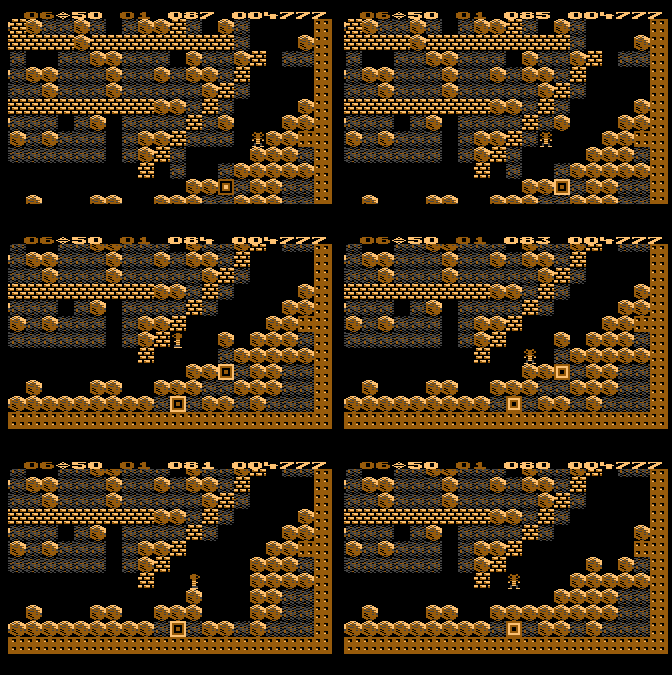
Clearing a path to the exit. It will open once I get enough gems.
There's an interesting comparison to Sokoban here, another tile-based puzzle game of similar vintage, and the differences are more interesting than the similarities. Both involve deterministic mechanics, creator-designed levels, and pushable objects. But Sokoban speaks to a much more minimalist design sensibility, apart from the set of levels with destructible walls (which later versions wisely removed). Sokoban, and Lode Runner too to some extent, are all about maximizing macro complexity with a minimal number of atomic building blocks. It is simple in Sokoban to predict what will happen in a single move - the challenge is predicting which actions won't screw you up several moves later, but the perfect information makes it possible.
Boulder Dash, being as far from a zen-like minimalist design as Ontario is from Japan, has as many gadgets, traps, and baddies as they could fit into the baseline 32KB of memory and often doesn't give you time to consider the full extent of what pushing a single boulder might do. Often, the affected portion of the stage is much larger than what can be shown on the screen. Making a mad dash through a gauntlet of boulders and hoping they dislodge and pile up in a favorable way is frequently a viable tactic, if you have nimble fingers.
Speaking of which, Boulder Dash's biggest flaw is that the controls can be laggy, and this got me killed about as often as my own carelessness did. Sometimes Rockford reacts immediately to your input, and sometimes you need to hold the joystick position for a fraction of a second before he acts. But sometimes he moves two spaces instead of one because, in anticipation of lag, you hold the joystick for a fraction second, and he moves immediately. It is infuriating to plan out a three-step hop and skip where you tunnel under a boulder, dig down, and move out out the way, only for that crucial last step to fail and your run ends with a rock on your head. In spite of this, doing long, serpentine dances through winding tunnels is pretty doable and responsive if you can find the rhythm - it was the short maneuvers of one to three spaces that often failed.
What I think is going on is that approximately every 150ms, the engine polls your joystick and then moves Rockford one space in the direction it is pushed. Sometimes lightly tapping the joystick moves you one space, and sometimes it does nothing at all - if you tap it for less than 150ms, releasing it just before an input tick, then nothing happens. But if you keep it held a bit longer, just to ensure Rockford does move then you risk moving two spaces in the event that an input tick happens immediately and a second one occurs 150ms after that. I believe some form of input buffering would have gone a long way toward improving Rockford's controls.
That said, Boulder Dash's puzzles lend themselves incredibly well to having a variety of solutions, and I'm sure that a skilled and dedicated player could find ones that minimize these risks and execute them reliably enough to complete all sixteen caves in a single session, if not a single life. My approach, in which I'd stubbornly stick with any solution until I made it work, would take a lot more practice and muscle memory to go start to finish like that, but nevertheless, I can't help but feel a bit angry when flawed controls get me killed.
Caves 'A' and 'B' are pretty simple - the first is a wide and linear path of dirt without too many boulders, and the second is grid of small cells, one of which holds a deadly firefly that you needn't disturb. But cave 'C' introduces a huge difficulty spike - not only did I lose my first life here, but I ran out of lives repeatedly, having to restart the game each time until my half hour was up, at which point I made my first save.
So many boulders occupying such narrow passages, and the ticking clock means you can't take your sweet time in clearing up all the maneuvering space you might want! Only 25% of the level is visible at any given moment too, so unless your visual memory is quite excellent, dislodging a set of boulders in one place could very well block off an important passage somewhere below, offscreen. Working your way from bottom to top seems safe, but there's never enough time to be as methodical as one might wish.
Cave 'D' introduces butterflies who patrol the cavern in a predictable right-hand rule pattern. They are deadly to touch but explode and release diamonds when killed. It's an easy level, though it pays to plan your moves so that the sometimes tricky input timing works for you rather than against you. Since they follow the right-hand wall, it's easier to kill them as they ascend a wall on the right than as they descend one on the left. When gathering, don't make the mistake, as I repeatedly did, of forgetting that diamonds can fall and kill you just as easily as boulders - snatch them from the top of the pile, not the bottom.
After every four caves is a bonus round, a chance to earn an extra life. This first one is a simple test of timing.
Cave 'E' reintroduces fireflies, but now you have no choice but to contend with them. Fireflies are left-hand wall followers, and explode when killed, but leave no diamonds when killed. It's not a particularly challenging level as long as you enter each pocket from the right.
Pockets of fireflies and diamonds flank a basin of dirt and boulders in cave 'F'. You've got to free at least four of them, and have a plan to kill or evade them as you snatch the diamonds and run for the exit.
As you enter cave 'G', you'll hear strange bubbling noises. This is the amoeba, which is nonlethal (to you) but will grow uncontrollably, and if it reaches critical mass, explodes into a mass of boulders. Explore as you might, there aren't enough gems to be found here to reach your quota.
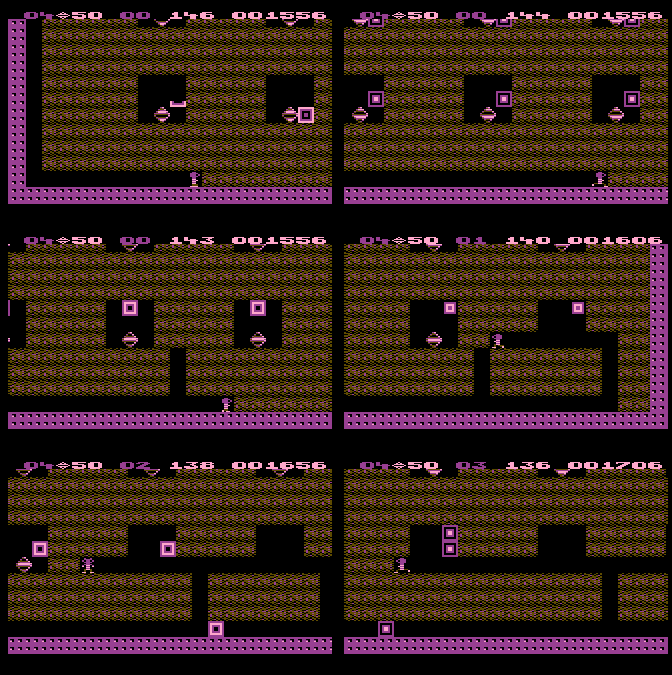
The trick, mentioned in the manual, is to trap the amoeba with boulders on all sides except one, leaving a tiny opening where Rockford will be positioned. Once it grows into the entire space, it will suffocate and turn into diamonds, and you'll be poised to enter its husk and collect them.
Cave 'H' features a magic wall that transforms boulders into gems, but it won't reveal itself until you trigger it, and it doesn't last long - you've got to drop ten boulders on it and ensure there's space below for the diamonds before it reverts to a normal wall. It's an easy level when you know where it is, but the first time you're likely to trigger it by accident and then run out of time.
Cave 'I' has massive veins diamonds overhanging two big empty wells and expects you to collect a whopping 75 of them. But you could run out of time waiting for everything to drain. Be efficient and "unplug" both dirt stoppers at once.
'K' is a pretty nasty maze, impossibly dense with boulders. It takes trial and error to find a way through that gets all of the diamonds without trapping yourself.
Cave 'L' is another that you are unlikely to finish on your first attempt. If you're like me, you won't notice the hermetically-sealed rooms to the right of your starting position, and tunnel up and to the right over them. Then, when you reach the other side, and see fireflies trapped in pockets of dirt, you'll realize the real challenge is freeing them, not getting killed by them, and crushing them against the walls of these rooms with boulders. Then, if you're like me, you'll try to do that, open their prisons up willy-nilly and try to smash them with the nearest boulder, and probably fail repeatedly and get frustrated. But if you're smarter, you can make this task much easier by planning ahead.
The amoeba returns in cave 'M', and this time it hangs from the ceiling and can't be buried under rocks like before. But a colony of butterflies, if properly manipulated so that they reach it, will explode and yield showers of diamonds. Don't forget that they too can crush you.
Cave 'N' has a simple problem. Six butterflies, six boulders, each one freeing a firefly when dropped. You only need to kill four of the butterflies to get enough gems, and the fireflies can be dealt with by carefully digging mazes for them to get lost in. It's a very open-ended level that probably has a lot of room for discovering creative solutions.
Cave 'O' is the penultimate stage, and appears to be bereft of gems, until you discover that it has another one of those magic walls that turns boulders into diamonds. Once you know this, the stage isn't all that difficult - just dig plenty of space below the wall, then prime a landslide above the wall without triggering it prematurely, and let it all out - if your landslide is big enough, the magic wall should function for just long enough to transform the 15 required boulders. Just don't accidentally bury the exit under the boulders like I did.
DAMNIT.
Finally, there's cave 'P,' appropriately the most difficult cave in the game.
Arghh, it's another magic wall stage! This time, you've got to dig out the fireflies, blow them up to destroy the walls so that you can get inside the two pockets of dirt, clear it out, and then quickly drop rocks onto both of them at once. There are a lot of ways you can screw it up, and once again, if getting the timing right is overly tricky, you'd do well to try to figure out another approach. I, being more stubborn than smart, figured this out eventually, but not before countless frustrating retries.
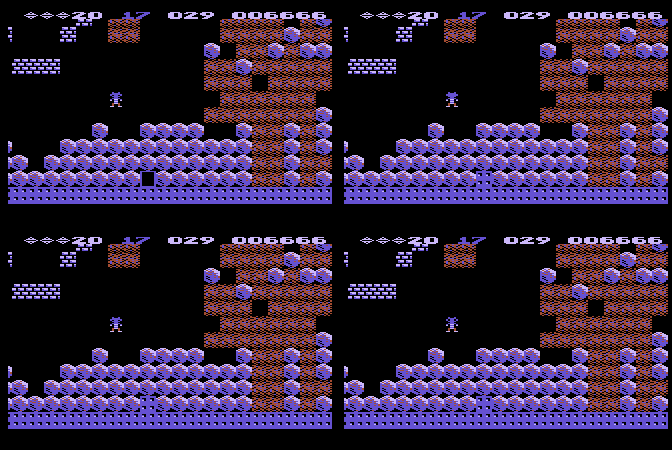
There's a bonus round afterward that plays a cruel trick with yet more magic wall shenanigans, but at this point I was past caring.
The game then returns you to cave 'A' and increases the difficulty by raising the gameplay speed and lowering your time, and this repeats up to a maximum of level 5, at which point it just loops infinitely. But I'm okay with not doing that.
GAB rating: Good. Despite my misgivings about the controls, and the sheer frustration of suffering the resulting failures, I like this game as much as its Java clones, if not more so. Puzzling out solutions was fun, executing them properly was satisfying, and aside from the spike in cave C, Boulder Dash is paced really well, introducing new concepts every few levels, building on them in subsequent ones, and ending before wearing out its welcome. I have no doubt that the included levels have only begun to explore the puzzle possibilities, which I think is proven by the sheer number of hacked pirate versions offering homemade level sets, not to mention all of its clones, of both commercial and shareware distribution.
First Star would release a level pack sequel in 1985, and in 1986, an official level editor titled Boulder Dash Construction Kit, alongside an obscure third game which featured a sci-fi setting and saw no release outside of Europe. Later releases would include remakes on NES and Game Boy, an arcade version and sequel, releases for XBox Live Arcade, mobile, handhelds, and most recently, a Boulder Dash Deluxe simultaneously released on Steam and Atari 2600, the latter in a very scaled-down but somehow functional form.
Coming up next in the whale watch is Boulder Dash, one of two games that its developer First Star Software is best known for. The other, Spy vs Spy, appears later the same year. This post concerns the earliest games by First Star's most directly involved founder, Fernando Herrera.
Scan by Atarimania
With a background in architecture and industrial engineering, Herrera was an early adopter of Atari computers, quickly learning how to write software, which he published through Swifty Software, a one-man publishing house operating as a Long Island schoolteacher's side hustle. First creating programmer's tools, and then a vector-based graphics editor, the program that caught Atari's attention and kickstarted his career was My First Alphabet, a BASIC program that he originally wrote for his 3 year old son, who had suffered from cataracts since birth. My First Alphabet was added to the APX catalog in late 1981, and won the first Atari Star Award, a quarterly cash prize of $25,000 awarded in recognition of the best submission to the catalog. With this award came publicity, prestige, more sales, and inspired the namesake of the company Herrera would soon found.
And ass-kissing.
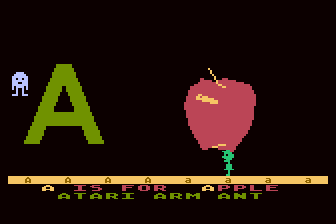
As for My First Alphabet, there's not much point in evaluating it with a critical eye. The engine draws pictures of things line-by-line, in the same style as Sierra's adventures, and prompts you to type the letter that the thing begins with. Sometimes, instead of letters, you have to count glasses of milk and type the corresponding number key. Correct keypresses are rewarded with shows of color and music. Some children's software holds adult appeal, but this one doesn't, and I can't imagine it impressing any toddlers today.
One curiosity is that the main menu holds a "graphics editor" option, which prompts you to insert disk 2. The original release through Swifty Software would have come with this disk, and the APX catalog sold it separately, but alas, neither version has been dumped, so it remains unavailable.
My First Alphabet was re-released as a regular Atari product the following year, and this version features mostly different pictures and things - for instance, instead of an apple, there's an animated airplane, instead of counting glasses of milk, you count clowns, and the "graphics editor" option is removed.
In 1982, Herrera submitted one of his games from Swifty's arcade lineup to APX, to less acclaim, but perhaps more substance for the modern gamer to digest.
Game 291: Space Chase
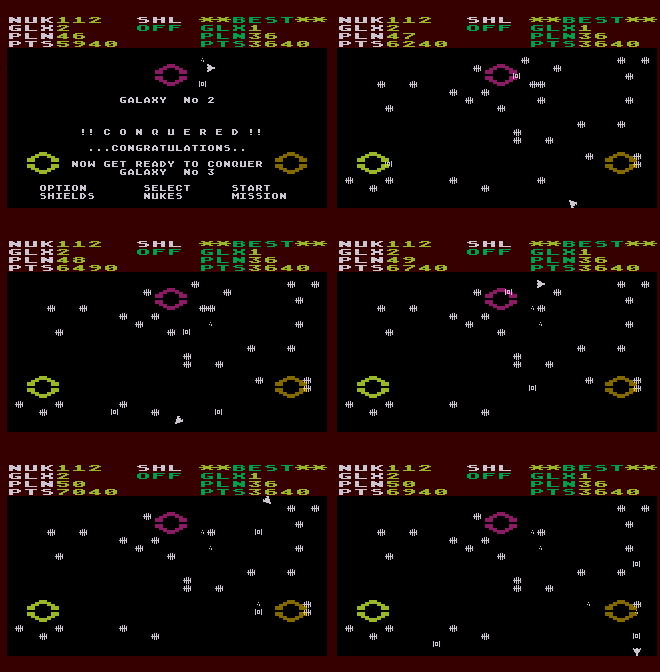
For a change of pace, your goal is to conquer the galaxy rather than to save it. To do this, you fly your ship over every planet in the galaxy while chased by pursuing TIE fighters, and if one of them touches you, then as the game says, only cosmic dust will be left. You can get them off your tail by dropping nuke mines, but they respawn infinitely. In most cases, it's better to fly off the edge of the screen and wrap around to the other side, forcing them to approach you by the long route. Planets may also be destroyed by accidentally or purposefully allowing TIE Fighters to fly over them, which removes them from the screen but also denies you points for conquering them.
In between levels, you can restock nukes, setting your stock to either 125, 25, 5, or 1, but I can't see much reason why you'd want to set it to anything but 125, even if they aren't all that useful. You may also turn your shields on and off, but all your shields do is protect you from your own nukes, while also cutting your points earned in half. I don't think I ever touched my own nukes even once.
GAB rating: Below average, and that's generous. Space Chase is amateurish stuff, too simple to sustain interest for long, and looks and plays pretty rough. But I've seen worse, even from professional channels.
Later that year, Herrera partnered with Hollywood producers Richard Spitalny and Billy Blake, and founded First Star Software, a name referencing Atari's Star Award.
Game 292: Astro Chase
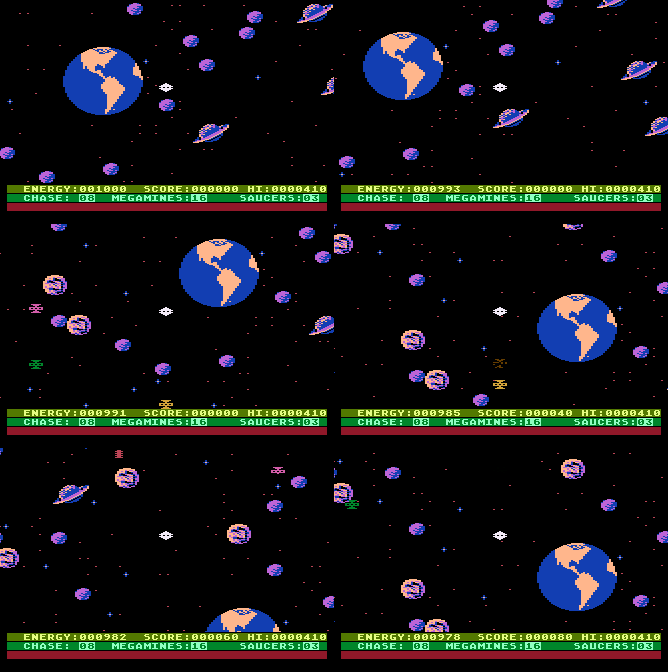
SINGLE THRUST PROPULSION could cause a minor revolution in programming video games and computer games, boasts the back of the box. What does it mean? It means you can move in one direction while shooting in another, but it also means you have no way to make your ship stop moving, ever. Robotron: 2084 did the same thing much more elegantly the same year, and didn't feel the need to self-aggrandize the feature or even call attention to it, simply allowing the dual joystick' labels to inform you of their respective purposes.
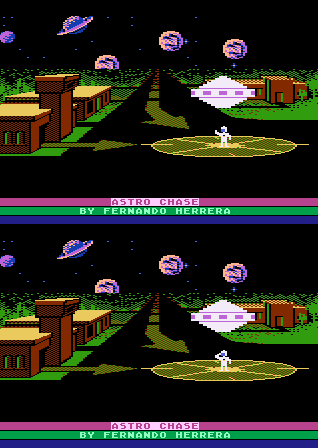
Astro Chase certainly looks nice, anyway. You couldn't beat the Atari for color depth until several years after its release, and Herrera puts it to good use in a way that isn't comparable to anything I've seen from its era, even in arcades. Cut-scenes in between sets of waves return you to earth, where ticker-tape parades may or may not march in your honor, depending on how far you get.
The game plays like a multi-scrolling but otherwise simplified Defender, where you have to protect the earth from 32 waves of Mega Mines and increasingly powerful interceptors. You can start on any wave from 1 to 24, but if you really want to win, you'll need to start on the easiest rounds to rack up as many extra lives as possible. That said, if even one mine gets through, the earth is destroyed and you lose them all.
Navigating the stage can be pretty frustrating, as an invisible force-field keeps you from straying far from earth, which is a good thing, but the fact that it's invisible means you get bounced back without warning while trying to pursue a mine just out of reach. Equally frustrating are the difficult to spot stars, which serve as obstacles even though perspective rules would dictate that they are several astronomical units away from the plane of action.
Energy is limited but replenishable in a suitably annoying way - refuelling stations placed in the far corners of the playing field mean you risk Terran annihilation by merely visiting them, and the longer you stand by, filling up your reserves, the more you risk the earth's destruction in your absence. Better to refuel at the end of a wave when there's only one mine left and you have some idea of where it is. You can get virtually unlimited energy, but one hit from an enemy and you lose it all except for the standard 1000 units that you'll always spawn with.
GAB rating: Average. Ultimately, Astro Chase didn't entertain me nearly enough to stick with it all the way to the end, and the twitchy controls and odd gameplay mechanics made for a bit of a learning curve, but I did have some fun for the brief period of time between getting its controls and exhausting its gameplay possibilities.
Coming up next is Boulder Dash, the first game of 1984 that I'm genuinely excited to play for the first time.