Showing posts with label Llamasoft. Show all posts

Saturday, May 16, 2020

Games 188-189: Andes Attack & Gridrunner

Download Jeff Minter's back catalog, including both of these VIC-20 titles on the "Llamasoft Baachive."
https://llamasoftarchive.org/systems/commodore-vic20/

Llamasoft's founding coincided with Minter's purchase of a shiny new Commodore VIC-20. Intended as a budget personal computer with game-specific features, the VIC-20 was the best-selling computer system in its day. Nowadays, the Apple II, Atari 800, and of course its successor the Commodore 64 completely overshadow it. With only 3.5KB of available RAM and only one video mode, which is essentially a hacked 22-column color text display, the VIC-20 seems weak compared to the much more expensive Apple II. However, Minter was coming from the ZX81, which was incapable of displaying anything but monochrome text in the system ROM font, and merely outputting a video signal was such a strain that programs often deliberately shut off the video signal when it wasn't absolutely needed just to speed up program execution. The fact that the VIC-20 had any dedicated video capability must have made it seem like a gaming powerhouse in comparison.

Like the ZX81, the VIC-20 technically can only display text, and only in an 8x8 monospace font, though it has access to 8 foreground colors and can assign each individual character cell any one of these colors, which is something other computers of the time couldn't do. Graphics work by redefining text character bitmaps, and the results are similar to arcade games' tiled graphics.

No sprites or sub-tile scrolling though.


That's a screenshot of the first ever Llamasoft game.

Game 188: Andes Attack

I used VICE to play this game, and in order for it to work, you must enable the 8KB memory expansion option, found under Settings->Settings->Machine->Model. After that you can just smart-attach the PRG file and then type "RUN."


The original cassette version had a loading screen, which is skipped over when directly loading the PRG.


After about two minutes, the game would start proper.


It sucks. It's like an extremely stripped-down version of Defender, with unresponsive controls, ugly, flickering visuals, bad play mechanics, and llamas instead of people. Sometimes your shots pass right through their targets, sometimes landers spawn right in front of you and you blow up before you even notice they're there, and overall I had more fun configuring my OBS settings than I did playing this game.

If you actually want to play this, know that although it controls primarily with the joystick, there are also some keyboard controls. F1 changes difficulty, and F8 fires smart bombs.

GAB rating: Bad. 

Game 189: Gridrunner

Minter's most famous game, and the whole reason for doing this early Jeff Minter retrospective, was also originally designed for the VIC-20, but soon ported to the C64, Atari 400, ZX Spectrum, and Dragon computers. Commodore 64 was probably the most popular platform, but I'll be playing the original VIC-20 version.

To play in VICE, you must not enable any memory expansion. Any memory expansion will prevent the game from loading.


Gridrunner feels a lot like a second attempt at making Centipede, but it works better this time. Minter's Centipede and Andes Attack both operated on a chunky grid system, and suffered in comparison to their arcade game counterparts. Gridrunner embraces this format - the game's called Gridrunner for crying out loud, and proudly puts its grid on full display. Everything in the game - you, your shots, the centipede segments - exist on discrete points on this grid, at the exact points where the lines intersect. Andes Attack felt choppy, but Gridrunner feels fast - faster than Atari's Centipede.


Gridrunner is still stripped down compared to Atari's Centipede, lacking any enemies other than the segmented things that zig-zag down to the bottom row, but there are a few tricks unique to this game. Most notably are the two turrets on the grid's X-Y axes constantly moving in a scanning pattern. The vertical turret doesn't directly threaten you and only fires obstacles onto the grid, though some of these obstacles will eventually come crashing down if not shot out of the way first, changing into a black diamond pattern first. The horizontal turret will periodically fire an electric blast, killing you instantly if you happen to be on its longitudinal line, but will also kill centipede segments. It's difficult to predict exactly where and when it will fire, but you can stay safe by staying to its right until it fires, and slipping past it immediately after. Doing this consistently when your attention is divided is still very difficult, though.

GAB rating: Above Average. Definitely Minter's best early game, Gridrunner looks and sounds really good considering the system's limits, and its fast-paced, sensory-overloading gameplay is addictive as anything on contemporary systems. Gridrunner isn't perfect - collision detection can be spotty, getting zapped right out of the gate is a frustrating and random occurrence, and centipede behavior can be unpredictable when the obstacles get dense enough. The gameplay is simplistic, relying more on speed and reaction times than I find ideal. Nevertheless, it kept me amused for a good hour and a half as I felt compelled to keep topping my score, and I'm sure that if I had been limited to the VIC's 1982 library, this would be one of my most played games of it.

Gridrunner was a hit, and would be followed up with successors like Attack of the Mutant Camels and Voidrunner, and in the 21st century received Windows reboots Gridrunner++, Gridrunner Revolution, and ports to iOS. We'll be moving on, though - only the original Gridrunner made whale status, and we won't be seeing Llamasoft again until the very distant future of 1994.

Thursday, May 14, 2020

Games 186-187: Centipede (ZX81) & 3D! 3D!

Download Jeff Minter's back catalog, including both of these ZX81 titles on the "Llamasoft Baachive":
https://llamasoftarchive.org/systems/sinclair-zx81/

If you've ever heard of Jeff Minter, you know that ruminating ungulates are his thing. He founded and continues to operate Llamasoft Ltd., references his favorite animal kingdom order in his games constantly, often goes by the handle Yak, etc.

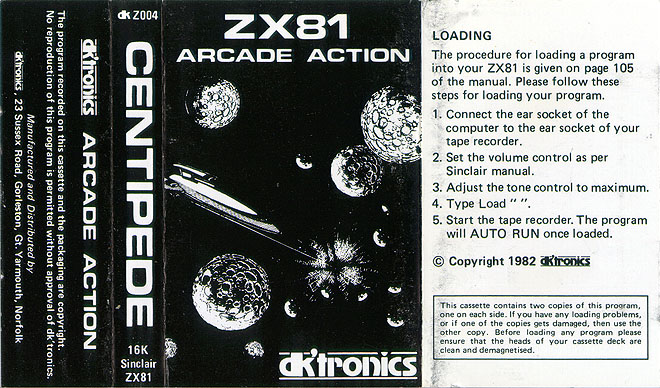
Cover of the first release of Minter's Centipede, not featuring any centipedes.


1982 re-release, now with artwork, still not featuring any centipedes.


Perfect!
(all scans provided by zx81stuff.org.uk)


Before founding Llamasoft, a developing house which at first focused on creating Commodore VIC-20 games, Minter's earliest commercial releases were through dk'tronics and released on the ZX81, a budget computer that I touched upon briefly with my post on Football Manager, and one that makes the VIC-20 look luxurious in comparison.

Game 186: Centipede

Finally, a friggin' centipede!


Supposedly, Minter programmed Centipede without playing the original, and I believe it, although its deficiencies as a Centipede port could just as easily be excused by the system's limitations. Without getting into too much technical detail, the ZX81 just seems inadequate for doing much of anything except running text-only BASIC programs (like Football Manager), and even then, only with a 16KB RAM upgrade - the stock 1KB isn't enough to hold 20 lines of code and display all of them on-screen at once!

As for Minter's Centipede, overall it plays more like Space Invaders than Centipede. You still face segmented invaders (who, unlike the original, fire shots back at you in later stages), but you can only fire one shot at a time, and you can only move left and right. Consequently, there's no strategy here - funneling the centipede is pointless thanks to the one shot limit, and once it reaches the bottom row, you're bug food.

The 420 reference was unintentional. Minter seems more like a shrooms guy anyway.


Controls are surprisingly responsive, but collision detection is spotty, and missed shots can act as barriers, bringing the centipedes ever-closer to the kill zone.

The game does offer instructions, and you can customize the starting speed, but the slowest is already difficult enough. The fastest is ludicrous.


GAB rating: Below Average. Here, I feel like context must be considered. Minter's Centipede plays poorly, but not offensively so, and was a budget title made for a budget computer. If I had lived in the U.K. in the early 80's, owned a ZX81, and was limited to the software available, I could see myself replaying this game, which is something I can't say about, say, Asteroids on the Atari VCS, or the much more expensive Apple Galaxian. As I'm not limited to the ZX81's library, I am happy to never touch this again.

Game 187: 3D! 3D!

Minter himself describes this other early effort as "a really bad 3D Maze game [...] balls-achingly slow making it pretty much impossible to play by creatures with metabolisms that run on a normal human timescale." Jolly.

3D! 3D! is exactly that. It's set in a randomly generated cube-shaped maze divided into 9 floors of 9x9 tiles, which you explore from a first person perspective. The controls are a bit counter-intuitive, giving you the ability to "look" in any of 6 directions and then "move" forward, but as Minter says, what mainly characterizes this game is its horrendously slow 3D drawing routine.


There's a "fast" mode and a "slow" mode, and it defaults to "slow." You may wonder, why even have a slow mode? Well, the ZX81's predecessor, the ZX80, was not designed to run a program and output a video signal at the same time. Typing characters into a BASIC prompt was excruciating, as the screen would flicker off with every single keystroke as your computer dedicated all of its CPU cycles to reading the keyboard input, fetching the corresponding byte, and writing it to the display RAM, and would only resume sending the video signal once this process finished. Clever programmers found ways around this by carefully timing program execution during the milliseconds when a video signal wasn't needed, but this wasn't efficient, and wasn't possible at all in BASIC mode. Recognizing this flaw while designing the ZX81, Sinclair Research added a "slow" mode capable of handling video and code execution at the same time, but, befitting the label, program execution is much slower in this mode.

ZEsarUX cheats by enabling video in the emulated "fast" mode, and this makes for a comparatively superior user experience.

"Comparatively."


With this option disabled, the screen in fast-mode simply shuts off until the 3D drawing routine completes, as it would on real hardware.


With this fast mode on, it took me about 40 minutes to find the exit to the maze, even with spending as much as 20 seconds per step, and a good part of that time was just spent coming to grips with the perspective and controls.


Overall I had explored very little of the maze; the path to the top was straightforward, some of the levels could be skipped entirely, and I never once had to descend a level.

Sample level map. Even this draws very slowly.


GAB rating: Bad. Minter is right in his description - this is a really bad game. If the 3D drawing routine had been fast, this would still have been nearly bereft of any interesting gameplay - the 3D aspect might have made it slightly exceptional, but the lenient random generation algorithm makes it essentially work out as nine easy 2D mazes instead of one challenging 3D maze, which would have been preferable if not for the slooooow drawing speed.

Most popular posts