Cinematronics nowadays is mostly known for producing Dragon’s Lair and Space Ace, but before that, they were a pioneer in vector arcade games, and likely an influence on Atari, whose subsequent use of vector graphics became a trademark of sorts. Cinematronics’ most successful vector game, Star Castle, is a known influence on our next whale Yars’ Revenge, which was conceived as a coversion but reworked to better fit the VCS’s capabilities.
Their earliest game listed on Mobygames is TV Pinball of 1975, and their earliest games mentioned on Wikipedia are Flipper Ball of 1976 and an unnamed Pong clone. None of these are emulated, but their first game of 1977 is.
A roadmap of the Cinematronics games I've selected to play, and their known or inferred influences:
Game 127: Embargo
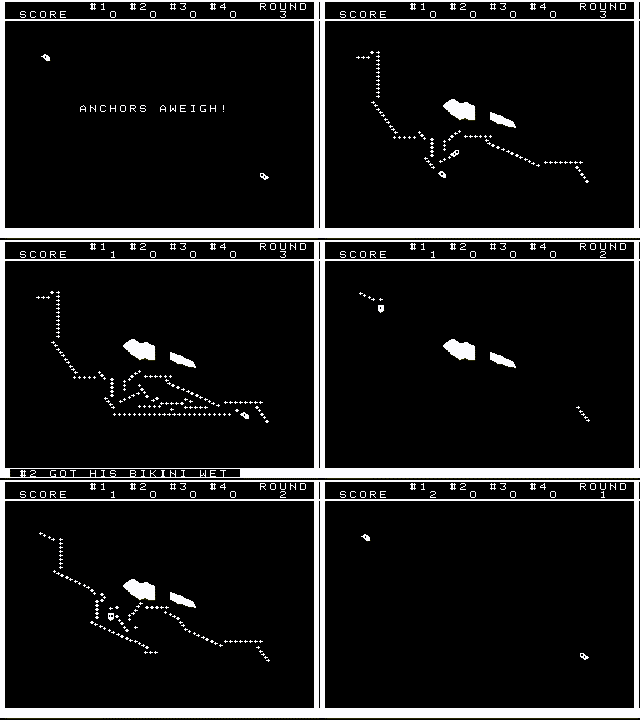
Cinematronics’ earliest emulated title and, according to Wikipedia, their first original design, is essentially a four-player Snake game with 12-direction movement. Two to four players steer boats around Cuba dropping a trail of sea mines, and score points whenever another boat sinks. I have to imagine Castro howling with laughter at the sight of these incompetent skippers blowing each other up in their attempt to form a blockade. The mine trail can be temporarily stopped with a button press, to strategically leave an opening for yourself to pass through. A round ends when there is one or no survivors remaining, and whoever has the most points after three rounds wins.
There is a one player mode that adds a single AI player, but the AI is really stupid.
Perfect emulation isn’t practical; the arcade cabinet was controlled with four dials, and I’ve only got one. Paddles won’t do it; you need 360 degree rotation. MAME also does not emulate any sound, though according to its emulation notes, the explosions on real hardware sound more like coughs.
My friend “R” and partner “D” played a few three-player rounds with me.
Everyone immediately noticed the Snake/TRON similarities, and enjoyed the game’s sarcastic remarks when a ship crashes (CAPTAIN #2 LOST HIS RUBBER DUCK / CAPTAIN #3 GOT HIS BIKINI WET), but we didn’t like the game all that much. Whether playing on gamepad or keyboard, we all found the controls overly sensitive, and MAME provided no happy medium between being too sensitive and too unresponsive. Left and right rotate the ship, but it’s very easy to oversteer right into your own trail of mines.
In the absence of proper controls, I’ll decline to rate this game, but I suspect it would at best make the difference between Bad and Below Average. For what it’s worth, I also tried playing solo with my spinner, and still found it difficult to control ship rotation accurately.
Game 128: Space Wars
An unapologetic conversion of SpaceWar down to the name, its designer Larry Rosenthal, an MIT alumnus, had long wished to create an inexpensive coin-operated conversion of that seminal PDP-1 game, and a deal with Cinematronics gave him that chance. Featuring a custom CPU and vector graphics hardware of his own design, Space Wars became the first commercial game with vector graphics, and Cinematronics’ first hit.
Space Wars has an unusual amount of customization for an arcade game. To start, there are ten game modes.
Beginner: No inertia, no gravity, slow ship speed
Beginner: No inertia, no gravity, fast ship speed
Beginner: No inertia, no gravity, very fast ship speed
Intermediate: Moderate inertia, fast ship speed
Intermediate: Moderate inertia, fast ship speed, faster missiles
Intermediate: Moderate inertia, very fast ship speed
Expert: Strong inertia, very slow ship speed
Expert: Strong inertia, slow ship speed
Expert: Strong inertia, fast ship speed
Expert: Strong inertia, fast ship speed, stronger gravity
In addition, there are five gameplay modifiers which can be individually turned on, but can’t be turned off!
Bounce back – Missiles and ships rebound when they hit the edge of the playfield
Expanded universe – The edge of the playfield extends a few inches past the edge of the screen
Black hole – Invisible sun
Negative gravity – The sun repels instead of pulling
No gravity – Negates mod 4 and mode 9. No effect on Beginner modes.
Unusually, tokens buy time rather than games. With default cabinet settings, each token inserted buys a minute of play, and coins can be inserted during play to extend play by the minute. But the only way to change modes or turn off the mods is to let the time run out, or reset the machine.
I played each of the ten base games with "B", ignoring the gameplay modifiers. I do feel like we rushed this a bit, but this is a strictly two player game, and I am limited by my friends’ available time and patience.
Game 0 – Beginner, slow ships
With no inertia or gravity, this game mode just isn’t very interesting at all, but I can see its use in helping new players come to grips with its controls. This was 1977, after all, nobody would have been familiar with Asteroids yet, and few consumers would have been familiar with SpaceWar or Computer Space.
Gameplay is quite a bit faster than SpaceWar, and the sound effects are kind of neat. Like SpaceWar, ships have limited fuel and torpedoes, but unlike SpaceWar, they are displayed on-screen, as is the score between rounds.
One addition is that sometimes, shots will blow chunks off your space ship instead of killing you outright. This can be pretty jarring; so little remains of a damaged ship that often neither of us realized that any of it had survived, until it dawned in on one of us that the round hadn’t ended. A few times, I blew so much off of “B”’s ship that nothing remained but a small fragment of the bow. He could do nothing but fire torpedoes, and still won as I carelessly flew into the sun.
Games 1-2: Beginner, fast/very fast ships
These modes still aren’t very interesting, only now they’re uncontrollable too. Without inertia, you instantly accelerate to your top speed as soon as you hit the thruster, which is too fast for normal human reactions. Rounds often ended with us crashing into each other. In the very fast mode we flew into our own torpedoes a few times.
Game 3: Intermediate, fast ships
With inertia and gravity, this now plays a lot more like SpaceWar but with a much more relaxed physics model, faster speed, and is better for it.
Interestingly, torpedoes are affected by the sun’s gravity, which was something they wanted to do in SpaceWar but couldn’t as it strained the computer too much.
I tried gravity whipping around the sun, but this usually failed, and with the relatively lax inertia in the intermediate modes, this technique is probably not that useful.
Game 4: Intermediate, fast missiles
Ship speed is the same as in mode 3, but with faster-moving missiles, which bend as they enter the star’s gravitational field, it quickly becomes very chaotic, with torpedoes flying at high speeds in multiple directions.
Game 5: Intermediate, very fast ships
Here, it’s necessary to use restraint to avoid overthrottling, or else the game becomes even more uncontrollable than the beginner’s fastest mode, as there you could at least stop instantly. But at least in these modes you have some control over the ship speed.
We didn’t enjoy this game mode as much as the slower intermediate modes.
Games 6-9: Expert
These were our favorite game modes. The slower speeds allowed thoughtfulness, and the stronger inertia made it necessary. Even at the slowest speed, it’s still faster than SpaceWar and with more relaxed physics, and the sun’s gravity still only affects you when you’re fairly close to it.
The powerful inertia did make modes 6-8 difficult to distinguish, as even with a fast top speed, it takes a lot of thrust to reach it, making for a slower paced game at any setting.
The final game mode increases the sun’s gravitational strength, and makes slingshotting your torpedoes more effective than usual. The field is still fairly small compared to the one in SpaceWar, even in this mode.
GAB rating: Above Average. Space Wars’ true legacy to gaming was its use of vector graphics. As a game, I think this was an overall improvement on the SpaceWar formula, more polished, more accessible, and speedier than the original. “B” and I spent a lot more time shooting at each other than avoiding the sun, which is good thing in our books. I regret that our playthrough was a bit rushed – I definitely think this merited some additional playing time.
According to an unsourced statement at arcade-history.com, Atari tried to license Space Wars, but Cinematronics refused, and when Atari released their own vector-based Asteroids to massive acclaim and success, Cinematronics unsuccessfully sued for patent infringement. I can’t really see Cinematronics’ case here – both companies had copied the 1962 SpaceWar design, and Atari did it first with Computer Space, but Cinematronics did it more completely. But I’ll be damned if that asteroid sprite doesn’t look oddly familiar.
Game 129: Starhawk
After the success of Space Wars, a dispute between Rosenthal and Cinematronics led Rosenthal to sell his technology to the company, who produced several more games using his technology.
Starting the game up, I was immediately reminded of a certain low budget indie film of the late 70’s.
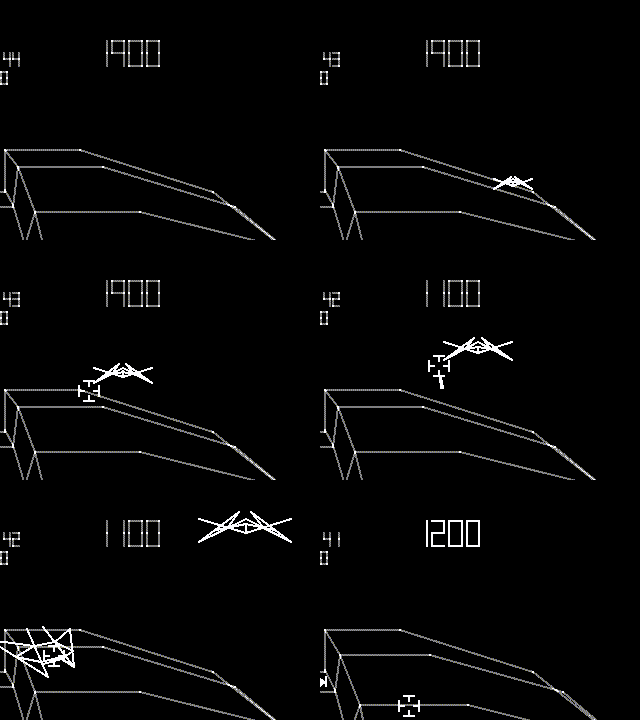
All you do in this game is shoot vector space ships by aiming your crosshairs over them and firing. It feels weird that in a vector space shooting game, the enemy ships aren’t actually 3D objects, but flat, static 2D sprites that use their vectors for no effect except to seamlessly grow or shrink to create the illusion of flying toward or away from the player. There is no other sense of 3D perspective except in the animated background and in your laser shots.
There is no analog control, but instead there are three selectable crosshair movement speeds. I didn’t find the slow movement necessary; medium was precise enough. Fast was too imprecise, and switching from fast to medium was too distracting. I did discover pretty soon that your shots are guided; they keep following your crosshair movement during their flight, which makes leading your shots much easier. The strategy becomes firing early without needing to also aim early.
Only one of the targets will shoot back; a “command ship” has a quick but predictable attack pattern, which will zap 800 points off your score, and certainly will if you don’t react immediately once your speakers buzz its tell-tale audio cue. Killing it is worth 800 points, so if your reaction is only a bit too slow, you stand a good chance of neutralizing this penalty.
Starhawk has a two-player mode, so “B” and I played a round.
“B” wasn’t really at the top of his game here, and took frequent breaks to nurse his hand as if it was hurting, and I nearly doubled his score. I would have offered a rematch at a later date, but this game just wasn’t a whole lot of fun in the first place. Even at a playtime of four minutes, it felt repetitive and dull long before that timer expired.
One gameplay quirk, which could have been a pretty big disadvantage for me, is that the command ship only zaps 800 points off the first player’s score. But either player can shoot it down for the 800 point score, so this really isn’t fair. Given how much I won by, I can’t complain too bitterly.
GAB rating: Below Average. It’s functional, but not a whole lot of fun.
Game 130: Armor Attack
This game reminds me a lot of Atari’s Tank, except that it’s cooperative and has simpler controls, with nothing more than two buttons for rotation, and two more for gas and firing.
You and optionally a partner drive armed jeeps around a city map, which is displayed on the screen with an overlay. Tanks and helicopters attack, the latter of which have a pleasingly realistic rotor animation.
“B” and I played some rounds of this.
It’s a fast and slightly chaotic game – the tanks are formidable opponents who shoot accurately and can sometimes take you out even after you’ve hit them once with a disabling shot, and the helicopters are dogged hunter-killers that ignore walls, though their bullets can’t pass through them. Patton tactics – hold ‘em by the balls and kick ‘em in the ass – proved really effective against isolated tanks when we were coordinated enough to pull it off, as they can’t aim for two jeeps at once, and aren’t as likely to hit you if you keep moving. But we weren’t coordinated enough to pull this off consistently, and the choppers were wildcards that could ruin things in an instant.
I played some solo rounds later, but they weren’t as much fun. I didn’t last long in any solo attempts; the difficulty seems balanced around co-op.
GAB rating: Above Average, but only if you can find a friend to play with. I generally enjoy co-op games more than competitive ones, and it was pretty neat to see such an early one.
Game 131: Star Castle
A singleplayer space shooter with SpaceWar-like controls, and cellophane overlays to create the illusion of color, this was Cinematronics’ most successful vector title.
The goal is to destroy the turret in the middle of the screen, protected by three spinning force rings. Your shots will destroy the rings, segment by segment, but completely destroying the outermost ring will cause regeneration, as the turret will spawn a new innermost ring and push the remains of the next two outward.
The castle will continually spawn small, slow-moving space mines which will chase you down mercilessly until you shoot them. Space wraps around, but the mines will not take advantage of this, allowing you to throw them off for a while by wrapping around yourself. Once there are holes in all of the rings, it only takes one shot to destroy the turret, but it will begin firing on you too, and its shots move fast.
I found that strafing runs were a pretty good strategy, building up speed so that I could fly past the castle and then rotate in its direction to fire a barrage of torpedoes while still moving laterally on inertia. This proved very useful for avoiding its own fire, though my accuracy wasn’t great, and it made dodging mines tricky. On later stages, the turret even led its shots, blasting me out of this maneuver on occasion.
I appreciate Star Castle’s unique concept, but I didn’t find it especially interesting or engaging, and it’s a bit luck-heavy for my tastes – landing a shot in the exposed core takes pinpoint accuracy, and taking time to line up a perfect shot is simply not an option, and the mines’ semi-random movements can make steering around them as you scream through space very easy or very difficult.
GAB rating: Average
Although Atari programmer Howard Scott Warshaw failed to port Star Castle to the VCS (and then turned his failure into the million-selling Yars’ Revenge), the homebrew scene succeeded where he had failed. Covering this conversion is beyond the scope of Data Driven Gamer, but it’s nonetheless very interesting to me that this even exists. You can download it yourself and be amazed that Atari hobbyist D. Scott Williamson managed to coax the VCS, a system never intended to display a scene with more moving pieces than two sprites, two bullets, and one ball, into displaying the segmented rotating concentric force fields, homing space mines, and sundry of explosions and particle effects of this game.
Cinematronics’ early games overall aren’t much to write home about. Space Wars is the best effort out of the games I played, based on a strong foundation, but the post-Rosenthal titles that I played haven’t got much to make them stand out apart from their vector graphics, and still come across as less polished and less interesting than Atari’s vector games of the era.
My longtime friend and occasional Data Driven Gamer partner "R" and I took a trip to Laconia, New Hampshire this past weekend, to visit the American Classic Arcade Museum. Located on the second floor of Funspot, a massive amusement center near the scenic shores of Weirs Beach, the museum boasts nearly 200 classic arcade machines, with half again as many circulating in and out of storage and repairs, including most of the arcade games that I played on this blog so far, and quite a few rarities and unusual cabs.
If you’ve read any of my posts on arcade games, or my “what I do and why” page, then you already know I am a big supporter of emulation as a means of preservation and accessibility. I roll my eyes at the usual arguments that it isn’t good enough – that low-resolution graphics only look right on a CRT, that you’re supposed to play video games on the couch with a gamepad, that emulation just doesn’t feel right, etc.
But I would hardly deny there are compelling reasons for preserving the original hardware and making it accessible to the public. Nowhere is this more evident than in the sector of arcade games, and the farther back in time you go, the more evident this is.
On one extreme end, there are electromechanical games and pinball, where the physicality is integral to the experience and can’t be emulated. Pinball simulators exist, but there are limits to how accurately a computer can simulate the laws of physics that they run on, they don’t replicate the feel of a steel ball slamming itself around a spring-loaded table, and to my knowledge there has been no serious attempt to generally simulate electromechanical arcade games, which constitutes a history unto itself.
There are purely electronic arcade games which haven’t been emulated yet. Atari’s early CPU-less games like Pong and Breakout have only been accurately emulated fairly recently, and there are plenty of gaps, such as Computer Space and Tank. Other developers who made their first electronic games in that era include Bally, Sega, Taito, and Nintendo, and their first efforts are mostly or entirely unemulated. There’s always the possibility, as long as there are still functioning boards out there, but this window won’t last forever, and may already be past for some of them.
Then there are arcade games which offered unique controls or cabinet designs that were integral to the gameplay experience. Discs of TRON might play fine with a gamepad in MAME, but without that walk-in cabinet, with the fluorescent lighting, the surround sound, and that bizarre 3D motion disc controller, it’s just not the same experience. These types of games have made a comeback of sorts in the post-Dreamcast era, when arcade games could no longer offer superior graphics to home consoles and computers, but could offer unique peripherals or thrill ride-like experiences.
Even when the gameplay experience translates flawlessly, the cabinets themselves are works of art worth preserving for their own sake. Teenage Mutant Ninja Turtles might play perfectly in MAME or XBLA, and look fine on your big screen HDTV, but that big illustrated control panel with color-coordinated joysticks and buttons is an aesthetic detail that Konami put a lot of effort into making especially for the game, and you’re missing out on it by not playing the game on it. Is it a relatively small aesthetic detail compared to the amount of effort and floorspace needed to maintain and preserve an antique machine that only plays one game? Absolutely.
And so ACAM, a former commercial business turned nonprofit museum, preserves and exhibits games of all of these categories. And it feels very much like a museum with interactive exhibits, more so than an arcade; the air is filled with the noise of vintage arcade games and their recognizable sounds, but the patrons, mostly GenX’ers, their kids, and a few of ages in between, are quiet and reserved, a far cry from the crowded and noisy scene downstairs filled with kid-pleasing redemption ticket games, which octogenarian founder Bob Lawton confirmed is what brings in the real money. I can only imagine how incapable the multi-hundred machines at ACAM are of turning a profit; it’s no secret that even commercial arcades have been struggling for decades. $20 bought us 125 tokens, which lasted a pretty long time as the machines mostly only cost one token per game. I can’t imagine the arcade games can even pay for their own electricity at that rate, let alone the maintenance – quite a few of the games on the floor were out of order, and many others had badly functioning controls.
The full experience of visiting the museum proved far more interesting than the sum experience of playing the games in it, which individually didn’t offer a better gameplay experience than emulation could, for the most part. Certainly there’s an intangible aspect that emulation can’t cover; the ambience, the feeling of walking to machine to machine, seeing the cabinet designs and artwork in person, the curation and arrangement, etc. Even disregarding custom controls and cabinets, having 200 dedicated machines holds a romantic appeal that a single setup with access to thousands of ROMs just doesn’t offer; hence we have frontends like 3D Arcade and New Retro Arcade. But as for individual game experiences, only a fraction left me thinking “that wouldn’t be the same on my MAME setup.” My reaction to playing ACAM’s famous Donkey Kong machine was more like “yep, that’s Donkey Kong alright.”
I’m going to discuss the games that stood out to me, but focus on tangible aspects that DID leave me thinking “yeah, that wouldn’t be the same on my MAME setup.” I won’t be delving very deep into gameplay on any of them; with so many games available, I didn’t spend more than a few minutes with any given game. The trip was absolutely worth it, and I’ll be going back some time, but I couldn’t do the comprehensive experience justice with words. Think of the rest of this post as not being about ACAM, but about the game-specific experiences that may be missed by settling for emulation, as we often must.
Computer Space
Computer Space was one of the major reasons I wanted to go to ACAM in the first place. It’s a seminal game that led to the founding of Atari, it’s rare compared to Pong, and it is not emulated. “R” held the camera while I played. Appropriately, this was one of the first machines I saw in the museum, very near the entrance, and was the first that I played.
I had played Ironic Computer Space Simulator, a remake of sorts running on a PDP-1 emulator, and discussed it in some detail as the second entry on Data Driven Gamer. Most of my observations here concern differences between that and the real thing.
The controls, which look really cool in the dark, consist of four buttons, not arranged very ergonomically, and are difficult to press, which may be due to the machine’s age. They move easily enough, but unless you push them right in the center and directly down, they’ll fail to make contact and won’t register.
The playfield is vertically larger than the screen. This makes gameplay confusing when you or the UFOs are near the top or bottom; anything close to those edges gets cut off from view.
Like in the simulator, you can only fire one missile at a time. Unlike the simulator, the missile does not disappear when it hits a UFO, which means you always have to wait for it to reach its maximum distance before firing the next. All too often I would score a hit, and then be unable to fire a follow-up shot to the next UFO when I wanted to. The missile range seems to be shorter too, and a lack of trails makes it hard to spot.
Scoring more than 9 points in the allotted time wasn’t hard at all, but the score counter glitches out when you do.
Hyperspace mode doesn’t seem to work as it should. Supposedly, if time runs out when you are ahead in score, you’re awarded bonus time and the screen colors invert during this period. I had no trouble meeting this requirement, but instead of seeing inverted colors, the screen’s white pixels just became finer and the score/time counter got rendered in a funny and illegible way.
Pong
We had played Pong on DICE, but struggled with the controls. Would a real machine be better?
This machine was in rough shape. The playfield was off-center, making the left side of it partially obscured by overscan. The net and the right paddle were rendered askew, seemingly distorted by the movement of the left paddle. The top and bottom portions of the screen were once again cut off, hiding the positions of the ball and paddles as they got close to the edges. And the screen was displaying white-on-light-grey rather than white-on-black. There’s video footage of Pong in action at ACAM, and it didn’t look like this, so this may just need some recalibration. But the day we played it, Pong wasn’t very playable.
Pong Doubles
I never played Pong Doubles before, but this is like Pong, except with four dials, which control four paddles; two per side of the screen. A “doubles” game costs two coins, but a single coin will begin a standard two-player game. So, just like Pong, right?
The machine functioned better than Pong, but there was one big problem; the paddles don’t move all the way up or down! Angled shots could be impossible to hit back, and often were.
At first I thought this might be a machine calibration issue, but later in the week I tried it in MAME, and the result was the same; the paddles don’t move all the way up and down. I imagine this is a deliberate balancing design for the doubles mode; you might not be able to hit an angled shot with your paddle, but your partner can. But in the standard singles mode, this is just unfair.
Tank
Another unemulated Atari game! This two-player cocktail cabinet was one of the first video games purchased by Funspot, and was located at the D.A. Long Tavern, where ACAM’s founder-owner Bob Lawton was chatting with the guests and his granddaughter served beer.
A predecessor to Combat, Tank has some intricacies not found in the VCS game. Most obviously, the controls are more flexible and immersive, with a pair of two-way joysticks, each controlling one of the tank’s treads. The maze is larger and more interesting than either VCS maze, with an open region in the middle full of mines. It also has some pretty realistic sounding tank engine noises and explosion sounds.
Unfortunately, it’s not that much fun to play. The big maze takes forever to traverse to reach your opponent, and like the VCS game, there’s not much strategy. Whoever gets hit first gets stunned, giving the other player a good opportunity to line up another shot and hit them again and again until the machine warps them through a wall to another random part of the maze. The VCS game mixed things up with a multitude of gameplay modes, the most interesting of them being the Tank-Pong variants, which was ultimately a better addition than any of the arcade game's bells and whistles.
Gun Fight
This features a unique control panel design with two joysticks; an 8-way digital stick for moving the cowboy, and a two-way analog stick that looks like a pistol grip for aiming the gun up or down, and a trigger underneath for firing.
Unfortunately, the second joystick would not register any movement except “down,” limiting that player’s mobility quite a bit.
This cabinet did not produce Marche funèbre on each successful kill.
Indy 4
This was the centerpiece of ACAM’s collection.
Photo by Funspotnh
It’s been emulated, and I covered this in my DICE post, but keyboards are a poor substitute for steering wheels. Steering on this machine just felt really good. On the downside, using the brakes while standing up is tricky, especially if you're trying to hit both the brakes and gas at the same time, so the drifting technique that I discovered playing in DICE doesn’t work too well unless you've got very large and nimble feet. We didn’t really use the brakes at all, just letting up on the gas when needing to take hairpin turns.
LeMans
I didn’t play this one, and I wish I did, because it isn’t emulated, and is a descendant of Gran Trak 10, another landmark unemulated game. Maybe next time!
Death Race
A rarity, with only 500 cabinets ever produced. This machine was near the entrance, right next to the Computer Space machine. Player 1’s steering wheel didn’t work right, so the only way to play was to insert two coins and play alone on the right wheel. I held the camera while “R” played.
This was one of the more fun games of the TTL era! It’s not so much a race as a macabre twist on a destruction derby – a bit like Atari’s Crash ‘N Score from a year earlier. Scoring kills becomes more difficult over time as the playfield is dotted with gravestone obstacles which impede you, but not your victims. “R” showed an uncharacteristically sadistic glee, cooing “you can’t escape death!” as he ran the stick figures over in his motored hearse.
It’s a bit hard to imagine that this bloodless carnage passed for controversial even back in the day. The mechanical dying screams are downright bloodcurdling, though, and not quite done justice by the recording. The mismatch between the realism of the sound effects and graphics is a bit disturbingly surreal too. The machine was placed, appropriately enough, to Exidy’s other game about murdering helpless people, the far more gruesome, and yet somehow much less controversial Chiller.
Sea Wolf
Sea Wolf’s graphics and gameplay are emulated in MAME just fine, but the real fun is the periscope, which serves as your torpedo sight and rotates to aim. A glowing red LED display seen through the periscope shows your torpedo status. This setup can’t be reproduced by emulation, and without it, the game’s nothing to write home about.
Triple Hunt
A pretty impressive looking display, more of a diorama than a computer monitor. Unfortunately, this was out of order. But if it worked, then a pixelated video bear would be projected into the 3D scene of trees and foliage, which you’d try to shoot at with a realistic looking rifle prop.
Also on display was a nonfunctional, cordoned-off electromechanical game from the 40’s called Shoot the Bear, which featured a mechanical bear that would walk through the forest diorama, with a photoreceptor on its side for you to shoot at with a light gun.
Destroyer
Sort of a counterpart to Sea Wolf, having you drop depth charges on submarines from a destroyer. Like Sea Wolf, the fun is in the unique controls, though they’re not nearly as fancy as Sea Wolf’s periscope.
Photo by iCollector
The lever controls your destroyer’s speed, and the wheel is rotated to adjust the depth at which your charges explode.
The monitor has a multi-layer cardboard art inserts, giving it a 3D diorama feel that emulation doesn’t replicate.
Monaco GP
By far the most technically impressive TTL-based arcade game that MAME doesn’t emulate. Full color graphics, realistic sounds, a headlight effect when you drive into tunnels, and it just boggles my mind that the CPU-less technology that produced Pong could produce this. ACAM had a deluxe sit-down model with score and sound displayed on a fancy looking dedicated LED panel.
Asteroids
MAME plays this fine from a gameplay perspective, but this was my first time seeing it on a real vector monitor. MAME gets the look all wrong, and I now know I’ve been living a lie.
What really blows me away here isn’t the smoothness of the vectors, but the brightness effect. Those shots, which look like moving dots in MAME, look like brightly glowing photon torpedoes on a real vector monitor. The video doesn’t do it justice, and I doubt any flat panel or raster display could truly reproduce the effect. But they could certainly do a better job of approximating it. You’re probably watching this recording on a flat panel, and I’m sure you can tell from it that the bullets should be much brighter than the asteroids. Emulation just draws everything at uniform brightness, but there’s no reason why it couldn’t do better than that.
Video Pinball
Unfortunately this machine wasn’t playable, because the plunger didn’t do anything. But the cabinet was interesting to look at. I could see that there was a 3D foam pinball table at the top of the cabinet, and the image reflected off a mirror below it, giving the virtual pinball table a 3D physical look to it, and the video ball and flippers were projected onto the mirror image from below.
Bandido
A re-release of Nintendo’s early milestone game Sheriff.
There’s an 8-way joystick for moving, and a dial for aiming the gun. But the joystick is STIFF. Pushing it takes some effort – this would NOT be evident when playing in an emulator, and when you do push it, there’s a noticeable delay before the sheriff actually does anything, though that would be evident when emulating.
Hercules
I’m not really a pinball fan. I’ve always found the tables kind of samey, with little to distinguish one from another but the artwork and gimmicks. I never last long enough to really appreciate gameplay flow, and the gimmicks only last for so many plays before I’ve seen them all. The Addams Family is my favorite, but it still holds less lasting value and playability than most of the Atari VCS games I’ve played so far.
ACAM’s got a row of pinball tables, with a few electromechanical tables like Old Chicago and Sky Jump, but most are well known solid state machines, like White Water, Black Knight, Black Knight 2000, Joker Poker, and three of Atari’s six normal-sized pinball machines.
But then there's Atari's other pinball machine, not on the ACAM floor, but positioned right outside of it near the entrance. This is the one known for its gimmick and not much else; Atari’s Hercules.
The gimmick, of course, is the mammoth size, with jumbo pinballs to match it. Note the comparative size of the vintage pinball table to its left, which is inoperable and for display purposes only.
Herc's got a very slow feel compared to most pinball tables. Ironically, the flippers feel weak, unable to deliver the force needed to send the ball all the way up the table. That’s about all there is to make the table stand out, really.
Missile Command
My MAME setup has a trackball, but I wanted to see if an authentic cabinet would feel any different.
In this case it does, but not in a good way. Spinning it to the left didn’t so much make the reticle move to the left as jitter around the screen in a somewhat leftward direction. I didn’t last terribly long here.
Wizard of Wor
I’ll be playing this game in more depth later on, but we played a coop game on real hardware while we were here. The biggest thing that emulation doesn’t replicate is the joystick, which is pressure sensitive. Tap it only slightly, and your worrior turns to face that direction but doesn’t move. MAME instead offers an additional button which can be held to prevent movement, which is fine for gameplay purposes but isn’t an authentic emulation.
Neither of us could make out what the Wizard was babbling on about during gameplay, his synthetic voice drowned out by the game’s music, and the noise of the arcade games on the floor. The starfield in the background had a shimmering look to it that MAME doesn’t quite match, but I don’t know if this is deliberate, or if this is due to wear and tear on the starfield circuits.
Battlezone
Another Atari game with a gimmicky cabinet and controls. You look at the monitor through a gunner’s sight, which helps you line up your shots and provides immersion (and a diegetic HUD which convincingly guises itself part of the tank sight), and the controls are similar to Tank’s, with a two-way joystick controlling each tread. Unfortunately, the left joystick did not register in the down position, making it impossible to reverse or pivot left. The vector graphics were smoother than what MAME offers, with none of the blocky vertices or aliasing artifacts present, but didn’t blow me away as Asteroids did.
Warlords
In an effect similar to Video Pinball, the castles are 3D objects projected onto the mirrored screen and overlaid with video. It’s even more striking, as they had more depth than a pool table. MAME sort of reproduces this with artwork files, but they’re only flat images and it’s not the same.
Mouse Trap
The sound effects were remarkably realistic for a 1981 game. I didn’t remember ever hearing them before in MAME. I did replay in MAME later, and the sounds were there (is this a thing that got added recently?), but they didn’t sound quite as clear as they sounded on the real thing.
Tunnel Hunt
It’s not a particularly good game by any means – all you do is shoot at unlicensed TIE Fighters, using an analog joystick to move crosshairs, while trippy rectangles in the background give the sensation of floating through a tunnel. But the unique cabinet makes this even more immersive than Sea Wolf and Battlezone.
Photo by centuri.net
The blinders keep sound and light out of your peripheral, and you need to lean forward into the alcove to see the angled screen. A magnifying lens on the cabinet causes the display to fill your field vision, sort of like a prototype for virtual reality. The effect is really immersive, and not just a little bit dizzying.
Dragon’s Lair, Space Ace, Cliff Hanger, Us vs. Them
This set of laserdisc games was arranged in a neat row. Sadly, the machines have been gutted and replaced with computers running Daphne (I’m assuming), as the laserdisc players stopped working months after the machines arrived. Or maybe it’s not so sad; I think you may be hard pressed to tell the difference. The LED screens used for displaying scores still work, etc.
One difference in Space Ace that was evident to me is that although the control panel has buttons for selecting a difficulty, they don’t do anything. And I’m fine with that; the default ROM used by Daphne disables them on purpose because the difficulty switch was badly implemented in the first place. All it would do is narrow the timing window for your inputs, causing some of them to nonsensically require input before you can even see what Dexter is supposed to be reacting to. If an arcade operator was so inclined, Daphne could be configured to use the original ROMs where the difficulty selection works as intended.
I never played Cliff Hanger or Us vs. Them before. Cliff Hanger is hot garbage, and I say this having enjoyed Dragon’s Lair and Space Ace. Those games aren’t to everyone’s taste nowadays, but they worked because the animation was designed to be played, not watched. The scenes are composed so that danger approaches in orthogonal directions, possible directions to move are likewise easily mapped to the directions on the joystick, and timed so that you know when you are expected to make a move. Cliff Hanger’s video is sourced from the feature film Castle of Cagliostro, which wasn’t animated with any of these considerations, and the timing and inputs needed to pass a scene are pure trial and error.
The death animations, which in Dragon’s Lair and Space Ace were lovingly animated to show you how Dirk or Dexter bought it at the moment where you were supposed to do something, are absent, and in their place awkwardly choppy transitions. For instance, when Lupin (sorry, Cliff) is driving a getaway car and I failed to press a direction before the car was supposed to make a turn, it did not show the car drive off the cliff, as no such scene had been animated for the film. Instead the screen turned blue and declared “YOU BLEW IT!!” and then showed a closeup of a generic explosion.
Us vs. Them has a different approach. It’s a rather bad and forgettable 2D sprite-based shoot’em up with a video backdrop showing the terrain you’re supposed to be flying over, sometimes switching back and forth between chase perspective and overhead perspective. The sprites do NOT blend well with the video backdrops, especially not during the chase cam perspective scenes, where the angles and positions of everything just looks entirely wrong. On the plus side, the video at least looks nice, with non-interactive cut-scenes that are pretty well produced, and occasionally quite funny, such as a silly parody of American Gothic.
Food Fight
An arcade game with a joystick that looks like a standard 8-way stick, but in fact it recognizes 49 different positions. MAME just expects you to use an analog joystick and automatically maps various ranges to the 49 different positions.
I played this to see if it felt any different from using an analog joystick. Other than the bat-shaped grip, it doesn’t.
Star Wars
ACAM has two Star Wars machines, an upright cabinet and a deluxe sit-down model. Both use an unusual yoke controller, which gives a different feel from an analog thumbstick without really doing anything that the thumbstick can’t do. Oddly, the controller has four fire buttons, but they all do the same thing. Kind of a missed opportunity, as the X-Wing has four laser cannons ingame, but they just cycle regardless of which buttons you press.
Tapper
This machine was placed, appropriately enough, in the tavern instead of the main ACAM floor. It’s the Budweiser model, not the tamer and more widely distributed Root Beer Tapper, and has beer taps on the control panel instead of buttons. A gimmicky detail to be sure, but one that ensures emulation isn’t quite the same.
Wacko
This cabinet stands out because it and the control panel are askew. Other than that, there’s nothing special about the game or its controls. Playing it felt about the same as playing it on my own MAME setup with a trackball and joystick, only with the slight annoyance of a non-level control panel.
Crossbow, Cheyenne, Chiller
This trio of Exidy shooters was near the entrance, right next to the Death Race and Spacewar machines. Cheyenne was out of order, but Crossbow and Chiller worked perfectly, a big surprise to me as we had terrible luck with light gun games. Crossbow just feels murderously hard; aiming is difficult, and your heroes kick the bucket in the blink of an eye if you don’t hit the tiny projectiles and monsters as soon as they appear on screen. Chiller on the other hand just feels murderous, with you blasting the flesh off naked and defenseless victims chained up in a torture chamber for no reason except the game asks you to.
Punch-Out!!
The control panel is kind of interesting because the “knock-out” button is positioned far away from the normal buttons used to deliver standard punches, and takes more than normal force to press. Once the announcer shouts “put him away!,” you need to really reach over and smack that button. Compare to the emulated experience, where the knock-out punch is just another button on your controller.
Star Trek
It seems there’s just no escaping Star Trek games for me. Gameplay does seem to be inspired by the mainframe title, but it’s in realtime, and there’s no exploration aspect, you just warp from sector to sector clearing each of enemy warships while defending the space stations. It’s a deluxe sit-down cabinet with a captain’s seat that looks like it came out of a TV set, a weighted spinner on its left arm for steering the ship, and an array of pushbutton controls on the other for activating phasers, torpedoes, engine, and warp drives.
Marble Madness
Singleplayer mode plays fine on MAME with my trackball, and feels about the same. But Marble Madness was meant to be played with two simultaneous players, and the only right way to do that is to have a control panel with two trackballs (and I don’t), or play on a real arcade machine.
720°
Notable for its odd controller, a 360-degree joystick that only moves in a circular motion, and is incapable of returning to the center. MAME just treats it like a generic paddle controller, which is probably accurate electronically but doesn’t reflect how it feels to use the thing.
Flower
I’d never heard of this game, and according to Funspot’s website only two were ever made. But it’s nothing special to play, just another vertical shoot’em up with a weird floral theme as menacing flowers in space drop lethal petals on your space ship. MAME emulates it, and there’s nothing special about the cabinet or controls to make this game worth the trip for any reason except the novelty of playing the real thing.
Night Stocker
This was actually the first arcade game we saw, as it was placed right at Funspot’s entrance, next to a display case detailing the history of Bally Sente, with a bunch of placards, a golf control panel, and an exposed cartridge PCB. The game is controlled with a steering wheel and light gun, anticipating Namco’s Lucky & Wild by several years. We played a round, with “R” at the wheel and me shooting. Unfortunately, the light gun did not work at all, so we didn’t last too long.
Operation Wolf
This game was actually only recently emulated correctly in MAME. For years, a copy protection chip was unemulated, and key ingame moments did not trigger correctly. That’s changed by now, though, but even accurate emulation is no substitute for holding a big toy Uzi in your hands.
Operation Wolf is infamously hard, and I couldn’t beat the first stage. It’s possible that the gun wasn’t calibrated correctly, and it’s possible my aim was just that bad. Maybe both. I didn’t really last long enough to get a chance to look into it.
After Burner
The deluxe sit-down cabinet is possibly the epitome of an unemulatable game. The entire cabinet shakes, tilts, and pivots as your fighter does, and your controls are a heavy duty yoke and throttle. But I have no idea how you’re supposed to play this game effectively. Every time I try, whether using MAME or not, I keep getting shot down and I can’t even see what hit me, or figure out how to prevent that from happening. It also didn’t help that the missile button was broken and didn’t do anything.
S.T.U.N. Runner
Another sit-down cabinet, or more accurately, a sit-on cabinet, and it has a sense of immediate speed that you don’t get from sitting on a normal couch or chair. The control device is a yoke, the same one used by Star Wars, but it didn’t work very well for steering left and right, and may have been broken. Tilting it up and down for aiming your guns worked pretty well, and it had a more limited vertical range than the yoke in Star Wars, corresponding exactly to the range that the guns can be aimed.
It may seem like I’m being harsh on ACAM, or perhaps on arcade games in general. The place deserves to be gushed over, but I'm not very good at gushing, nor is that especially interesting to me. There's plenty of gushy reviews of Funspot at Yelp, if you would like to see articulate praise of the place and experience as a whole. And this is far from a comprehensive list of games I played; I left out the several dozen joystick-and-CRT machines that I played, because on an individual game-to-game basis, there was nothing novel about them to discuss. Most of these games play the same at home as they do at ACAM. And yet, being there at ACAM and playing these games in that setting was just as much an integral part of the experience as playing any of the most unique and irreproducable games
From a perspective of gameplay experience in the individual games, maybe I’m not even being harsh enough. None of the games I played and deemed troublesome to emulate have a great deal of substance to them. A single CRPG from the early 80’s has more substance than a dozen novelty arcade cabinets, and it would take much less effort to preserve and distribute a thousand such CRPGs than it would take to preserve and exhibit a single Atari sit-down game. It seems like the more challenging it is to preserve a video game, the less substance you actually preserve by doing so. But maybe that’s for the best. Imagine a bizarro-world where cabinets of Death Race, After Burner, and every other rare or deluxe sit-down game are available everywhere and can be delivered to your home and somehow don’t take up any space. And in the same world, Ultima IV can only be played by taking a trip to a museum that preserves the last remaining Apple II computers which run games off of the last floppy disks, and the keyboards don’t always work right. I think that would be a very poor trade!
But although I’m grateful that so much substantial gaming history is preserved and made trivially accessible through emulation, I’m also grateful that places like ACAM exist to preserve the side of gaming history that’s not so easily preserved. In one day, I had a chance to have many gaming experiences that can’t be had any other way, and would certainly be resigned to the dustbin of history were it up to purely commercial interests. And I’ll be back; there’s plenty I didn’t see, either from lack of time, energy, or because they were out of circulation that day. These games won’t be around forever; they rely on custom parts that haven’t been manufactured in decades, and must be cannibalized from other machines when repairs are needed. Once these parts run out, these experiences will be lost forever. Or perhaps they’ll retrofit these machines with emulators someday, much like they did with the laserdisc machines, and replace other failing parts with approximate 3D-printed substitutes. Or perhaps someday Funspot itself will fail as a business, and be forced to liquidate its collection. I don’t know, but for now it’s there, and tirelessly fulfilling its mission to collect, curate, and preserve the history of classic coin-op games.
We’ll be going back to the regular schedule of whale-watching soon enough, starting with a 1980 port that achieved whale status independently of the arcade game it was ported from.