Showing posts with label Data East. Show all posts

Friday, May 13, 2022

Game 319: Karate Champ


Aren't you a little old for video games?


Few genres have proven so resilient to evolution as fighters since Street Fighter II carved the modern template into stone with a well placed uppercut. This isn't to deny the genre any advancement since, but fact is, decades later, Street Fighter II and its contemporaries feel nowhere near as foreign as Wolfenstein 3D does compared to later shooters, or King's Quest to later adventures, or Ultima Underworld to later dungeon crawlers. The modern fighter differs from its codifying ancestors mainly by degrees of breadth and complexity. Groundbreakers that carved out a niche within this niche have at best coexisted with the Street Fighter formula, but even the most successful have yet to truly revolutionize it.

The fighting games that predate Street Fighter II, though, are a diverse array of weirdness, as one may expect from a landscape where dozens of developers all have different ideas on how to simulate a martial arts tournament without having any one particularly successful example to take notes from. Technos Japan & Data East's Karate Champ is, in my opinion, the first attempt of significance, and the first to directly influence many key elements to come, even if the holistic experience feels both primitive and alien.

Karate Champ sides more toward simulation than most, with its realistically proportioned and fluidly animated practitioners, its limited but authentic set of karate strikes, and full contact kumite rules. There are no health bars here - each hit scores a full or half point depending on the difficulty of the move and the skill of its execution, and the first to score two full points wins the match. There's a weighty, physical feel to the movement, where every footstep forward or backward counts discretely, and each strike is a commitment that can be reversed at any point but never taken back (i.e. you can do a fakeout roundhouse but forget about kara-canceling a fully extended foot).

Move execution itself is probably the most unique aspect of Karate Champ. Lacking any face buttons, the cabinet presents you with twin 4-way joysticks, and each combination of directions performs a different action. Some combinations are even context sensitive -  for instance, pushing forward on the right stick performs either a front kick or reverse punch depending on how close you are, and pushing back on the left stick normally backsteps, but may also cause you to block incoming strikes (sound familiar?)
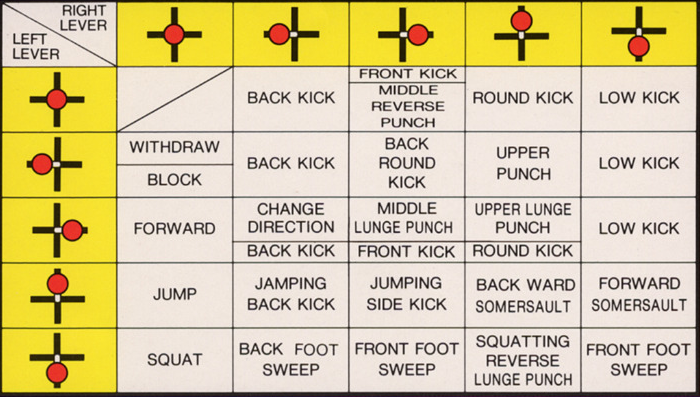

Moves differ by reach and speed, and the quicker ones never score you the full point. Any move is a bit risky; slower moves can be blocked, dodged, or just plain miss, exposing you to counterattack, and quicker, short-ranged moves require moving in close, risking a hit from a long-reaching strike as you step in. The system is a little intimidating at first, with so much presented up front, and expecting you to memorize a matrix of unintuitive lever motions just to do basic moves, but basic moves is all you get here.

I soon found a strategy that let me win consistently for quite awhile.


Flip over the opponent, and the AI will invariably try to swat you out of the air. And nine times out of ten, it will miss. Then you can position yourself in just the perfect spot to deliver a back roundhouse to the face for a full point. Or if you land too close, you can use a quicker move for an easy half point. Even if you screw up and completely miss, you can still sometimes salvage the half point in the ensuing melee, and it's no tragedy if you fail. The AI rarely uses full point moves on you, so you only need this gambit to succeed two or three times to win the match, but you must fail four times to lose it.

You win some, you lose some. Mostly I win some.

This cheesy tactic got me all the way to 8th dan (that's how karate tournaments work, right?) where a 9th dan promptly beat my ass.

This is why you always wear a cup.

Karate Champ also has score-boosting minigames between matches, and likely inspired the same in Street Fighter & Mortal Kombat in the years to come.

Haven't you learned? Always wear a cup.


Granted, it won't help much here.


I'm pretty good at the cinder block chop.

So, even though Karate Champ doesn't really play much like what we expect of a fighting game, there are a lot of elements pioneered here. That universal side-view format where fighters face each other and nonsensically can somersault over one another but not walk around, controls being reversed depending on which way you face, a variety of punches and kicks, squatting, jumping, and blocking, minigames between matches, and multiple venues are all seen here. It even made me think of Mortal Kombat when the students applauded after winning the opening round in the dojo.


One crucial genre element not seen here, though, is competitive play. Even though the cabinet has a two-player mode, all you do is take turns against the AI. And that brings me to the "versus" version.


Titled "Taisen Karate Dou" in Japan and simply "Karate Champ" in the U.S., this is for all intents and purposes a different game from the original, though I have not seen a single game database catalog it as such. It plays the same, with some tweaks to the physics and AI, and more challenging minigames. The venues are completely new and much more varied, more in line with Street Fighter's urban rumbles than solo Karate Champ's tournament setting. The voice samples are a lot clearer, though the (still) goofy-looking referee sounds like a teenage boy with a stuffed nose in the U.S. version.

The main difference, of course, is the addition of two-player versus matches, in which the white and red karatekas fight a best-of-three format match to impress a girl who appears to be ten at the oldest.

"I like being strong"... ?

I played a set of matches with "B," a somewhat avid fan of fighting games. I've cut out a few of the embarrassing early matches in which neither of us has any idea what we are doing, but left one of them in.


As you might expect, it's a very different game against an opponent who isn't bound to a rigid script. With one-hit knockdowns, it becomes a tense game of reading your opponent, anticipating their moves or baiting them into a mistake that you can exploit. When a plan doesn't work out, discipline tended to fail as I'd flail around, often executing the entirely wrong (and nearly as often useless) move in the ensuing panicked melee.

GAB rating: Good. This rating is for the "versus" variant; solo play gets "above average" as while the fighting mechanics are otherwise solid, the computer doesn't make for an enjoyable opponent for long. But the methodical, simulation-like gameplay holds up well in two-player mode, and is rewarding of smart, skillful play, as any fighting game should.

Monday, February 24, 2020

Games 150-153: Early Data East

Data East is one of those developers that never resonated me in terms of branding. I had played BurgerTime on the NES back in the day. City Connection was one of the first NES games I ever rented. I knew about Bad Dudes and its ridiculous plot, had some notion of Robocop and Shadowrun video games, and of SomethingAwful’s love of Karnov, but while other Japanese companies like Konami, Sunsoft, and Irem had established large footprints in the arcade scene and as well as being major third party developers for Nintendo and Sega, Data East just seemed to exist on the sidelines. I played Sly Spy quite a bit at a local pizza parlor in the early 90’s, but it never occurred to me that this was a Data East game until fairly recently. One of the titles I mentioned in this paragraph isn’t even a Data East game, and I’d wager most of you didn’t notice that.

The company was founded in 1976, and according to an archive of their home page, their first arcade games were Jacklot, a token-dispensing blackjack game, and Super Break, which of course is a Breakout clone with “obstacles in front of walls to increase difficulty.” It’s nice, for once, to see an early Japanese arcade developer meticulously documenting their own pre-1980’s history, even if nearly all of them sound like blatant plagiarizing (e.g. “Shooting game that uses a missile to destroy an invader from space while avoiding attacks from invaders”).

The earliest of their games emulated in MAME is that game’s sequel; Space Fighter Mark II.

Game 150: Space Fighter Mark II


And it’s barely distinguishable from Space Invaders. The biggest difference is the color graphics, though tiles are still monochrome. If this is the Mark II, then I have to wonder how primitive the unemulated first one is.

There are some gameplay differences. The invaders start off at a quicker pace, and you really can’t dawdle the way you can during the first few seconds of Space Invaders. And the UFO shows up pretty much constantly, but it now takes multiple hits to destroy, and your laser cannon blasts small chunks out of it like the barriers. Because of the faster pace, you’ve really got to focus on thinning the phalanx width a little bit before you can afford to start taking shots at the UFO.

MAME doesn’t emulate the sound, so here’s a GIF of the last two rounds of play, from the only session that I bothered recording.


GAB rating: Average. It’s a competent enough clone, and I’ve seen worse, but I can’t fathom any reason to play this instead of Space Invaders.

Game 151: Astro Fighter

Astro Fighter reminds me a lot of SNK’s Ozma Wars, which came out around the same time. Both are obviously influenced by Space Invaders, and both advance on the formula in a similar way – by introducing a variety of enemy types, with different movement and attack patterns, which appear in a sequence of phases ending in a boss fight. Their mostly forward movement and a scrolling starfield lend the appearance of a vertically scrolling shmup, even though you can’t actually move vertically, or at least not deliberately.

Ozma Wars is a lot more ambitious, though. Here, each phase has only one kind of enemy, and they all have simple, if not always easily predictable movement patterns. There are also no animations at all, aside from simple explosions; Ozma Wars’ enemies pitched, weaved, rotated, and grew and shrank to suggest 3D movement, but Astro Fighter’s enemies just come at you, unmoved from their single frame of animation until you shoot them.

Like Ozma Wars, there’s a fuel meter to keep a time pressure on you, but in the former game it was a shared energy meter that depleted from elapsed time, from moving, from shooting, and most of all from taking damage. Here, getting hit just kills you, and the fuel meter’s biggest effect is the time crunch. The only way to refuel is to finish a loop, and even losing a life doesn’t refill it! In addition, there’s a cruel punishment for letting even one enemy past your guard; the entire phase repeats, with that much less fuel available, and your ship is kicked forward one rank just to make things even harder.


GAB rating: Average. On paper it’s an upgrade from Space Invaders, but subjectively, I find that this game is a bit boring.

Game 152: Lock 'n' Chase

In 1980, Data East released the DECO Cassette System, an arcade system which operated in a manner similar to cassette-based computer systems of the day. A tape player accepted miniature cassette tapes which would play when the machine was powered on, loading the game data into 32KB of memory. They released 44 games in this format from 1980 to 1985, with the idea that arcade operators could easily showcase the latest Data East games by simply swapping out old cassettes for new, without needing to replace their large and expensive cabinets or change the often incompatible circuitry within. The first, Highway Chase, was a conversion of an earlier ROM-based game Mad Alien, with some minor graphical and gameplay changes.

The system was not a huge success outside of Japan. Arcade operators, who were used to machines that turned on instantly, found the comparatively long load times a nuisance, and the tapes themselves were prone to failure over time. I also must imagine that by 1982, this system’s technology was starting to look dated. The majority of its games, likewise, saw no release outside of Japan.

Lock ‘n’ Chase, released in 1981 as a response to Pac-Man, was one of the more successful titles for this system (though not the most successful – we’ll get to that one later), and was popular enough to receive ports to the Atari VCS, Intellivision, and Apple II.

The bezel of the US version shows some play instructions.

Yeah, so you’re running from “the D.” And their de facto leader is named “Stiffy D.”


Lock ‘n’ Chase is one of at least three Pac-Man variants of 1981 featuring some ability to change the maze layout on the fly. Between it, Lady Bug, and Mouse Trap, this one's implementation is probably the simplest - you can press a button to place a barrier at the last corridor you passed through, but they don’t last long, and only two can be placed at once. The actual barrier placement seems a bit finicky; if you or the “D” are anywhere near the junction that you’re trying to seal off (a common enough scenario since you probably want to use these barriers to get them off your tail), there’s a good chance of it forming somewhere else where it won’t do anything to help, or it might even trap you.


Like Pac-Man, your goal is to collect all of the dots, and four enemies – the cops that initially start on the sidelines – try to catch you. Unlike Pac-Man, and most of the Pac-Man clones for that matter, there’s no way to catch them back. You can, however, score some big points by trapping several of them between two barriers in the lower-left and upper-right corners (the lower-right corner works too but is worth no bonus points). To complicate things, the junctions near the center will have their own doors that open and close on their own.

One neat touch, which I haven't seen in any Pac-Man style game yet, is that to finish a stage, you must escape from the maze via one of two exit doors which swing open upon collecting the last dot.

Frequently, bags of cash or other treasures will spawn near the middle of the screen. Money bags are worth more the more of them you collect, and this also causes the “D” to cry, buying you maybe a second of time to escape from this vulnerable location. The other treasures – hats, briefcases, pocket watches, etc., increase in value with each stage you finish. In later stages, these valuables don’t last long at all, and seem to always spawn at the worst possible times; when you’re far away, or when the most direct path is blocked by a self-closing door, or when a “D” is patrolling the center area. I expect that their appearance is determined by the number of dots remaining in a stage, and that a skilled player can use this to force their appearance at opportune times.

My best attempt made it to level 6 and scored not quite $30,000.


GAB rating: Above Average. There are good ideas here, and for these ideas Lock ‘n’ Chase is a smarter, more strategic take on Pac-Man without losing any of its excitement, but it’s held back from greatness by unreliable controls and a boring maze layout. I’m not really sure how that last part could be fixed, as the game would be too easy if it had multiple long Pac-Man-like corridors to lose the “D” in, but navigating a basic orthographic grid isn’t all that interesting.

Game 153: BurgerTime

The 26th DECO Cassette System tape, originally just called Hamburger, was almost certainly the most successful, given that it had sequels, re-releases, contemporary ports to thirteen console and computer systems, and remains an active IP to this day, with a Nintendo Switch game released in 2019.

I’m sure you know the premise. You, a short-order cook, must prepare hamburgers by stomping on all of the ingredients, while being chased around the kitchen by surly sausages, evil eggs, and pernicious pickles. It’s a lot like working at Dairy Queen, but slightly more hygienic.


One minute quirk that continually threw me off is that although each stage opens with a jingle, typically signifying a few breather seconds before gameplay truly begins, you can actually start moving immediately, and you really should.

Stomping on an ingredient kicks it down to the platform below, where it will dislodge anything there, sending a cascade of ingredients down as far as the plate, and crushing any enemies in this path, which can score you a great deal of points if you can get a large number in a single drop. But this won’t send more than a single ingredient all the way to the bottom, and isn’t very efficient. If you can get an enemy to follow you closely, and drop the ingredient while an enemy is also standing on it, then it will drop as far as three platforms, carrying the enemy with it. If you can drop two enemies at once, it will fall six platforms, which on most levels completes your burger in one swoop.


This is easier said than done though, as the enemies have a nasty habit of blindsiding you from the other end of the ingredient. Pepper helps when this happens, but you really don’t want to be profligate with your pepper; once it runs out, your lives have a way of quickly running out soon after.

My best attempt reached level 6 and scored 62,000 points.


There’s actually a bug in the ROM-based conversion of BurgerTime, which I was playing when I recorded this video. The background layer is rendered one pixel too low, and because of it, it looks like the characters and all of the burger ingredients are floating one pixel’s height above the platforms. The cassette version doesn’t have this bug, but does have long loading times.

GAB rating: Average. I have a beef with BurgerTime. It just feels so sluggish. It’s an original enough game concept, and is mechanically pretty solid, if visually plain-looking, and controls well (though sometimes pepper does spray in the wrong direction for no apparent reason and climbing ladders can be finicky if not positioned pixel-perfect). But, like Frogger, it’s just too leisurely for my taste, and with the chef’s slow, slow walking and climbing speed and so much time spent herding enemies and waiting for them to approach, I got bored very quickly and had little desire to improve on my score.

Also, that damned, repetitive six-second music loop.

Most popular posts