Showing posts with label Activision. Show all posts

Saturday, December 6, 2025

Game 460: Little Computer People


Background: 

In late 1985, Activision's R&D department made a breakthrough computing discovery; that so-called "Little Computer People" dwell in every personal computer, and possess individual appearances, names, and personality traits. To aid in their study, researcher David Crane created the "House-on-a-Disk" diskette, a simulated three-story house with five rooms and a spacious attic, which said people can live in and be directly observed.

These studies have, of course, been long abandoned, superseded by projects such as "The Sims" and "The Sims 4" which do not require obsolete 8-bit personal computers. However, the sudden scarcity of RAM in the year 2025 impels fieldwork with more modest requirements, and with it, an opportunity for a retrospective in 64KB. How are these Little Computer People doing after 40 years? Can they tell that their natural habitat is also a simulation? Does the Y2K bug affect them?


Video log of activity:


Field notes:


9:30: Simulation begins. A Little Computer Person (henceforth to be referred to as LCP) enters the domicile and begins to inspect it. The kitchen pleases him. The computer in the study does not. LCP uses the washroom, does not flush or shut the door, and barely washes his hands afterward.

9:35: LCP goes to the living room and sits on the lounge chair for less than a second before standing back up. Exits and leaves the lights on. LCP inspects the bedroom and leaves the closet door and all drawers open. Attic and kitchen are re-inspected before he leaves via front door - at least he closed the refrigerator.

9:37: LCP returns with a small parcel of his personal effects. A small dog follows. LCP watches television, then acknowledges my presence by turning his head toward the glass of the computer monitor. He speaks, but I cannot understand his language. I suggest to him, through a teletype-like interface, that he type me a letter, but he ignores me and goes downstairs, leaving the TV on.

9:39: LCP picks up the phone and speaks. Did he mean to speak to a friend, or is he trying to speak to us? He didn't dial. Either way, I still can't understand him. LCP then does jumping jacks in the master bedroom.

I said please!


9:40: LCP puts on a 33 1/3 RPM record. "We Wish you a Merry Christmas," and sits and watches TV quite unmerrily. Perhaps a new record might brighten his mood?

9:41: LCP taps on the glass of the monitor and requests a game of "Card War."


This is an incredibly boring and drawn out game of chance with no strategy and no decisions whatsoever, but this is also the most interactivity that's been offered since the simulation started, so I humor him. Playing improves his mood somewhat, namely when he is winning, but beating his hands makes him grumpier.

9:47: I unilaterally end the game, being ahead by 26 cards at the time with no end in sight, and LCP is visibly unhappy. I send him a new record as a holiday present, which he dispassionately collects from the front door and stashes away.

9:49: LCP makes another unintelligible phone call. I call him, and we speak, unproductively.


9:50: LCP plays his new record, a progressive rock album, and leaves the house, not bothering to stop the player.

9:51: LCP returns and makes another phone call. I attempt to pat him on the back; he stands up before the network-activated mechanical hand can make physical contact. Nevertheless, and to my surprise, this immediately improves his mood. Could simple touch be the key to a good disposition? LCP turns off the record and feeling inspired, plays some piano, and shows himself to be fairly skilled.

The sprite animation does a reasonable job of looking like the LCP is playing music and not just pressing random keys.


9:54: LCP washes his hands and prepares a quick, unheated meal.


9:56: LCP brushes his teeth. I try to tell him to turn off the TV, but he ignores me again.


9:57: LCP makes another phone call, then goes upstairs to watch more TV. I end the observation, leaving him to his devices.


Addendum:

I return briefly in the afternoon. LCP is named Ian - I learn this as I'm able to coax a letter out of him.
 

Ian misspells 'typist' before backspacing and correcting.


Strange - his water cooler isn't empty! In fact, it's at the same volume as when I left it. Is he rationing?

I dutifully fill it to the brim and offer a phone call, but then I leave.


GAB rating: N/A.

Little Computer People is a cute semi-interactive toy, but it's not a game, and there's only so much to see and do. Even in 1985, I have to imagine that I would have exhausted the possibilities of this house-on-a-disk very quickly and gotten bored of it.

Also, in a rather consumer-unfriendly twist, though one that makes sense in-universe, once you generate an LCP, you're stuck with him on your disk forever, without any way to "reset" the game except by using fanmade utility disks. The manual even recommends ordering more house-on-a-disks if you want new LCP's. I don't think they can die through neglect a la Tamagotchi, but wouldn't it be cruel if they could?

Monday, August 18, 2025

Superauthenticity: Atari 2600 aspect ratios

Combat, in a superauthentic 2:1 PAR

As one of the first commercial console systems ever, the Atari 2600 didn't handle resolution or aspect ratio in a standard way. MAME, when emulating an NTSC model, assumes a framebuffer of 176x223, but this is misleading; the vertical resolution was whatever the programmer wanted it to be, and can even change frame-to-frame, which plays hell with upscaling hardware (but works fine on analog televisions... or emulators). Atari themselves recommended using 192, but even they didn't always follow this. As for the horizontal resolution, 160px was the effective maximum, and only the very limited sprite capabilities could even use that degree of resolution, but some developers would make it less than that by extending the HBLANK period, effectively buying their code some extra clock cycles in exchange for resolution.

Consequently, the system's authentic display aspect ratio isn't really straightforward. You can certainly assume 4:3 is correct and expect your framebuffer (itself an anachronism) to just scale up to a 4:3 resolution. That's the default behavior of MAME and Stella, and this typically looks okay, but it isn't truly authentic; a real system on a real NTSC television wouldn't use the entire display most of the time. Nor is this necessarily my preference! I had been overriding this on a case-by-case basis almost from the start.

To seek superauthenticity, we should be looking at PAR rather than DAR. According to MAME's source code, the NTSC Atari 2600 has a sprite-pixel aspect ratio of 12:7, or about 1.714:1. Background pixels are four times as wide. I'm not going to bother with PAL calculations.

Combat

Scaling:
PAR:
DAR:


12:7 PAR is indeed very close to 4:3 DAR, and could well be the reason why the MAME developers settled on a 176x223 resolution.

However, for this particular game, there's a good reason not to use it. The game has rotating tank (and plane) sprites, and only double-wide pixels let them retain their correct dimensions in all orientations. Atari's artwork simply assumed the pixels would be doubled. Not because they actually thought this, but because this made plotting out the rotated sprites much less work.

Though I will say, the scores look better with square pixels. 

Verdict: Double pixels


Adventure

Scaling:
PAR:
DAR:

12:7 looks best to me.

Verdict: 12:7 PAR 


Space Invaders

Scaling:
PAR:
DAR:

Funnily enough, I think the square pixels look best! Better approximation of the arcade's vertical orientation, and the invaders (and laser base) get very chonky as you go wider.

Verdict: Square pixels


Yars' Revenge

Scaling:
PAR:
DAR:

This is another game with rotating sprites, and only double-width pixels preserve their dimensions, but in this case I think the spritework looks better with 12:7 pixels.

Verdict: 12:7 PAR


E.T.

Scaling:
PAR:
DAR:

E.T.'s a short, chubby little guy. But the humans look best at authentic PAR.

Verdict: 12:7 PAR


Ms. Pac-Man

Scaling:
PAR:
DAR:

You might assume that Ms. Pac-Man's vertical sprite is just rotated, but she isn't. Atari did the responsible thing here and re-drew it to consider non-Pythagorean scale pixels. It's still a bit too wide, but 4:3 comes the closest to a perfect rotation.

Verdict: 4:3


Let's look at some Imagic games next!


Demon Attack

Scaling:
PAR:
DAR:

This is interesting. The Imagic logo? Perfect match for the official printed logo at square pixels. And the rest of the game looks fine with square pixels too.

Verdict: Square pixels


Atlantis

Scaling:
PAR:
DAR:

Subjectively, this one also looks best to me with square pixels, especially those ampoule-like domes.

Verdict: Square pixels


We'll finish this series with some Activision.


Pitfall!

Scaling:
PAR:
DAR:

Square is very obviously too thin. I defer to authenticity here.

Note the thicker than usual black bar on the left side of the screen - Activision games tended to give up some of the active picture to prevent the artifacts that you see in other games.

Verdict: 12:7 PAR


River Raid

Scaling:
PAR:
DAR:

Subjectively, square pixels look best to me. The sprites just seem too fat otherwise.

Verdict: Square pixels.


H.E.R.O.

Scaling:
PAR:
DAR:


This one seems a bit off at any aspect ratio, but square honestly looks the most okay, even if R. Hero looks a little bit skinny.

Verdict: Square pixels.


Pitfall II: Lost Caverns

Scaling:
PAR:
DAR:


Authentic 12:7 looks the best. Easily.

Verdict: 12:7 PAR.


I'm not really sure why I did this series; I'm done with the Atari 2600 whales and I don't know if I'll ever play another one, and I doubt many people care about optimizing how good their Atari games look. Comprehensiveness, I guess. But it seems to me that Atari developers were very inconsistent about designing for the system's pixel aspect ratio. Square pixels are objectively wrong; you'd never get a vertical 160x192 display on original hardware, and yet subjectively, most of the games not by David Crane or by Atari themselves look better this way.

We'll be returning to the simple, square-pixel world of Macintosh games soon enough, if only for a little while. 

Wednesday, September 11, 2024

Hacker: Won!

During my first attempt at cracking Hacker since the last post, two mercies presented as a game over.

While exploring the maze, I very soon discovered the restricted area's location tunneling under Australia.


This ended the game, but upon restart I could use the password "Australia" at the initial login screen to skip the introduction minigames and go straight to the maze, where I worked to continue making maps of the underground, and of the spy trading matrix. And once the probes launched, I now had answers to all of their challenge questions - "Australia" being the final answer, they'd leave me alone forever and allow me to focus... until an invisible time limit expired, forcing another restart.

Even with this extended time limit completing the tunnel map was a bit annoying, and took several restarts before I could finish.


Mapping out the trade matrix was incredibly annoying. There are 21 items to buy and trade, and 10 different places to offer them all, giving about 190 possible trades to test. To find out, for example, who will accept the goods you can buy in China, first I'd have to buy the deed in France, go all the way to New York to trade it and buy Stocks & Bonds, then take another convoluted route to reach China and trade them in to buy their goods, and by then there's enough time left on the clock to visit maybe half of the remaining places to see if the Ming Vase and Jade Carving are acceptable there.

I had to restart so many times to finish this up, and of course each time you restart, you have to go through all of the incoming messages again, answer the probe challenges again, etc.

But I eventually finished it as much as it is possible to:

Location Wants Offers
France Cash Deed, Chronograph
England Chronograph, Jade Carving Beatles Album, Crown Jewels
Egypt Deed, Chronograph Emerald Scarab, Tut Statue
India Chronograph, Tut Statuette Star of India, Jeweled Lamp
Greece Emerald Scarab, Tut Statuette Ancient Artifact, Grecian Urn
Cuba Deed, 35MM Camera Spanish Doubloons, Treasure Map
New York Deed Diamond, Stocks & Bonds
China Stocks & Bonds, Cultured Pearls Ming Vase, Jade Carving
Japan Stocks & Bonds Cultured Pearls, 35MM Camera
California Beatles Album, 35MM Camera Gold Nuggets, 49er Tickets
Cuba: "I will accept a Swiss chalet or a Canon AE-1. Castro's tariffs are loco."
 

By process of elimination, I can logic out who gets what, though not yet in which order, except that France, who alone deals in cash, must come first, and D.C., who wants the completed memo, must come last.

Location Give
Buy
France Cash Deed, Chronograph
England Jade Carving Beatles Album
Egypt Chronograph Emerald Scarab, Tut Statue
India Tut Statuette
Greece Emerald Scarab
Cuba 35mm Camera
New York Deed Stocks & Bonds
China Cultured Pearls Jade Carving
Japan Stocks & Bonds Cultured Pearls, 35MM Camera
California Beatles Album
 

I optimize this traveling salesman-like problem as well as I can, and come up with this solution:

France->Egypt->Greece->India->New York->Japan->China->Cuba->England->California->D.C.

France to Japan


China comes next, but immediately after leaving, I get a nasty surprise - the robot's navigation unit fails! No longer showing my position on the map, I must navigate the last portion of tunnels blind, which includes a loop around the Australian death continent.


After reaching California and offering the surfing spy there a Beatles Album, I get my last strip of the shredded memo.

This tells me nothing I didn't already know!

I take it to D.C. where... the game ends!?


WaPo today: Saboteur delays Magma Ltd's 'Warm Energy' initiative

I guess I'd rather be done than have to solve another equally tedious puzzle, but the game still feels unfinished.


GAB rating: Below average.

This... is not what I was expecting. Hacker, in its initial screen of mysterious blankness, seemed like it might be neat, suggesting a direct ancestral link to hacking sims like Uplink, but it plays its hand in minutes and then you see what's going on; a weighted graphing problem which must be mapped out by way of countless attempts and failures before it can be solved. The scant bits of "hacking" involved here are trivial microgames which are figured out once and then become nothing more than nuisance tasks on all of your subsequent restarts.

Monday, September 9, 2024

Game 436: Hacker


Other computer games often have lengthy instructions to explain how the game is played, observes Hacker's manual. We've told you how to load the program: everything else is up to you.

With no instructions, no objectives, and no rules, I can do little but fumble around at the initial login prompt. My every attempt fails and produces a cryptic error message, until eventually the system threatens to lock me out, and then it doesn't.


A minigame follows as you are asked to identify various robot components such as the "infrared sensor" and "phlamson joint" by pointing and clicking with the joystick. It's a trial and error guessing game, but once you identify everything correctly, you'll have to do it again without error.


Taking control of the robot, I eventually come to some grips with the situation and controls here. A maze of subterranean pipes span the globe, which are navigated from a pseudo-3D perspective.

After moving a bit, an ominous incoming message suggests a cataclysmic eruption is imminent, and soon after that, another message spells out our goal.


It didn't take me long to find the French spy.

I could not figure out how to specify my offer, or to see how much cash I had left.


The spy offered me two other items - a Swiss chalet deed, and a chronograph. I bought both.

Next, I found England.


He didn't want my money or the deed, but accepted the chronograph. And then offered to sell me an autographed Beatles album and the crown jewels (!), but I could only afford the former.

While looking for the path to the next point of contact, the security system began launching probes! On contact, I'd be issued challenge questions.

They'd start off easy enough.


... but quickly got more difficult, requiring me to consult past screenshots. Until the fourth probe issued a maximum security challenge.

Well, shit. I don't know!

Three wrong guesses, and they pulled the plug, ending my game.


I have two challenges ahead of me - map out the global tunnel network, and figure out who wants what. And with the time limit imposed by the security probes, it seems this going to take a lot of trial and error as I gather this information bit by bit.

Sunday, August 25, 2024

Games 433-435: Early Steve Cartwright

I thought I was done with the Atari 2600 forever, but I wasn't thinking about ancestors. Steve Cartwright, author of our next whale Hacker for the Commodore 64, is notable enough to have a Wikipedia page, so I am visiting a selection of his early Atari games at Activision as ancestors.


Game 433: Barnstorming

Cartwright's first video game challenges you to complete a stunt course in a single-engine airplane. Fly low to pass through the barns, fly high to pass over the windmills, and generally try to avoid geese, which will slow you down a bit but not as much as a collision with a barn or windmill does. Think Flappy Bird but more forgiving and with more emphasis on speed.

The two difficulty switches affect the flock density and how strict the barn clearances are, though the barns appear the same. In the below video, I have both difficulty switches set to hard and go through all four of the game's courses - a 10-barn course, two 15-barn courses, and a final, randomly generated 25-barn course.


The first three courses present the same patterns of barns, windmills, and geese each time, and it's fairly easy to memorize them. Despite making a few mistakes, I came pretty close to Flying Ace qualifying times on courses 1 & 3 without all that much effort, and I'm sure I could beat them all and earn their patches if I cared enough to keep trying - and that's with the hard difficulty modifiers. Only the randomly generated course 4 was any challenge, and the manual offers no qualifying time for it anyway.

GAB rating: Below average. It's functional. Just repetitive and boring.


Game 434: Megamania

Space Invaders except the invaders are hamburgers, clothes irons, and bowties! So wacky!! And one puppy away from getting sued by Parker Brothers!

Once you get past the silly, surface-level premise, which shouldn't take long since these crappy Atari 2600 sprites don't really look like much of anything at all, Megamania's actually one of the better Space Invaders clones!

Any good Space Invader clone needs something to make it stand out - a silly asset flip isn't nearly enough - and what Megamania offers is aggressive enemies that move in a seemingly unlimited variety of patterns. Said patterns are completely deterministic, unlike the chaotic, frustrating patterns in, say, Phoenix, but are still a challenge to anticipate, especially during subsequent loops where they become more complicated. A wave of hamburgers will move left-to-right, wrapping around, pausing at intervals to throw off your aim and return fire. A wave of radial tires will descend in a zig-zag pattern, forcing you to thin out their ranks before they reach ramming distance and force you into a death corner. Fuzzy dice fall from the sky. And after the eight round, it loops back with even more complicated patterns! I haven't seen any repeating patterns, but I assume they are encoded into the wave number's binary representation - for instance, odd waves always have horizontal patterns, and even waves vertical.

Activision would give an award patch to players who reached 45,000 points, and I made it my goal to reach this under the hardest combination of difficulty switches and game modes, in which your lasers move slowly and are unguided. Surprisingly, I managed this in a few hours of attempts, but just barely.


GAB rating: Good. Megamania might not look terribly original at first glance, but it's deceptively deep. With practice, you learn to read and anticipate the aliens' erratic-seeming patterns, and develop a rhythm for dodging and shooting accurately. You learn how to clear chains of descending enemies so that there's breathing room when they enter your space and can move around them and live. This isn't the flashiest, the most exciting, or the most feature-packed action game of its time, but it is one of the most polished and most tightly designed on the Atari 2600, and I give it a place in the ivory deck.

In 1983, Megamania was ported to the Atari 5200 with somewhat better graphics, and Cartwright made three more 2600 games, including Seaquest and Plaque Attack. But I'm only interested in third and final one - Frostbite.


Game 435: Frostbite

You play Frostbite Bailey, a native Alaskan igloo architect, and must cross a river back and forth by jumping across the floating ice blocks, which causes a snow igloo on the north shore to gradually construct itself for some reason. Dangerous wildlife inhabit these waters - crabs, seagulls, and crabs - and must be avoided. Occasionally, tasty fish appear which can be snagged for extra points, but the quickly cooling temperature forces you to work fast or become an ice sculpture.

It sounds awfully similar to Frogger, and it is, but the quicker speed and smaller play area give it a quicker pace, and the overall design is more strategy-focused, in an almost puzzle-like way. The obstacles can be numerous and claustrophobic, and poor planning can get you trapped, but Frostbite Bailey also has some serious air maneuverability and can leap to ice floes nearly half the screen's width away with good timing and execution. Of course you're still dead in the water if anything nasty touches you on landing! On top of that, you can reverse your platform's direction with a button push, which becomes invaluable on the later, more difficult levels.

Your only game options are a pointless 2-player mode, and the option to start the game on wave 5, which adds a polar bear on the north shore to deal with. Activision would award a patch to players who reached 40,000 points, but I made it my goal to obtain the magic fish, which is awarded after 100,000.

I found this easier than Megamania's patch - much of this is thanks to Frostbite's generosity when it comes to extra lives, which are earned every 5,000 points.


GAB rating: Good. Activision produced some of the most technically solid and thematically strong games on Atari 2600, and Frostbite is easily Cartwright's best in this regard. I liked this game better than Frogger, thanks to its hidden depth of strategy, and along with Megamania, promote it to the ivory deck.


Data Driven Gamer will be on break for a few weeks. We will return with Cartwright's C64 whale Hacker, but no earlier than mid-September.

Monday, December 4, 2023

Mindshadow: Won!

Welcome to Mindshadow's final chapter - Luxembourg! I explored and Trizborted this new area; it's perhaps the biggest one yet.

Just north of the airport was an inn, which we can only assume is the one that a clue in England told us to meet "Bob" at.

Poor Bob.

Searching him reveals his ID card, and a note advising us that "Jared" is in room 207. "THINK" recalls him as a lowlife, presumed dead in a car accident. Guess not.

Inventory starts to be a problem, and I have to start discarding items that seem useless.

Further north is a bank, and to the east, a "mountain wilderness" area.


It's another MOTLP! But at least this time there's no quicksand. I found no purpose to this area yet, though I noted that one room was described as a "remote" mountain wilderness and featured two trees instead of one.

Northwest, I enter the grand hotel, where the clerk tells me I am at room 202.


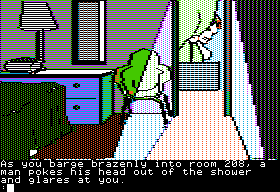
Eight rooms are here, and no doors are locked.


Room 202 proves dangerous!


Room 207 proves deadly!


The others are mostly harmless.

There's a cute Psycho reference if you attack him with your cleaver.
 

Room 202 is the important one. After ducking an obvious booby trap, a parchment here reveals a clue.


Back to the mountain wilderness it is!

I was wondering when I'd find a leaflet.

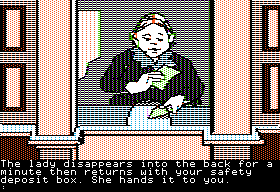
The leaflet is a safety deposit box slip, which I take to the bank.


There is a gun inside the box! I haven't got any better ideas, so I go to room 207 and shoot Jared.


The message - "Jared-- beware. William was seen flying into Luxembourg."

So I use the command "THINK WILLIAM." And end the game.

Yay, I have lawyers who can defend me from my inevitable premeditated murder charge!

Incidentally, you can trigger the game's victory condition at any time. The power to recall was in you all along. You think Myst can be beaten quickly once you know how? Mindshadow can be won on the first screen by thinking about the subjects TYCOON, BOB, ARCMAN, JARED, and WILLIAM. I tried it. Let's see how far your "wealthy industrialist" status gets you while marooned on a desert island, Arcman.

GAB rating: Average. Interplay was never known for their adventures, and Mindshadow is okay, I guess. Certainly better than The Demon's Forge, but by 1985 adventure standards it's nothing special. Despite the Robert Ludlum spy thriller inspiration and a box cover promising mystery and psychological intrigue, Mindshadow is very much a run of the mill quest in the Adventureland mold that barely explores its own conceit. The whole angle of being an amnesiac recovering his own identity is a big adventure game cliche by now, but here it just feels like an afterthought.

The Apple II graphics aren't bad, and I enjoyed the writing - it's no Infocom, but it's more entertaining than the perfunctory prose seen in Scott Adam's Questprobes, or in those Sierra Hi-Res Adventures that I suffered through a few years back. Some of the game's responses to my off-the-cuff actions were cute and unexpected. Puzzles are mostly on the easy side, but I'll take that over unsolvably obscure, which tends to be the alternative when the formula is still stuck in the Adventureland get-object use-object format. When I needed them, the Condor's ingame hints were both amusing and a welcome alternative to Internet spoilers. More adventures could have used this! And Mindshadow is relatively free of annoying adventure game conventions like hunger, darkness, and non-Euclidean mapping. Even the mazes are straightforward.

But still, in the end Mindshadow is a brief, primitive, and unsubstantial adventure that doesn't offer much that we haven't seen before.


Luxembourg map:


Most popular posts